Silver Rises Over 120% YTD




Picture Athens in 430 BC. It is, by any measure, the most impressive city on earth.
The Parthenon gleams white on the Acropolis. The agora buzzes with merchants, philosophers, and politicians. Athenian silver coins — stamped with the owl of Athena — are the most trusted currency in the known world. Traders from Egypt to Persia accept them without question. Athens has invented democracy, pioneered free markets, and built a civilization so advanced that people are still studying it 2,500 years later.
And then, in the span of a single generation, it all falls apart.
Not because of plague. Not because of a natural disaster. But because of something far more mundane — and far more dangerous: the slow, deliberate destruction of their own money.
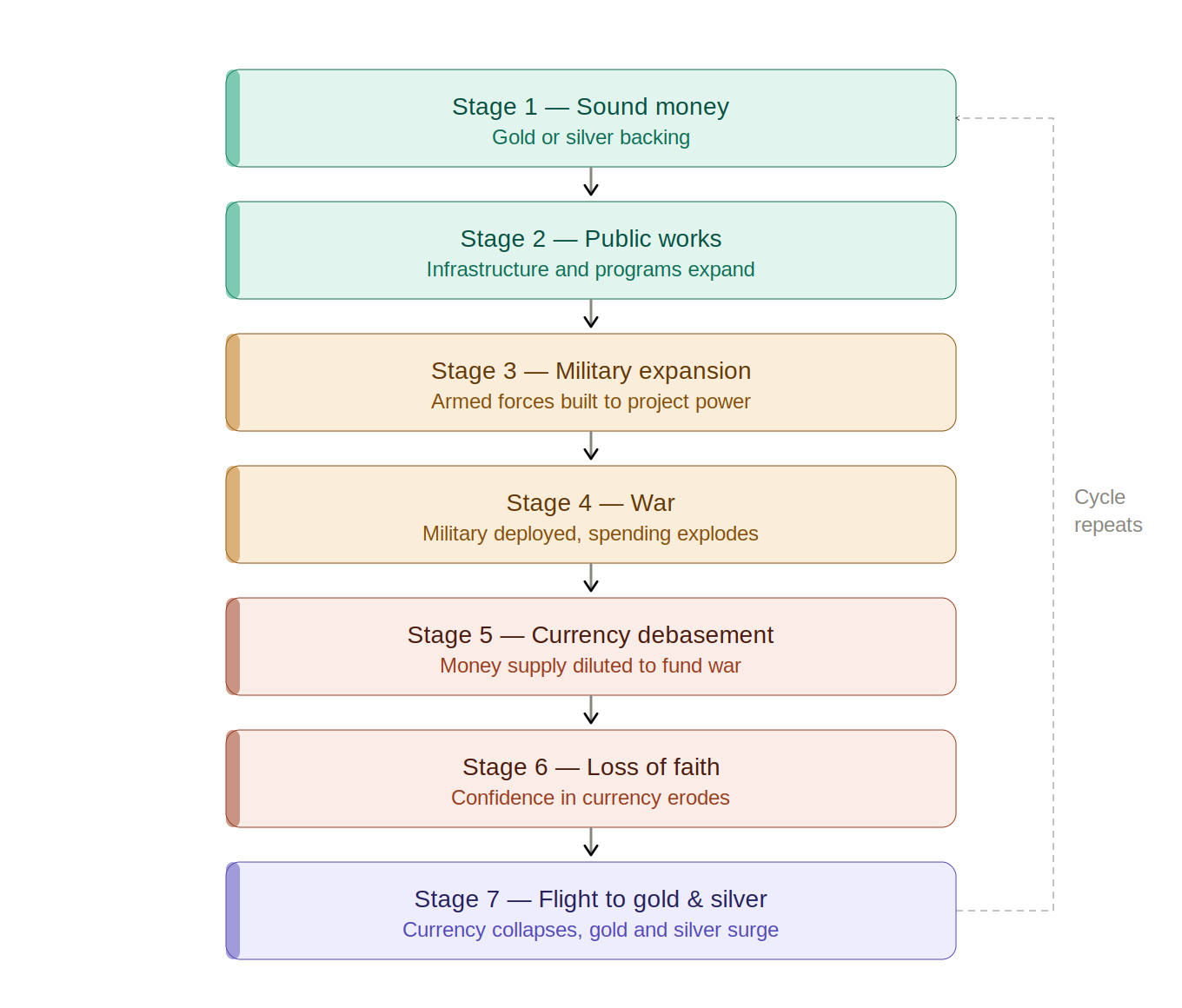
This is the story of the Seven Stages of Empire — one of the most predictable patterns in all of monetary history. And here is the part that should give you pause: it isn’t just Athens’ story. It’s the story of every great empire in history. And if the pattern holds — and it always has — it may be the story of our own era too.
What Do Athens, Rome, and America Have in Common?
Monetary historian and investor Mike Maloney has spent decades studying the rise and fall of currencies. His conclusion is stark: throughout 5,000 years of recorded history, every single fiat currency — every form of money that isn’t backed by something real — has eventually failed. Not most of them. All of them.
What’s more, they tend to fail in exactly the same way, following a predictable arc that Maloney calls the Seven Stages of Empire. It’s a cycle that has played out across ancient Greece, Rome, revolutionary France, Weimar Germany, and dozens of other civilizations. Each time, the details differ. The names and the dates change. But the underlying logic is always the same.
Let’s walk through it — and watch it happen in real time.
Stage One: Sound Money
Every empire begins with good money — typically gold or silver coins, or paper currency fully backed by gold or silver in a vault. The key feature is trust. The money holds its value because it represents something real and finite. You can’t just print more of it.
Athens built its early prosperity on precisely this foundation. The silver coins minted at Laurion were consistent in weight, universally accepted, and deeply trusted. Sound money creates the conditions for free markets to flourish — and for the kind of explosive economic growth that Athens experienced in the fifth century BC.
Stage Two: Public Works and Social Programs
Success breeds ambition. As a civilization grows wealthy, it begins adding layers of public spending — roads, temples, infrastructure, welfare programs. These aren’t inherently bad. Many are genuine expressions of a society’s values and priorities.
Athens built the Parthenon during this phase. The US built the interstate highway system, Social Security, Medicare. At Stage Two, the economy is strong enough to support these ambitions. The trouble is, they’re rarely temporary — and they set expectations that are very hard to walk back.
Stage Three: Military Expansion
Economic power leads to political power, which leads to military power. The empire begins spending heavily on its armed forces — not just to defend itself, but to project strength across the world.
This is where the financial pressures start to compound. The empire is now funding both an expansive domestic spending agenda and a massive military. As long as things are going well, the math more or less works. But there’s very little margin for error.
Stage Four: War
Eventually, the military gets used. For Athens, it was the Peloponnesian War — a brutal 27-year conflict with Sparta that began in 431 BC. For the United States, it has been a near-continuous series of military engagements since the mid-twentieth century.
War is extraordinarily expensive. Armies need to be fed, equipped, and paid. Campaigns stretch for years. And critically, the costs arrive all at once while revenues — taxes — take time to collect. The gap between what the empire needs to spend and what it can raise through taxation creates a problem that requires a creative solution.
That solution is almost always the same — and it’s almost always disastrous.

Get Expert Insights from Alan Hibbard Learn from Alan Hibbard, a trusted voice in precious metals delivering clear, actionable analysis on gold, silver and the global economy.
Stage Five: Debasement
To pay for the war, the empire steals from its own people. Not through taxation — that would require an honest accounting. Instead, it dilutes the money supply.
Athens did it by melting down their silver coins and mixing in copper. If you collect 1,000 silver coins in taxes and melt them down with an equal weight of copper, you can mint 2,000 coins. You’ve just doubled your money supply — and hidden a 50% pay cut from every soldier, merchant, and citizen in the empire.
Modern governments do it differently, but the principle is identical. Since August 15, 1971 — when President Nixon formally severed the US dollar’s last link to gold — every currency on earth has been fiat currency, backed by nothing but government promises. Dollars can be created in unlimited quantities with a few keystrokes. And they have been. The US money supply has expanded by more than 40 times since 1971.
This is deficit spending in its most naked form: creating currency out of thin air to fund obligations you can’t actually afford.
Stage Six: Loss of Faith
At first, people accept the new debased currency at face value. They don’t realize anything has changed. But gradually — through higher prices at the market, through a vague sense that their savings don’t stretch as far as they used to — they begin to sense that something is wrong.
This is Gresham’s Law in action: bad money drives out good. When Athenians noticed that the new copper-heavy coins were less valuable than the old silver ones, they did what any rational person would do. They spent the cheap coins and hoarded the good ones. Within a generation, the pure silver coins had almost entirely disappeared from daily commerce.
We saw the same thing happen in the United States in 1965, when President Johnson quietly removed silver from quarters and dimes, replacing them with copper-nickel slugs. Anyone who understood monetary history knew exactly what was happening — and started pulling the old silver coins out of circulation. Within a few years, they were essentially gone.
Stage Seven: The Flight to Real Money
In the final stage, the loss of faith in currency becomes widespread. People stop trusting the paper. They move their savings into tangible assets — real estate, commodities, and above all, gold and silver.
For Athens, this process ended in financial collapse. By 404 BC, their currency had been debased into what were essentially copper flecks. The empire that had built the Parthenon surrendered to Sparta, then faded into a footnote of the Roman Empire.
Gold and silver don’t collapse. They don’t default. They can’t be printed. And when the currencies around them fail, they tend to rise — dramatically — as the market reprices all the currency that was created during the preceding stages of the cycle.
Where Are We in the Cycle?
Apply the Seven Stages to the United States and the picture comes into focus quickly.
Stage One ran through most of American history — a dollar backed by gold, trusted worldwide. Stages Two and Three unfolded through the New Deal era and the military buildup of the twentieth century. Stage Four brought decades of military engagement from Korea to the present day. Stage Five began in earnest in 1971 when Nixon closed the gold window, freeing the Federal Reserve to create dollars without limit.
Stage Six — the gradual erosion of confidence — has been underway for some time. Inflation has eaten into the purchasing power of savings for decades. Trust in institutions is near historic lows. The cracks are widening.
Stage Seven, the flight to real money, appears to already be in its early innings. Gold, which was priced at $250 per ounce in 2001, has risen substantially since then as investors around the world quietly begin asking the same question Gresham’s Law predicts they will ask: what is actually worth holding?
What Are the Seven Stages of Empire?
There’s a reason Winston Churchill said that the further back you look, the further forward you can see. The Seven Stages of Empire isn’t a prophecy. It’s a pattern — one with a remarkably consistent track record across thousands of years and dozens of civilizations.
History doesn’t reward those who are surprised by it. It rewards those who studied it.
The Athenians who saw what was happening — who quietly set aside their old silver coins while their neighbors spent copper — didn’t just survive the collapse. They came out the other side with their wealth intact, positioned to thrive in whatever came next.
That opportunity — to understand the cycle, to position yourself on the right side of history’s greatest wealth transfers — is exactly why the study of monetary history matters. Not as an academic exercise. As a practical guide to one of the most consequential questions of our time.
Wealth is never destroyed. It is merely transferred. The only question is which side of that transfer you end up on.
Investing in Physical Metals Made Easy

People Also Ask
What are the Seven Stages of Empire?
The Seven Stages of Empire is a framework developed by Mike Maloney describing the recurring cycle that causes great currencies to collapse. The stages move from sound money through public works, military expansion, war, currency debasement, loss of faith, and finally a mass flight into gold and silver. The full cycle is detailed in Episode 2 of GoldSilver’s Hidden Secrets of Money series.
Why do empires debase their currency?
Empires typically debase their currency to fund military conflicts and public spending when tax revenues fall short. By diluting the money supply — whether by mixing copper into silver coins or printing unbacked paper — governments can create more currency without raising taxes. The short-term relief always comes at the cost of long-term inflation and loss of public trust.
What is Gresham’s Law and how does it apply today?
Gresham’s Law states that bad money drives out good — meaning people naturally spend the weaker currency and hoard the stronger one. It’s why silver coins disappeared from American pockets almost immediately after the US government replaced them with copper-nickel substitutes in 1965. The same principle explains why demand for physical gold and silver tends to rise as confidence in fiat currencies erodes.
What happened when Nixon took the US off the gold standard in 1971?
On August 15, 1971, President Nixon ended the dollar’s convertibility to gold, making the US dollar — and by extension every major world currency — a fiat currency backed by nothing but government promises. This removed the last constraint on how many dollars the Federal Reserve could create and marked the beginning of decades of monetary expansion.
Has any fiat currency ever survived long-term?
No. Every fiat currency in recorded history — currencies not backed by gold, silver, or another hard asset — has eventually failed. Mike Maloney has documented thousands of examples across 5,000 years of monetary history, and the failure rate is 100%. Physical gold and silver have outlasted every one of them.