Silver Rises Over 120% YTD




For many investors, the modern financial system feels increasingly fragile.
Central banks intervene more frequently. Government debt keeps climbing. Economic cycles are growing more volatile — not less. And despite decades of monetary policy tools, the same fundamental problems keep coming back.
This raises an obvious question: if central banks control monetary policy, why can’t they solve these problems?
The answer starts somewhere most people never look — with the difference between money and currency.
Money vs. Currency: A Critical Distinction
Most people use these words interchangeably. Economically, they describe two very different things.
Currency is the medium we use for transactions. It needs to be portable, divisible, durable, and widely accepted — and today’s paper currencies check all those boxes.
But money must do something more. As Mike Maloney explains in Episode 1 of Hidden Secrets of Money, “Money must be a store of value and maintain its purchasing power over long periods of time.”
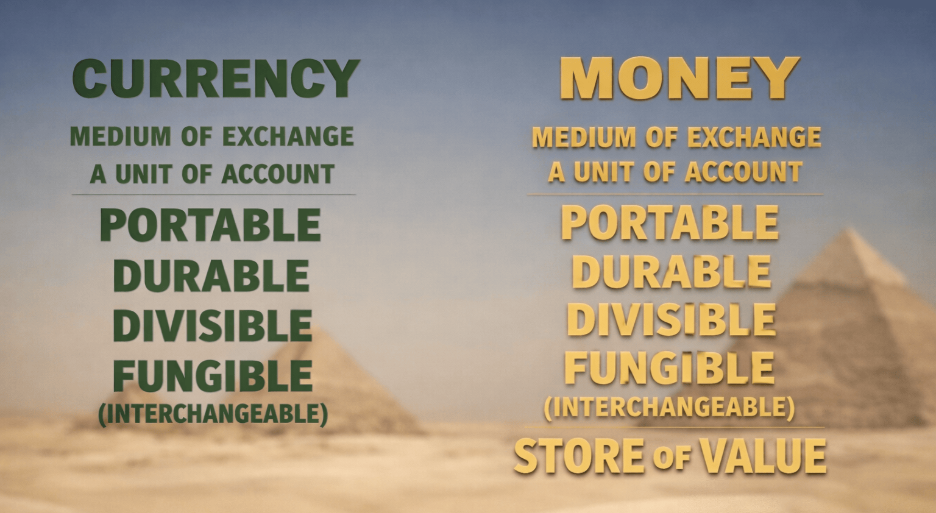
That one extra requirement — store of value — is where modern currencies fall short.
When the supply of currency expands faster than the supply of goods and services, each unit loses purchasing power. It still works for transactions. But it slowly fails at preserving the economic energy you put into earning it.
This is not a new problem. Societies have wrestled with it for thousands of years.

Get Expert Insights from Alan Hibbard Learn from Alan Hibbard, a trusted voice in precious metals delivering clear, actionable analysis on gold, silver and the global economy.
Why Gold and Silver Became Money
Civilizations have experimented with many forms of exchange — shells, beads, agricultural goods. Gold and silver kept winning.
Why? Because they possess a rare combination of properties. They’re scarce, durable, divisible, portable, and fungible — meaning each unit is essentially identical to the next. Gold doesn’t corrode. Its supply grows slowly. It can’t be inflated away.
These characteristics made gold and silver the foundation of monetary systems across cultures and centuries. For most of that time, paper currency wasn’t considered money itself.
It was a claim check on real money held in reserve. Eventually, that system changed.
The Rise of Fiat Currency
Before World War I, U.S. currency notes said it plainly: the bearer could redeem this note for gold stored in the U.S. Treasury. The paper wasn’t the money. The gold was.
You can see it written clearly on this $20 bill here:
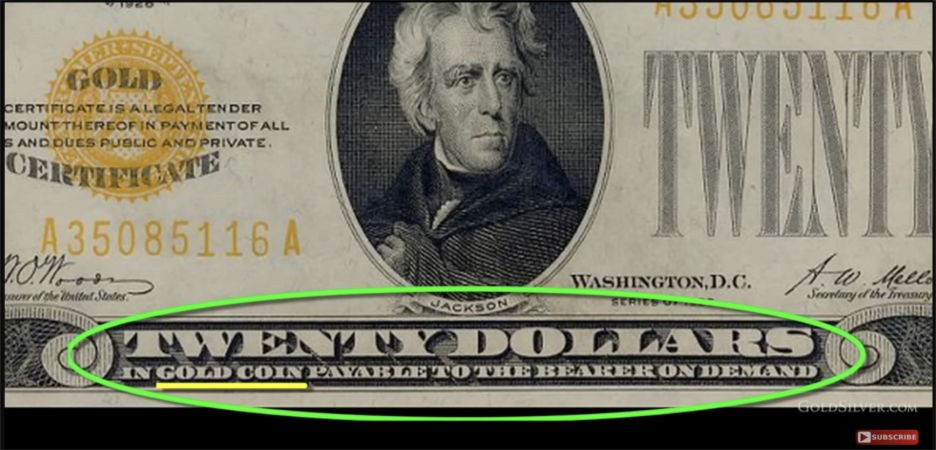
Figure: Early U.S. currency was redeemable for gold.
That relationship between our currency and gold held for decades. Then, in 1971, President Nixon officially ended it.
Facing mounting debt from the Vietnam War and rising inflation, his administration suspended the dollar’s convertibility into gold entirely. It became known as the Nixon Shock, and it marked the moment the world’s reserve currency became backed by nothing but government promise.
Today’s currencies aren’t backed by anything physical. They exist by government decree — which is the literal meaning of fiat.
Fiat systems offer flexibility. Governments can respond to crises quickly. But they also introduce a long-term vulnerability: the supply of currency can always be expanded. And when it expands faster than economic productivity, purchasing power falls.
That’s called inflation — and it’s permanently baked into the system.
Inflation and the Expansion of Currency Supply
Inflation is usually described as rising prices. But prices are just the visible symptom.
The underlying cause is almost always the same: more currency chasing the same amount of goods and services. Sometimes that excess liquidity flows into financial markets first — stocks, real estate, commodities. Sometimes it shows up immediately at the grocery store. The path varies. The mechanism doesn’t.
As the supply of currency increases, the value of each unit decreases. For savers and long-term investors, that erosion compounds quietly over time — and it’s one of the most important factors in financial planning.
The Central Bank Dilemma
Central banks face a genuinely difficult balancing act.
When growth slows or financial stress emerges, the standard response is to lower interest rates and inject liquidity. These measures can stabilize markets and encourage borrowing. In the short term, they work.
But the same policies that provide short-term relief tend to fuel long-term monetary expansion. As governments accumulate debt and central banks maintain accommodative stances, the financial system becomes increasingly dependent on continued intervention.
Tighten too quickly and you risk disrupting markets. Keep expanding and you risk undermining the currency. There’s no clean exit — and that’s the structural trap at the heart of modern monetary policy.
Why Many Investors Pay Attention to Gold
Gold can’t be created by policy decision. Its supply grows slowly, driven by mining — not government spending.
Historically, gold has responded to the conditions that fiat currency creates: monetary expansion, falling real interest rates, and declining confidence in financial systems. During those periods, investors often increase their gold allocations as a way of preserving purchasing power.
That doesn’t mean gold moves in a straight line. It cycles like any asset. But over long historical periods, gold has maintained a relatively stable relationship with real goods and services. It’s one reason central banks themselves continue to hold it in reserve.
Building a Resilient Portfolio
Individual investors can’t control central bank policy. They can control how they respond to it.
A diversified portfolio typically combines assets that serve different roles. Equities offer long-term growth potential. Bonds provide income and stability. Cash handles short-term needs.
Some investors also allocate a portion to precious metals — not as a speculative bet, but as monetary diversification. An asset that may behave differently during periods of currency expansion or financial stress.
The goal isn’t to predict every cycle. It’s to build a portfolio capable of weathering a wide range of outcomes. Protecting your purchasing power shouldn’t come with an unnecessary tax bill. See how a precious metals IRA works.
Investing in Physical Metals Made Easy

Education Comes First
One of the key themes of Mike Maloney’s Hidden Secrets of Money series is that education is the most powerful investment you can make.
Understanding how monetary systems work, how inflation develops, and how different assets respond to economic stress puts you in a fundamentally different position than most investors.
GoldSilver has developed a wide range of educational resources covering monetary history, precious metals investing, and portfolio strategy. The Hidden Secrets of Money series is a strong starting point for anyone who wants to go deeper.
[Watch the Full Episode here]
Final Thoughts
Modern monetary systems are complex, and no single policy decision fixes their structural challenges.
But the underlying principles are simple — and they’ve held for thousands of years. Currencies change. Sound money doesn’t. And for investors focused on preserving purchasing power, understanding that distinction is the first step toward making more informed decisions.
People Also Ask
What is the difference between money and currency?
Currency is the medium people use for everyday transactions, such as paper bills and digital balances. However, money goes a step further by reliably storing value over long periods of time. Historically, for example, assets like gold and silver have functioned as money because their supply cannot be easily expanded.
Why do fiat currencies lose value over time?
Fiat currencies are created by governments and central banks and are not backed by physical commodities. As a result, policymakers can expand the currency supply to stimulate the economy or manage debt. Over time, therefore, the purchasing power of each unit tends to decline, which often shows up as inflation.
Why is gold considered real money?
Gold has historically served as money because it possesses key monetary properties such as scarcity, durability, divisibility, portability, and global acceptance. Unlike fiat currencies, gold cannot be printed or created through monetary policy. Because of this, it has tended to preserve purchasing power over long periods.
Can central banks control inflation permanently?
Central banks can influence inflation through interest rates and monetary policy. However, they cannot eliminate it entirely. Over time, economic growth, government debt, and currency expansion interact in complex ways, which is why inflation has historically remained a persistent feature of fiat systems.
Why do investors buy gold during inflation?
Investors often turn to gold when inflation rises because it has historically preserved purchasing power during periods of currency expansion. While gold prices may fluctuate in the short term, over longer periods its limited supply can make it attractive as a hedge against monetary debasement.