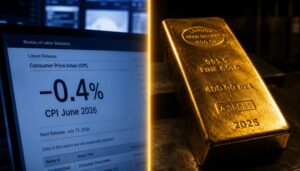
Silver Rises Over 120% YTD




Published: 12-23-2025, 10:30 am | Updated: 12-23-2025, 10:04 am
Daily News Nuggets | Today’s top stories for gold and silver investors
December 23rd, 2025
Silver Breaks $70 as Industrial Demand Roars Back
Spot silver surged past $70/oz for the first time ever, capping a weeks-long rally fueled by tight supply and red-hot industrial demand. Solar manufacturing, EV components, and electronics are driving the surge — and some refiners say they’re running at full capacity while miners struggle to keep pace after years of underinvestment.
Silver is behaving less like a sleepy precious metal and more like a high-beta industrial barometer. When manufacturing demand collides with safe-haven buying — especially during currency volatility — moves like this happen. If silver holds above $70, expect turbulence to stick around.
Silver isn’t the only precious metal catching a bid right now.
The Financial System Isn’t Safer — And You Know It As risks mount, see why gold and silver are projected to keep shining in 2026 and beyond.
Gold Buying Shifts as Investors Move Beyond ETFs
A new Reuters analysis shows a major shift in how investors accumulate gold. Large funds and family offices are pulling back on ETF exposure and increasingly buying allocated bars, coins, and vaulted products — driven partly by distrust of financial intermediaries and a push for direct ownership. Meanwhile, central banks continue heavy buying, especially across Asia and the Middle East.
Why it matters: Physical demand is one of gold’s strongest long-term price anchors. When sophisticated investors opt for metal they can touch rather than paper vehicles, it signals deeper concerns about financial-system stability — the kind gold has historically responded to.
Part of what’s fueling the precious metals surge? A collapsing dollar.
Dollar Suffers Its Worst Slide Since 2017
The U.S. dollar is in the middle of its steepest multi-month decline in nearly a decade. Traders are betting on a 2026 rate-cut cycle and bracing for political uncertainty, rotating into the euro, yen, and emerging-market currencies. The dollar index just hit its lowest level in eight years.
What we’re watching: A weaker dollar typically boosts commodities — especially gold and silver, which are priced globally in USD. If the slide continues, it could extend the metal rally already underway and complicate the Fed’s fight against still-sticky inflation.
The dollar’s weakness is lifting more than just gold and silver — industrial metals are surging too.

Copper Rockets to $12,000 on Supply Crunch Fears
Copper prices smashed through $12,000/ton for the first time as traders brace for extreme shortages. Supply disruptions in Peru and Zambia, combined with relentless demand from AI data centers, EVs, and grid buildouts, have created a perfect storm. Inventories on major exchanges are at 15-year lows.
Copper is often viewed as the economy’s real-time pulse. But today’s surge is less about booming growth and more about structural scarcity — another signal that inflation pressures may not be as “tamed” as headline data suggests. Rising industrial metal prices often spill over into broader commodity inflation, a backdrop that historically supports gold.
With commodities flashing inflation warnings, today’s GDP report offered a different — and more complicated — signal.
U.S. GDP Pops to 4.3% — But the Details Tell a More Complicated Story
The U.S. economy clocked a surprisingly strong 4.3% annualized growth rate — the fastest in two years. It crushed forecasts. On the surface, it looks like a major acceleration.
But the details are messier than the headline.
What drove the jump:
Consumer spending came in firmer than expected. Government spending expanded, partly reflecting delayed activity from the fall shutdown. And a sharp drop in imports mechanically lifted the GDP calculation. All three pushed the number higher, even as underlying momentum remains uneven.
Why it doesn’t “feel” this strong:
The labor market is cooling. Business sentiment is softening. Tariff uncertainty lingers. These trends point to a slowing economy beneath the surface.
Here’s the kicker: Falling imports can actually signal weakening domestic demand — even though they boost GDP mathematically. And those non-recurring government outlays? They make this quarter look stronger than what most economists expect heading into 2026.
The takeaway:
The GDP report is eye-catching. But much of the strength stems from temporary or technical factors, not a broad economic reacceleration.
For investors, this creates a tricky environment. Strong headline numbers suggest the economy is accelerating. Underlying data suggests the opposite. This kind of divergence makes it harder for markets to price risk accurately — and that’s exactly when gold tends to find its footing. When the signal-to-noise ratio deteriorates, hard assets become the clearer bet.