Silver Rises Over 120% YTD




Published: 03-19-2026, 02:15 pm | Updated: 03-19-2026, 02:23 pm
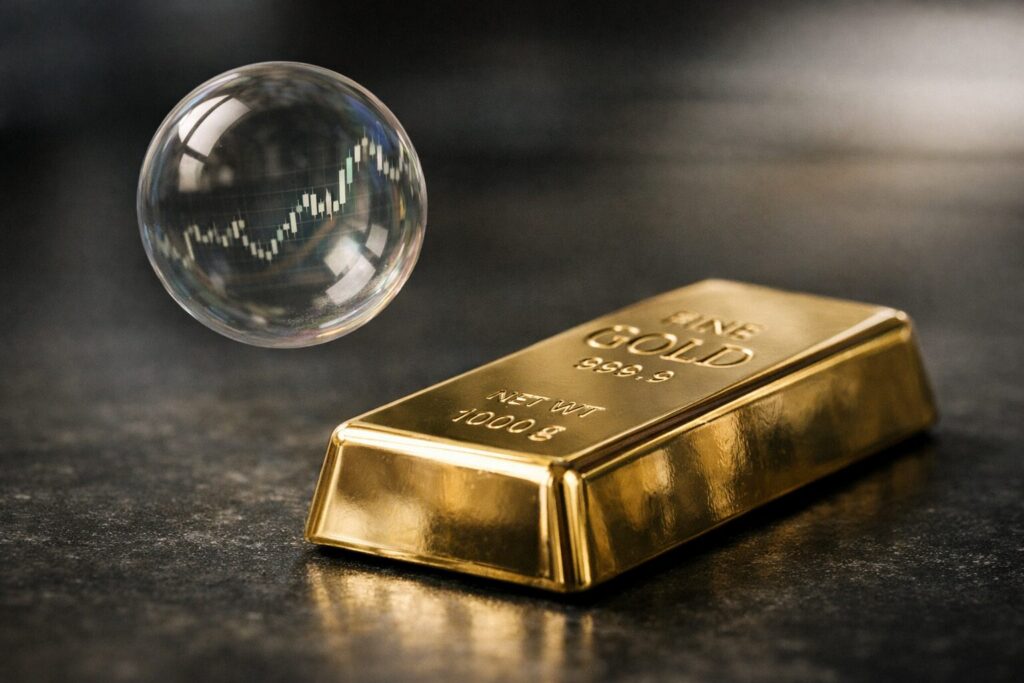
When gold doubles in a year, everyone starts asking the same question. Is this a bubble?
It’s the right question. But most people asking it are focused on the wrong thing. The real issue isn’t whether gold has risen too far. It’s whether the conditions driving that rise are real — or whether speculation has gotten out ahead of fundamentals.
Robert Kiyosaki has a definitive answer. The Rich Dad Poor Dad author told his 2.4 million followers on March 16, 2026 that gold will hit $35,000 within one year of “the biggest bubble bust in history.”
That’s either visionary or reckless. Here’s how to tell the difference.
Why Does Kiyosaki Predict $35,000 Gold?
Kiyosaki’s thesis isn’t a simple price target. It’s a macro argument about systemic collapse.
In his March 16 post, Kiyosaki wrote:
BIGGEST BUBBLE BUST
— Robert Kiyosaki (@theRealKiyosaki) March 16, 2026
I do not know what pin, what event will pop the biggest bubbles in histor. What ever the event, the pin is near.
It’s not IF. It’s WHEN.
When the bubbles go bust I predict gold will hit $35,000 an ounce one year after the gold bubble goes pop..
I predict…
Three interconnected beliefs drive his framework:
Unsustainable debt. Global debt levels — especially in the U.S. — are growing faster than any economy can absorb. Kiyosaki points to unresolved structural damage from 2008 and surging private credit exposure as likely triggers for a cascade failure.
Fiat currency debasement. Central banks can print money indefinitely. Gold cannot be created at will. That asymmetry is the heart of his argument — and it’s one shared by central banks themselves, which have been buying gold at record levels.
Post-crash revaluation. The $35,000 figure isn’t a near-term forecast. It’s what Kiyosaki believes gold will be worth after paper assets implode and investors flood into tangible stores of value.
The math is staggering. A $35,000 price implies a total gold market cap exceeding $175 trillion — larger than all global equities combined. Whether that’s visionary or absurd depends entirely on how seriously you take the collapse scenario underneath it.

The Financial System Isn’t Safer — And You Know It As risks mount, see why gold and silver are projected to keep shining in 2026 and beyond.
What Actually Makes an Asset a Bubble?
A financial bubble forms when price detaches from value. Speculation takes over from fundamentals. And the asset keeps rising — until it doesn’t.
Bubbles follow a recognizable pattern: genuine value creation, then irrational exuberance, then a violent correction. The dot-com crash of 2000 and the 2008 housing crisis are the clearest modern examples. In both cases, easy credit and herd psychology drove prices beyond anything underlying cash flows or collateral could justify. When sentiment flipped, the collapse was swift.
So is gold following the same script? The short answer is no — but the reasons matter.
Is Gold in a Bubble — or a Bull Market?
The case for “yes” isn’t entirely without merit. Gold has roughly doubled in under two years. Momentum-chasing flows are clearly at work.
But the price action tells a more complicated story. Gold surged past $5,000 in late 2024, pushed above $5,500 in January 2026, then pulled back sharply. The U.S.-Iran conflict drove prices back toward $4,600 — a reminder that even safe-haven assets aren’t immune to geopolitical whiplash. When fear spikes, investors sometimes sell gold to cover losses elsewhere. That’s short term volatility, not a broken thesis.
Gold also differs from classic bubble assets in a fundamental way. It produces no earnings and pays no dividend — so traditional valuation metrics don’t apply. Its value is anchored to what it does: store wealth, hedge against currency debasement, and hold up when other assets don’t. Those functions don’t disappear when prices rise. They often become more relevant.
What’s driving demand today? Persistent fiscal deficits. Central bank buying at historically elevated levels. Geopolitical instability. And growing concern about fiat currency purchasing power. These are structural forces — not the speculative mania that defines a bubble’s final stage.
Pullbacks will happen. They already have. But a price correction isn’t the same thing as a bubble bursting.
Should You Trust Kiyosaki’s $35,000 Gold Prediction?
Directionally, Kiyosaki has a decent track record on the calls that have played out. In 2023, he predicted gold would climb from $2,000 to $3,700 — a target many dismissed at the time. Gold surpassed it in 2025. His silver calls have also moved in the right direction, even if the timing repeatedly slipped.
But the credibility concerns are real and worth taking seriously.
According to a widely cited GrokAI summary, he has issued some variation of the “biggest bubble in history” warning more than 30 times since 2022. Each time the crash failed to materialize, the target moved further out. There have also been public contradictions about his Bitcoin positioning — enough to raise questions about how literally his audience should take his entry and exit calls.
The honest read: Kiyosaki is a useful macro sentiment indicator, not a precise forecaster. His core instinct — that hard assets outperform paper assets during a major deleveraging — is historically sound. The $35,000 figure is better understood as a directional argument than a price target.
Take the signal. Ignore the specifics. For a data-driven look at where gold could realistically head, see our 2026 gold price forecast.
What Does Gold’s History Tell Us About Where It’s Headed?
Gold has a consistent pattern. It rises sharply during stress. It consolidates during calm. Then it builds a new base and moves higher.
During the 2020 pandemic, gold climbed 25.1% in a single year. During the relative stability of 2021, it gave back 3.6%. That’s not bubble behavior — that’s a functional hedge doing exactly what it’s supposed to do.
Bubbles collapse when the catalyst is removed. Gold doesn’t. It absorbs the shock, resets, and holds its structural floor.
The biggest variable in gold’s long-run trajectory is monetary policy. When real interest rates are deeply negative, gold shines. When the Fed turns hawkish and yields rise, gold faces headwinds. That dynamic explains recent volatility as much as any geopolitical headline does.
But here’s what hasn’t changed: the underlying drivers — debt, deficits, dollar credibility, geopolitical risk — are still firmly in place. Short-term price swings are noise. The macro environment that’s been pushing gold higher since 2022 hasn’t meaningfully shifted.
How Should You Actually Position for This?
You don’t need to believe in Kiyosaki’s crash scenario to make a case for gold. The fundamentals stand on their own.
Gold has a historically low correlation with stocks and bonds. It has held up as an inflation hedge across multiple economic cycles. Those properties don’t require a collapse to be useful — they just require uncertainty. And uncertainty isn’t in short supply.
The practical question is how much and what form. Most allocation frameworks suggest somewhere between 5% and 15% of a portfolio, depending on risk tolerance. Conservative investors tend to anchor toward gold for stability. More aggressive investors add silver — accepting higher volatility in exchange for greater upside potential.
If you’re newer to precious metals, the range of options can feel overwhelming. Physical gold, ETFs, mining equities — each carries different tradeoffs. Our [guide to investing in gold] breaks down which approach fits which investor profile.
As for timing: don’t try to call the top or the bottom. Dollar-cost averaging — buying incrementally over time — removes that pressure entirely. If Kiyosaki’s thesis is even partially right, it also means you’re accumulating before any revaluation hits. If he’s wrong, you’ve still built a diversified position at multiple price points.
Either way, you’re not betting on a single outcome. That’s the point.
The Bottom Line: Is Gold in a Bubble?
No, not by any classical definition. Gold’s price rise reflects real macro pressures: debt, inflation risk, geopolitical tension, and central bank buying at historic levels. Those aren’t signs of speculative mania. They’re signs of a world with serious unresolved problems.
Will those pressures intensify into the full collapse Kiyosaki envisions? Nobody knows. His $35,000 target is almost certainly hyperbolic on any near-term horizon. But the core logic — that hard assets hold up in a world drowning in debt — is historically sound.
Don’t build a portfolio around Kiyosaki’s timeline. Do build one that doesn’t collapse if he’s right.
Gold has held its value through every major economic crisis in modern history. The debt, the deficits, the geopolitical instability — none of that is going away. A measured allocation doesn’t need $35,000 gold to justify itself. It needs the world to stay uncertain.
Look around.
Stay On Top of Gold & Silver Prices
Get important market alerts sent straight to your inbox.
People Also Ask
Is gold currently in a bubble?
Not by the classical definition. Gold’s price rise is driven by structural fundamentals — rising global debt, central bank buying, geopolitical instability, and inflation risk — rather than the speculative mania that defines a true bubble. Short-term pullbacks are possible, but the underlying demand drivers remain intact.
What is Robert Kiyosaki’s $35,000 gold prediction based on?
Kiyosaki’s forecast is a post-crash projection, not a near-term price target. He argues that unsustainable global debt, fiat currency debasement, and unresolved structural problems from the 2008 financial crisis will eventually trigger a systemic collapse — after which gold will be revalued dramatically as investors flee paper assets.
How does a financial bubble differ from a gold bull market?
A financial bubble occurs when an asset’s price detaches from its intrinsic value due to speculation and herd psychology, and collapses when sentiment reverses. A gold bull market, by contrast, is typically driven by deteriorating macro conditions — negative real interest rates, currency weakness, or geopolitical risk — that make gold’s safe-haven properties genuinely more valuable.
Has Kiyosaki’s gold prediction been accurate in the past?
Directionally, yes — gold has surpassed several of his earlier targets, including $3,700 and levels toward $27,000. However, his timing has repeatedly slipped, and he has issued variations of a “biggest bubble in history” warning more than 30 times since 2022. His forecasts are best read as macro directional signals, not precise price targets.
How much gold should an investor hold in their portfolio?
Most recommendations suggest allocating between 5% and 15% of a portfolio to precious metals, depending on risk tolerance. Conservative investors typically hold more gold for its stability, while aggressive investors may add silver for higher upside potential. Dollar-cost averaging — buying incrementally over time — is widely considered the most practical approach to building a position.
This article is for informational purposes only and does not constitute investment advice. Past performance is not indicative of future results. Always consult a qualified financial advisor before making investment decisions.