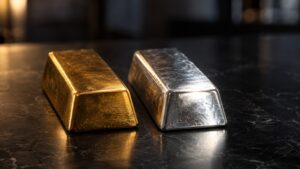
Silver Rises Over 120% YTD




Published: 03-27-2026, 06:15 pm | Updated: 03-27-2026, 06:09 pm
🌆 Evening News Nuggets | Today’s top stories for gold and silver investors
March 27th, 2026 | Brandon Sauerwein, Editor
Gold and silver are staging a modest Friday rebound, but the gold price correction remains one of the sharpest in recent memory — down 17% from January’s all-time high even as war, inflation, and dollar uncertainty dominate the headlines.
Is the Gold Price Correction Finally Reversing?
Gold and silver closed out the week on a positive note, each gaining roughly 3% on the session as buyers stepped back in after a brutal month-long selloff. Gold settled near $4,493/oz. Silver recovered to approximately $69.71/oz. Both metals remain well below their January highs.
The 30-day drawdown has been steep. Gold is off roughly 17% from its all-time high of $5,400.25, reached on January 28. Silver has fallen further — down more than 40% from its January 28 peak of $116.61/oz. Today’s bounce likely reflects a mix of end-of-week short covering and early bargain hunting, but the macro headwinds that drove the selloff haven’t cleared.
Three forces drove the correction: a hawkish Federal Reserve hold, the escalating U.S.-Iran conflict disrupting global energy markets, and oil-driven volatility that has whipsawed broader risk sentiment throughout March.
Why Is Gold Down While Energy and the Dollar Surge?
The gold price correction has deepened through March as capital rotated away from metals and into yield-bearing assets, with major indexes down roughly 7–8% as investors navigate the combined weight of geopolitical conflict, persistent inflation, and a higher-for-longer rate environment. That’s a backdrop that historically favors gold. This cycle, it hasn’t — at least not yet.
War-related supply disruptions have pushed energy prices up approximately 45%. That’s fueled inflation expectations and reinforced the Fed’s hawkish posture, keeping real yields elevated. Higher yields raise the opportunity cost of holding non-yielding assets like gold and silver, and capital has responded accordingly — rotating into the dollar and yield-bearing assets instead.
The result is an unusual divergence. Gold and silver are declining even as the conditions that typically drive safe-haven demand — conflict, inflation, dollar uncertainty — are all present. Traditional correlations are breaking down, and that breakdown is central to understanding both the recent selling pressure and what a reversal could look like.
The Edge Every Investor Needs Smarter precious metals investing starts here. The Nuggets Newsletter brings you essential market insights, Fed updates, global trends, educational videos, and much more.
What’s Behind the Selloff in Gold Mining Equities?
Gold’s correction has hit mining stocks harder than the metal itself. Many names have dropped sharply in recent weeks. Gold miners have fallen out of major momentum screens including the IBD 50 — a clear signal of institutional rotation out of the sector.
The amplification is typical. Mining equities carry operational leverage to the gold price, meaning corrections in the metal tend to produce steeper declines in miners. Margin pressure, sentiment shifts, and profit-taking have all accelerated the move.
The longer-term picture looks more constructive. Gold is still up 47% from a year ago. The macro drivers that pushed it to an all-time high — central bank accumulation, fiscal instability, dollar debasement concerns — remain intact. Historically, gold miners have reclaimed leadership within two to three months of major corrections when the underlying gold price has held above prior support levels. Whether that pattern holds this cycle depends largely on how quickly geopolitical risk reprices and whether the Fed signals any policy shift.
Stay On Top of Gold & Silver Prices
Get important market alerts sent straight to your inbox.
Sources:
Gold price data: Investing.com — XAU/USD Historical Data
Silver price data: Investing.com — XAG/USD Historical Data
Mining stocks: Investor’s Business Daily — IBD 50 Gold & Precious Metals
Market performance: Investopedia — Stocks in Retreat: Losers and Winners