Silver Rises Over 120% YTD




Published: 04-20-2026, 05:38 pm | Updated: 06-19-2026, 03:56 pm
Silver has already had a remarkable run. It surged more than 147% in 2025. It hit a nominal all-time high of approximately $121 per ounce in January 2026. And as of June 2026, it trades near $64.83/oz — down 46% from that January peak after the Fed’s June dot plot put rate hikes back on the table.
So what comes next?
That’s the question investors are now asking. The original bull and bear cases have shifted significantly. Understanding where each scenario stands today is essential before making any decisions.
Here’s a grounded look at both sides of the 2026–2027 silver debate.
Where Silver Stands Heading Into the Rest of 2026
Silver is no longer a “cheap, overlooked” metal waiting for its moment. It has already had one. However, that doesn’t mean the story is over — or that risks have disappeared.
The gold-to-silver ratio tells an important part of this story. It measures how many ounces of silver are needed to buy one ounce of gold. In April 2025, that ratio hit 105:1 — a historically extreme level signaling silver was deeply undervalued. By early 2026, it had compressed to approximately 57–63:1. That compression reflected silver’s dramatic outperformance.
As of June 2026, the ratio has expanded back to approximately 64:1 — the May compression to 55:1 fully reversed after the hawkish FOMC meeting on June 16–17. That’s below the modern long-term average of around 70:1. In other words, silver is no longer historically cheap relative to gold. It has repriced significantly. Where it goes from here depends on which of two scenarios plays out.
You can track the live silver price trends and ratio in real time to stay current as conditions evolve.

Your Gold Buying Guide Most investors overpay when they buy gold. Then overpay again when they sell. This guide shows you exactly what to own — and why.
The Bull Case for Silver in 2026–2027
Q: What factors could push silver prices significantly higher from current levels?
Several institutional forecasters remain bullish — even at today’s elevated prices. Here’s why.
1. Industrial Demand Has Structural Momentum
Silver isn’t just a monetary metal. It is a critical industrial input. Solar panel manufacturing accounts for roughly 16% of annual global silver demand — and that share grows each year. Electric vehicles, 5G infrastructure, semiconductors, and medical devices all rely on silver’s unique conductive properties.
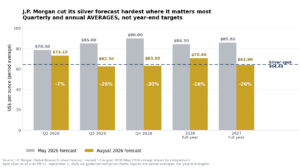
J.P. Morgan projects silver will average $81/oz across 2026. Commerzbank forecasts $90/oz by year-end, with further gains to $95/oz by end of 2027. These targets are now within reach from current levels. Furthermore, they could be exceeded if industrial demand accelerates beyond current projections.
2. Six Consecutive Years of Supply Deficit
The Silver Institute has tracked five consecutive years of global silver supply deficits. A sixth deficit is widely expected in 2026. When supply consistently falls short of demand over multiple years, upward price pressure builds — even when short-term volatility obscures the trend.
Mine output has not kept pace with demand. Several major producers face declining ore grades. As a result, new supply takes years to develop. If the deficit deepens further, prices could push materially higher.
3. The Fed Policy Tailwind
If the Federal Reserve begins cutting rates in the second half of 2026, real yields would fall. That typically supports non-yielding assets like silver. A weaker dollar would amplify this effect further. Both conditions remain plausible catalysts for a second leg of the rally.
4. Extended Bull Targets from Major Banks
More aggressive forecasters have raised their targets significantly. The LBMA analyst survey for 2026 shows an average forecast of $79.57/oz — with a range running from $42 to $165. Bank of America has flagged a bull scenario of $135–$309 if physical shortages intensify. These are not base cases. However, they reflect genuine institutional conviction about silver’s structural supply-demand gap.
The bull case, in short: Persistent supply deficits, strong industrial demand, and a potential Fed pivot could push silver toward $100/oz and beyond — even from today’s already elevated levels.
The Bear Case for Silver in 2026–2027
Q: What risks could cause silver prices to decline or disappoint in 2026–2027?
The bear case is grounded in real and present risks. Here’s what skeptics are watching closely.
1. Silver Already Had Its Major Move
Silver surged 147% in 2025. It hit $121 in January 2026 before pulling back to the mid-$70s. That retreat raised questions about sustainability. Specifically, a significant portion of that January surge appeared to be speculative rather than fundamental. When speculative froth cleared, prices fell sharply.
Furthermore, the gold-to-silver ratio at current levels no longer signals obvious undervaluation. That removes one of the most reliable structural arguments for buying silver aggressively.
2. A Stronger Dollar and Resilient Rates
The Fed’s June 2026 dot plot went further than a simple hold — committee members are now openly debating rate hikes for later in 2026. Inflation confirmed at 4.2% in May, the highest since early 2023 [Bureau of Labor Statistics]. Silver fell from $69.85 to $64 in the week of the FOMC meeting alone.
Inflation has remained persistent. A strong dollar makes dollar-denominated commodities more expensive for foreign buyers — and that suppresses demand. TD Securities, among the more bearish voices in the LBMA survey, forecasts silver averaging just $44/oz for 2026. That scenario would require a meaningful macro deterioration from current conditions.
3. Industrial Demand Softness Through Thrifting
Silver’s industrial exposure is a double-edged sword. If global growth disappoints — particularly in China, which plays an outsized role in metals demand — silver would likely be hit harder than gold. In addition, the Silver Institute and Metals Focus have flagged efficiency gains in solar panel manufacturing as a near-term headwind. Manufacturers use less silver per panel as technology improves. This “thrifting” effect could cap demand growth even as solar installations expand.
4. Geopolitical Wildcards Cut Both Ways
Geopolitical risk has been a supportive factor for precious metals in 2026. However, if ongoing conflicts drive oil prices sharply higher and force central banks into more aggressive tightening, silver could face dual headwinds — weaker economic growth and higher interest rates simultaneously.
The bear case, in short: A speculative overhang, resilient rates, and industrial demand softness has already pulled silver to $64.83 — and a Fed hike would test the $55–60 support zone— a meaningful correction from current levels.
Commerzbank: $90 EOY
LBMA low: $42
What Are Analysts Forecasting for Silver in 2027?
The 2027 picture is where institutional views diverge most sharply. HSBC projects silver averaging $57/oz in 2027, anticipating that gradual supply improvements will ease 2026’s tightness. TD Securities forecasts a decline from $80/oz in mid-2026 toward $70 by end-2027, citing demand normalisation.
On the bullish end, OCBC projects a climb from $92 in Q1 2027 to $95 by mid-year, while Commerzbank’s base case of $90 by end-2026 implies further upside into 2027 if industrial demand holds. The wide range — $57 to $95+ — reflects a genuine split between analysts who see 2026’s correction as the new floor and those who see it as the start of a longer consolidation.
The most important variable for 2027 is whether the Fed cuts rates in H2 2026. If it does, real yields fall, and silver’s historical 2–3x amplification of gold moves kicks in. If it doesn’t — or hikes — 2027 targets at the lower end of the range become more plausible.
Is 2026–2027 Still a Good Time to Invest in Silver?
There is no clean answer. However, the question looks very different now than it did 12 months ago.
Investors who bought silver when the gold-to-silver ratio exceeded 100:1 in 2025 made an exceptional trade. At the current ratio of approximately 64:1, silver is around the modern historical average — no longer the obvious asymmetric opportunity it was at 105:1 in 2025. In contrast, the structural arguments — supply deficits, industrial demand, inflation protection — remain valid for the long term.
For those with a long-term horizon, silver’s fundamentals still make a case. For those expecting a quick repeat of 2025’s gains, the risk profile is meaningfully different. Volatility remains a constant. Position sizing matters more than timing.
The investing in silver guide at GoldSilver.com walks through how to build a position that accounts for both upside potential and downside risk — without the hype.
Silver in 2026–2027: Tension, Not a Verdict
Silver has already proven the skeptics wrong once. The structural bull arguments — green energy demand, persistent supply deficits, inflation protection — are real and ongoing.
However, risks have evolved too. The metal is no longer cheap by historical ratio standards. Speculative positioning is higher. And macro headwinds — a resilient dollar, sticky inflation, and geopolitical uncertainty — haven’t gone away.
The most prudent approach isn’t to bet entirely on one scenario. Instead, understand both, size your position to your risk tolerance, and avoid the extremes of blind optimism or reflexive avoidance.
For regularly updated silver market analysis and price forecasts, GoldSilver.com’s research team publishes ongoing analysis as conditions evolve.
Stay On Top of Gold & Silver Prices
Get important market alerts sent straight to your inbox.
People Also Ask
What are the bull and bear case scenarios for silver prices in 2026–2027?
The bull case targets $90–$150+/oz. It is driven by six consecutive supply deficits, strong industrial demand from solar and EVs, and potential Fed rate cuts. The bear case points to a correction toward $60–$65. That scenario is driven by a resilient dollar, sticky inflation, and softening industrial demand. Institutional forecasts range from $44 (TD Securities) to $165+ (LBMA bull respondent), with J.P. Morgan projecting an average of $81/oz for 2026.
What factors could drive silver prices to $300 or higher by 2026?
A $300 silver price would require a severe physical supply shortage, a dramatic dollar collapse, and a broad institutional flight to real assets — all happening simultaneously. Most mainstream analysts do not treat this as a base case. However, Bank of America has flagged a bull scenario of $135–$309 if physical deficits intensify sharply. Commerzbank’s base case sits at a more measured $90/oz by year-end 2026.
What risks or economic conditions could cause silver prices to decline in 2026–2027?
The primary downside risks are a persistently strong dollar, Federal Reserve rate hikes instead of cuts, a Chinese economic slowdown reducing industrial demand, and a further unwinding of speculative positions built during the 2025 rally. Notably, silver already corrected from $121 to the mid-$70s in early 2026 — demonstrating that sharp pullbacks are possible even in a structurally bullish market.
How do expert predictions for silver in 2026 compare to historical trends?
Silver surged 147% in 2025 — one of its strongest years on record — and hit a nominal all-time high of $121.64 in January 2026. Current institutional forecasts average around $79–$81/oz for 2026 (J.P. Morgan, LBMA consensus). That is broadly consistent with historical patterns where silver consolidates after a major breakout before resuming its trend. The wide forecast range — $44 to $165 — reflects silver’s inherent and well-documented volatility.
Is 2026–2027 a good time to invest in silver based on current forecasts?
It depends on your entry point, time horizon, and risk tolerance. The structural case — supply deficits, industrial demand, inflation hedging — remains valid. However, silver is no longer historically cheap relative to gold at a ratio of 59–61:1. Investors with a long-term view and tolerance for volatility may still find value. Those expecting a quick repeat of 2025’s 147% gain face a meaningfully different risk profile. Dollar-cost averaging remains a more prudent approach than timing a single entry point.
SOURCES
1. J.P. Morgan Global Research — How Will Silver Prices Fare in 2026?
2. SBC Gold — Silver Price Forecast 2026: Institutional Target Aggregation
3. deVere Group — What’s Next for Silver in 2026? Analysts Predict Volatility Ahead
4. Finance Magnates — Silver Price Predictions: Targets and Scenarios for 2026
5. GoldSilver.com — What the Falling Gold-to-Silver Ratio Means for Investors
6. CoinDCX — Silver Price Forecast 2026–2030: Outlook and Key Drivers
7. The Silver Institute — World Silver Survey: Supply and Demand Data
8. LBMA — Precious Metals Forecast Survey 2026
This article is for informational purposes only and does not constitute investment advice. Precious metals investing involves risk, including the possible loss of principal. Price data referenced as of April 2026. Consult a qualified financial advisor before making investment decisions.
You May Also Like:
- How to Buy Silver Bars: The Investor’s Guide
- Why Silver Falls While Gold Rises: What It Means for You
- Gold Price Forecast 2026–2027: Key Predictions from Top Analysts
- Is Now a Good Time to Buy Gold? Here’s the Macro Case
- Is Gold a Better Investment Than Bitcoin Right Now?
- What the Silver-to-CPI Ratio Reveals That Spot Price Hides
- Gold & Silver Supply and Demand: What Really Drives Prices Over Time
- Dow to Gold Ratio: 100 Years of History Decoded
- How the 50 Day SMA Helps You Understand Gold & Silver