Silver Rises Over 120% YTD




Published: 04-16-2026, 12:33 pm
In the gold vs bitcoin 2026 debate, the headline numbers tell most of the story.
Gold is down roughly 14% from its January 2026 all-time high of $5,589. Bitcoin is down more than 41% from its October 2025 record of $126,198. Both have pulled back — but the comparison ends there.
Gold’s correction is a consolidation within a structural bull market. Bitcoin’s is a reminder that volatility cuts both ways. The forces driving gold — central bank accumulation, real yield compression, dollar weakness, and geopolitical risk — remain fully intact. Here’s what the data shows, and what it means for investors weighing both assets right now. For ongoing coverage of gold and precious metals markets, visit GoldSilver News.
Gold Dropped. Bitcoin Dropped Harder. Here’s the Data.
Gold hit an all-time high of $5,589 per ounce on January 28, 2026. The day was marked by escalating US-Iran tensions and a Federal Reserve rate hold. Today, the metal trades near $4,810 — down approximately 14% from that peak. That pullback is the starting point of this conversation, not the conclusion.
Bitcoin tells a different story. It hit $126,198 on October 6, 2025 — its own all-time high. As of April 15, 2026, it’s trading near $74,300, down more than 41% from that record. Bitcoin entered 2026 at around $87,500 and has shed roughly 23% since, marking its first back-to-back quarterly losses since 2022 [Reuters]. Gold, over that same stretch, is up approximately 11% year to date.
A 14% pullback from an all-time high versus a 41% decline from one. One is a pause. The other has wiped out more than $51,000 per coin in six months.
How Far Has Gold Actually Fallen?
By historical standards, not far. Gold has retraced approximately 14% from its $5,589 peak, settling into a current range of $4,780–$4,810. The decline tracks directly to a two-week US-Iran ceasefire that briefly reduced safe-haven demand and pushed oil below $100. As tensions re-escalated, gold recovered — climbing back toward $4,800 by April 14 [Trading Economics].
Gold posted a 67% return in 2025, setting 53 all-time highs during the year [World Gold Council]. A 14% pullback after a 67% gain is not a breakdown. It is a compression of gains that has, in previous cycles, consistently resolved higher.
The metal started 2025 at approximately $2,625, ended December at $4,368, then surged to $5,589 in late January 2026. Anyone who held through 2025 is sitting on returns that most asset classes haven’t come close to matching.

Your Gold Buying Guide Most investors overpay when they buy gold. Then overpay again when they sell. This guide shows you exactly what to own — and why.
Is Bitcoin’s Drop Just a Deeper Version of Gold’s?
No — and the distinction matters. Bitcoin peaked at $126,198 on October 6, 2025, and has fallen to around $74,300. That’s a decline of over 41%. By most conventional definitions, that’s a bear market, not a correction.
This is a recurring pattern. Bitcoin has experienced drawdowns exceeding 70% in both 2018 and 2022, and its less severe pullbacks still routinely dwarf anything gold investors have faced [Morningstar]. Bitcoin’s annualized realized volatility stood at approximately 52% as of early 2025 — more than three times gold’s annualized volatility of below 15% [CoinMetrics]. That gap isn’t a footnote. It determines whether a position is manageable during a crisis or becomes one.
Bitcoin’s long-term return record is real. Over multi-year cycles, it has outperformed gold in absolute terms. But that outperformance comes at a specific cost: the psychological and financial stamina to hold through drawdowns that would end most portfolios. When the correlation between the two assets broke down in early 2025 — right as geopolitical stress peaked — gold moved to new highs while Bitcoin moved lower. That divergence is not noise. It is what these two assets actually are.
Why Does Gold Hold Its Value When Markets Break Down?
It’s not tradition. It’s structure. During four major market drawdowns between 2018 and 2025, gold posted an average gain of 4.7% when equities fell more than 12%. Bitcoin lost an average of 35.3% in those same episodes [State Street Global Advisors].
Gold is a risk-off asset. When institutions, central banks, and sovereign wealth funds need to reduce risk, they buy gold. Bitcoin behaves differently — it sells alongside equities in stress events and recovers only after liquidity conditions ease. The “digital gold” label is a marketing claim, not a market behavior.
The liquidity gap reinforces this. A sale of 100,000 BTC — roughly $7.4 billion at current prices — could create a 25% price impact on Bitcoin’s market. The same transaction in gold would barely register against daily turnover. At scale, that asymmetry is not a theoretical concern. It is the difference between a safe-haven asset and an illiquid one.
Does Gold’s Track Record Support Buying the Dip?
The historical record is clear. Gold corrections within established bull markets share one feature: they end, and prices move higher. The current setup — a 14% pullback after a parabolic geopolitical spike — mirrors every major consolidation of the past two decades.
Gold ended 2025 at $4,368 and reached $5,589 just four weeks later [Reuters]. The structural forces behind that move — dollar weakness, compressed real yields, institutional safe-haven demand, and record central bank accumulation — have not reversed. The underlying conflict has re-escalated. Ceasefire talks have broken down. The US naval blockade of Iranian oil shipments is now in effect.
The 25-year record says the same thing in slower motion. From 2000 to 2025, gold delivered an average annual return of 10.9%, compounding to a total return of 1,075% [World Gold Council]. Every significant pullback in that span — including a 20%+ correction in 2008 and a multi-year decline from 2011 to 2015 — was followed by new highs.
What Are the Biggest Institutions Saying About Gold Right Now?
They’re buying — and raising their targets. Central banks purchased 863 tonnes of gold in 2025, among the highest levels in modern history, with demand spreading to more countries than in prior years. Global gold ETFs recorded their strongest inflow year ever: $89 billion absorbed, physical holdings reaching a historic peak of 4,025 tonnes [World Gold Council] [Bloomberg].
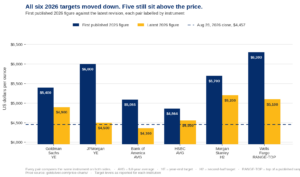
The forecasts are equally bullish. JP Morgan revised its gold outlook upward on February 2, 2026, projecting $6,300 per ounce by Q4 2026. The bank expects quarterly central bank and investor demand to average 585 tonnes — enough to sustain upward price pressure through the year [JP Morgan Global Research]. UBS targets $6,200 by September 2026, then $5,900 by year-end following the US midterm elections. State Street puts the $4,400–$4,600 range as strong structural support, with a base case of $4,750–$5,500 carrying a 50% probability.
What’s driving these calls? Gold’s 2025 rally was explained in roughly equal parts by geopolitical risk premium, dollar weakness, and real yield compression. None of those tailwinds have materially shifted.
Is This a Good Entry Point for Gold?
A 14% pullback within a confirmed bull market is historically one of the better times to add exposure — not because prices are guaranteed to recover, but because the structural case is intact and the emotional pressure to buy has eased.
Gold is still approximately 80% above where it was 18 months ago. The drivers that built that move — central bank reserve diversification, persistent inflation above Fed targets, geopolitical risk premium, and record ETF inflows — remain in place. JP Morgan put it plainly: the long-term trend of official reserve and investor diversification into gold has further to run [JP Morgan Global Research].
The more useful comparison isn’t gold versus its January peak. It’s gold versus everything else. Bitcoin is down 41% from its record. Equities have underperformed gold meaningfully over the past 12 months. Cash yields, after inflation, remain negative. The argument for gold doesn’t rest on whether it’s 14% off a high. It rests on what the alternatives look like — and right now, they don’t look better.
Physical gold ownership is ultimately a position on monetary debasement, fiscal expansion, and the long-term erosion of purchasing power. If you want to understand the deeper case for gold — why it has functioned as real money across centuries while currencies have failed — Mike Maloney’s Hidden Secrets of Money series is the clearest explanation available. History has consistently settled that argument in gold’s favor. If you’re thinking about how gold fits into your portfolio, GoldSilver.com is a good place to start — with guides, data, and tools built for investors who want to understand what they own.
Bottom Line
Gold’s 14% correction from its January 2026 all-time high is not a warning signal. It’s a pause inside a structural bull market with intact fundamentals. Bitcoin’s 41% decline from its 2025 peak is something else entirely — a sharp reminder that higher potential returns and higher risk are the same thing, not separate features.
The institutional picture is consistent. Central banks bought 863 tonnes of gold in 2025. ETF inflows hit a record $89 billion. JP Morgan, UBS, and State Street are all forecasting significantly higher prices. The investors and institutions that track gold most closely are not selling into this pullback. They are adding to it.
If you’ve been waiting for a better entry point than January’s all-time high, the data suggests you may be looking at one. Learn more about owning gold and silver — or take the next step and buy gold at GoldSilver.com.
Stay On Top of Gold & Silver Prices
Get important market alerts sent straight to your inbox.
People Also Ask
Is gold a better investment than Bitcoin right now?
Based on current data, gold is outperforming Bitcoin significantly in 2026. Gold is down approximately 14% from its January all-time high while Bitcoin is down over 41% from its October 2025 record. Gold has also outperformed Bitcoin year to date and in every major geopolitical stress event since their correlation broke down in early 2025.
Why is gold down if it’s supposed to be a safe-haven asset?
Gold’s 14% pullback from its January 2026 all-time high of $5,589 follows a temporary easing of US-Iran tensions during a two-week ceasefire period. As tensions have re-escalated, gold has already begun recovering toward $4,800. Corrections of this magnitude are typical within bull markets and do not reflect a change in gold’s structural drivers.
How does gold’s volatility compare to Bitcoin’s?
Gold’s annualized volatility is generally below 15%, while Bitcoin’s annualized realized volatility stands at approximately 52% — more than three times higher. Bitcoin has experienced peak-to-trough drawdowns exceeding 70% in both 2018 and 2022. Gold’s worst drawdowns over the same period remained below 20%.
What is Bitcoin’s all-time high and how far is it from that now?
Bitcoin reached its all-time high of $126,198 per coin on October 6, 2025. As of April 2026, Bitcoin is trading near $74,300, representing a decline of more than 41% from that record.
Are central banks buying gold or Bitcoin?
Central banks are buying gold. In 2025, global central bank gold purchases reached 863 tonnes — among the highest on record — according to the World Gold Council. No major central bank has publicly disclosed significant Bitcoin holdings as a reserve asset.
What do major banks forecast for gold prices in 2026?
JP Morgan projects gold reaching $6,300 per ounce by Q4 2026. UBS has raised its target to $6,200 by September 2026, with a year-end 2026 forecast of $5,900. State Street’s base-case scenario places gold between $4,750 and $5,500, assigned a 50% probability.
Does gold protect against inflation better than Bitcoin?
Historical data suggests gold has a more consistent and reliable correlation with inflation and real yields than Bitcoin. Research from Morningstar found that gold correlates more directly with inflation and real yield dynamics, while Bitcoin’s inflation-hedging properties are far less consistent across macro regimes [Morningstar].
Has gold ever recovered after a pullback this size?
Yes. From 2000 to 2025, gold delivered an average annual return of 10.9%, compounding to a 1,075% total return over 25 years according to World Gold Council data. Every significant pullback in that period — including declines of 15–20% — was followed by new highs. The pattern has held across financial crises, rate cycles, and geopolitical shocks.
What drove gold to its January 2026 all-time high?
Gold’s January 2026 all-time high of $5,589 was driven by a combination of escalating US-Iran geopolitical tensions, a Federal Reserve decision to hold interest rates steady, US dollar weakness, and record-high global ETF inflows in 2025. The World Gold Council’s return attribution model identified geopolitical risk and dollar weakness as the largest contributors to gold’s 2025–2026 rally.
SOURCES
1. Reuters — Commodities Markets: Gold and Precious Metals Coverage
2. Trading Economics — Gold Spot Price, Historical Data and Market News
3. World Gold Council — Gold Demand Trends: Q4 and Full Year 2025
4. World Gold Council — Gold Price Returns: Historical Performance Data
5. Morningstar — Bitcoin and Gold Comparative Drawdown and Inflation Analysis
6. CoinMetrics — Bitcoin Annualized Realized Volatility and Market Data
7. State Street Global Advisors — Gold vs Bitcoin Performance During Market Stress Events
8. Bloomberg — Commodities Markets: Gold ETF Flows and Institutional Demand
9. JP Morgan Global Research — Gold Price Forecast and Commodities Outlook 2026
Disclaimer: This article is for informational and educational purposes only. It does not constitute investment advice. Past performance is not a guarantee of future results. Consult a qualified financial advisor before making any investment decision.
You May Also Like:
- What the Silver-to-CPI Ratio Reveals That Spot Price Hides
- Gold & Silver Supply and Demand: What Really Drives Prices Over Time
- Dow to Gold Ratio: 100 Years of History Decoded
- How the 50 Day SMA Helps You Understand Gold & Silver
- Gold Silver Ratio Forecast (75): Buy Gold, Add Silver, or Wait?
- Gold Dip Buying Explained: Is This A Smart Move Now?
- What Is Quantitative Easing — and How Does It Affect Metals?
- Gold Coins vs. Gold Bars — Which is Better for Investors