Silver Rises Over 120% YTD




Published: 04-20-2026, 11:19 am | Updated: 04-20-2026, 12:21 pm
Gold and Silver market update — April 20, 2026
Key Takeaways
- The US Navy seized the MV Touska, oil surged 7%, and gold fell ~1% — a fraction of what prior escalations produced. The floor has structurally shifted.
- Gold is now priced as a monetary hedge, not a geopolitical one. The driver: fiscal dominance — US debt interest crossing $1 trillion, three years of Fed operating losses, accelerating central bank de-dollarization.
- The bull case doesn’t require the war to end. It requires the Fed to stay trapped between inflation and debt service. That trap isn’t going anywhere.
- 2026–2027 bank gold price targets: Goldman Sachs $5,400 (year-end), J.P. Morgan $6,300, Deutsche Bank $6,000, Bank of America $6,000, Wells Fargo Investment Institute $6,100–$6,300, Société Générale $6,000.
On Sunday morning, the US Navy destroyer USS Spruance fired on and seized an Iranian-flagged vessel in the Gulf of Oman. The Strait of Hormuz — through which roughly 20% of the world’s seaborne oil flows — was closed again. Oil futures surged 7%. Stock futures fell. And gold? Gold dropped roughly 1%.
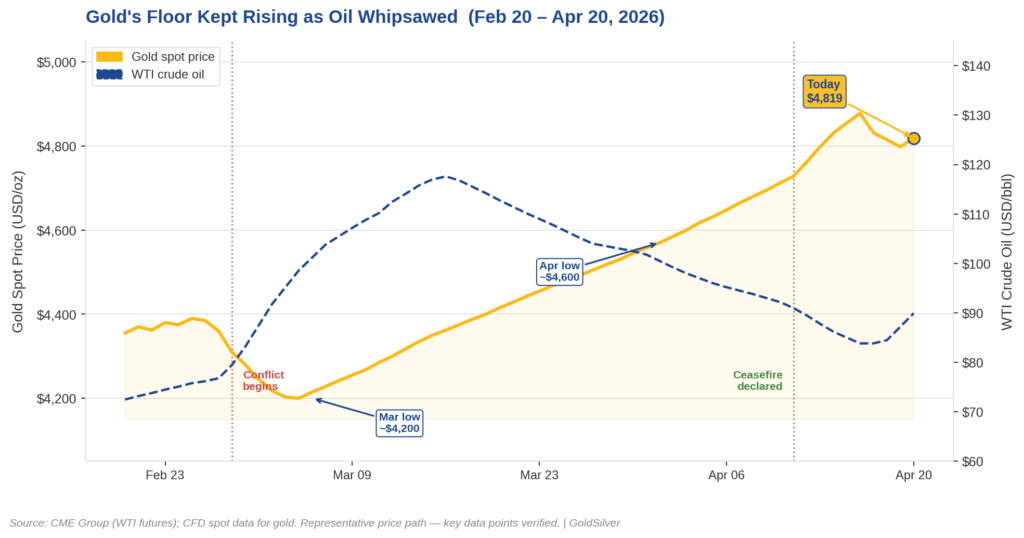
Not 3%, 5%, or back to $4,400. Gold opened Monday at around $4,819, holding a floor that didn’t exist in February. The question isn’t why gold is falling. It’s why it isn’t.
Where Is the Gold Price Right Now?
Gold: ~$4,819/oz, down ~1% from Friday’s close of $4,831. Silver: ~$80.13/oz, off ~2%. Gold-silver ratio: 59.7 — mild safe-haven rotation into gold, with silver underperforming. DXY up 0.20% to ~98.29. WTI crude ~$89–90/bbl. Oil is the headline. Gold is the signal.
What Happened Over the Weekend?
Once again, the weekend followed a now-familiar pattern: false optimism, then inevitable re-escalation. On Friday, Iran declared the Strait “completely open” for a 10-day ceasefire. Oil plunged 10%, stocks hit all-time highs, gold rallied to an intraday high of $4,878.
By Saturday it had unraveled. Trump refused to lift the naval blockade on Iranian ports — a condition Iran called non-negotiable. The strait re-closed. Ships came under fire from Iran’s “mosquito fleet.” On Sunday, USS Spruance intercepted the Iranian-flagged MV Touska in the north Arabian Sea, firing after it ignored warnings to stop. First ship seizure of the conflict.
Sunday evening: WTI +7.14% to $89.94/bbl. Brent +~6% to $95.71. S&P 500 futures -0.67%. Dow futures -0.88%. Gold: -~1%.

The Edge Every Investor Needs Smarter precious metals investing starts here. The Nuggets Newsletter brings you essential market insights, Fed updates, global trends, educational videos, and much more.
Why Isn’t Gold Falling More When Oil Spikes?
This kind of escalation normally hits gold from two directions. Typically, the chain reaction looks like this: dollar strengthening, oil shock, inflation, hawkish Fed, higher yields, bearish gold. At the same time, margin calls push investors to sell gold to cover losses elsewhere. Indeed, that’s exactly what happened when the conflict first broke in March 2026 — gold dropped 2–3%.
This time: gold fell ~1%, holding above $4,800. Something has changed in how gold is being priced.
What is fiscal dominance — and why does it matter for gold? Fiscal dominance is when a government’s debt load is so large that the central bank loses control of rates. The Fed holds at 3.50%–3.75%. Markets price a 97.9% chance of no change at April 28–29, per CME FedWatch (April 17, 2026). Chicago Fed President Austan Goolsbee warned on April 14 the first rate cut may not arrive until 2027 if oil stays elevated. The Fed posted $18.7B in operating losses for 2025 — three consecutive years in the red, cumulative loss $210.3B. It can no longer remit funds to the US Treasury, ending over $1 trillion in historical remittances. US debt interest payments are crossing $1 trillion this fiscal year, more than the entire defense budget. The Fed can’t raise rates without blowing out the Treasury’s interest bill. That constraint is gold’s structural floor. It doesn’t move when Iran does.
What Are the Big Banks Forecasting for Gold in 2026?
Wall Street is reading the same math. Goldman Sachs set a year-end 2026 gold price target of $5,400 in January 2026. They reaffirmed it in late March, after gold’s worst month since 2013. Bank of America, Wells Fargo Investment Institute, Deutsche Bank, and Société Générale have all placed 2026–2027 forecasts in the $6,000 range. J.P. Morgan projects ~800 tonnes of official-sector gold purchases in 2026 — roughly double the pre-2022 norm.
The central banks buying gold are voting, with their balance sheets, against the paper money system they operate.
Has the Gold Price Floor Permanently Shifted Higher?
Gold’s floor isn’t set by whether Hormuz is open or closed. Rather, it’s set by whether central banks are trapped. Right now, they are.
The Fed can’t raise rates — every 25 basis points deepens the government’s interest bill. It can’t cut either — CPI ran 3.3% year-over-year in March 2026 (Bureau of Labor Statistics), and oil near $90 makes any easing signal dangerous. Gold sits outside that system entirely — indeed, it benefits whether the Fed raises, holds, or cuts.
Gold was ~$4,300–$4,400 pre-conflict. March low: ~$4,200. April low: ~$4,600. This morning: $4,784. Every pullback has bottomed higher than the last. The PBoC has been a net buyer for 17 consecutive months. In January 2026, France sold 129 tonnes of NY Fed-held gold and replaced them with LBMA-compliant bars in Europe, netting ~€13 billion.
The ship seizure is a headline. The repricing of gold in a world of fiscal dominance is the story. That’s not doomsday thinking — that’s financial sovereignty.
What Should Gold Investors Watch This Week?
Pakistan talks (Tuesday): Gold may dip 1–2% on any ceasefire news. The monetary math doesn’t care about diplomacy.
FOMC meeting (April 28–29): A hold is nearly certain at 97.9%. Watch how Powell frames inflation vs. growth — any signal on 2026 cuts moves markets.
$4,750 support: Gold’s new structural floor. A daily close below it would signal the floor is giving way.
WTI above $85: If oil holds here through April 29, “higher for longer” consequently locks in. Physical gold looks better against cash, not worse.
Stay On Top of Gold & Silver Prices
Get important market alerts sent straight to your inbox.
SOURCES
- U.S. Energy Information Administration — Amid regional conflict, the Strait of Hormuz remains critical oil chokepoint
- CME Group — Gold Futures Quotes, WTI Crude Oil Futures Quotes, Brent Crude Oil Futures Quotes, CME FedWatch Tool
- Reuters via Yahoo Finance — Fed’s Goolsbee says rate cuts may need to wait until 2027
- Federal Reserve — FOMC Meeting Calendars and Information, H.4.1 Factors Affecting Reserve Balances, Monetary Policy Report, February 2025 — Part 2: Monetary Policy
- Congressional Budget Office — The Budget and Economic Outlook: 2026 to 2036
- Peter G. Peterson Foundation — Interest Costs on the National Debt
- U.S. Bureau of Labor Statistics — Consumer Price Index — March 2026
- J.P. Morgan Global Research — A new high? Gold price predictions from J.P. Morgan Global Research
- World Gold Council — China gold market update: A seasonal demand rebound in March
By the GoldSilver Editorial Team — helping investors understand sound money since 2005. This article is for informational purposes only and does not constitute financial, investment, or tax advice. Always consult a qualified financial advisor before making investment decisions.
You May Also Like:
- Oil Crashed 11%. Gold Went Up. That Tells You Everything.
- $1 Trillion in Debt Interest Is Why Gold Keeps Climbing
- 5 Signals That Say Gold’s Bull Case Just Got Stronger
- The Largest Gold ETF Outflow Ever – But China Disagrees
- Silver Market Deficit 2026: Six Years and Getting Worse
- Is the Petrodollar Ending? What the Iran War Means for Gold
- France’s Gold Repatriation Is Done. Germany Is Next
- Gold/Silver Ratio Hits 61.1 — Silver’s Turn to Run