Silver Rises Over 120% YTD




Published: 05-13-2026, 03:55 pm
Gold and silver market update — May 13, 2026
Key Takeaways
- India doubled gold and silver import duties from 6% to 15% on May 13, 2026 to defend the rupee — adding roughly $704 per ounce to the import cost of gold at current prices.
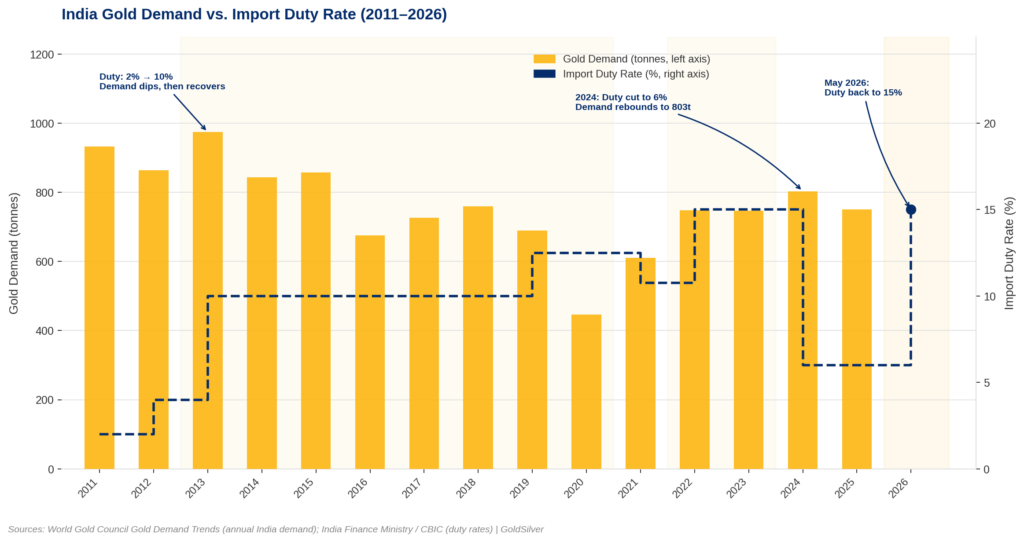
- Short-term demand will soften. But deferred demand is not destroyed demand — the same move across 2013 triggered a smuggling surge and a sharp recovery once duties eased.
- When a government taxes gold to save its currency, it is confirming that its citizens have already chosen gold over paper money. That’s the sound money thesis, not a bearish signal.
India gold import duty jumped from 6% to 15% on Wednesday — more than doubling the rate overnight. The goal: slow the outflow of dollars and stop the rupee from falling further.
On the surface, the read is bearish. The world’s second-largest gold consumer just made gold more expensive to buy.
The real read is the opposite. When a government doubles the tax on gold to defend its currency, it is confirming — in policy form — that its citizens have already chosen gold over rupees. So the duty hike is not a verdict on gold. Rather, it is a confession about the rupee.
Why Did India Raise Gold Import Duties?
India pays for oil in US dollars. The Strait of Hormuz has been disrupted since late February, and Brent crude is trading around $107 a barrel. As a result, India’s import bill has surged. Gold imports — typically 700 to 900 tonnes a year, all dollar-denominated — compete directly with oil for the same foreign exchange reserves keeping the rupee afloat.
The new India gold import duty structure: 10% basic customs duty plus a 5% Agriculture Infrastructure and Development Cess — 15% total. At today’s gold price of $4,689.74 (nFusion Solutions, 2:25 PM ET), that adds roughly $704 per ounce before dealer premiums or sales taxes.
The government had already tried persuasion. Prime Minister Modi made a voluntary appeal on May 11, asking citizens to stop buying gold for a year. Wednesday’s hike is what happens when a polite request doesn’t move the market.
The Edge Every Investor Needs Smarter precious metals investing starts here. The Nuggets Newsletter brings you essential market insights, Fed updates, global trends, educational videos, and much more.
Does a Duty Hike Actually Kill Indian Gold Demand?
Higher import costs will suppress near-term buying. Some retail purchases get delayed. Wedding-season orders get postponed. That part is not in dispute.
But India’s relationship with gold is not a trade. It is cultural, generational, and built on 5,000 years of treating gold as real money. Indeed, the precedent from 2013 is instructive. When India raised its gold import duty from 2% to 10% across that year — same crisis, same logic — official imports fell sharply. Historically, estimates suggest up to 200 tonnes moved through unofficial channels annually at the peak. When duties eased, official demand snapped back. Yet the structural bid didn’t disappear. It went underground, then came back.
Deferred demand is not destroyed demand.
What the Duty Hike Reveals About the Rupee
Every time a government raises its gold import duty to protect its currency, the same logic applies: citizens have already voted for sound money. The government’s response is to make that vote more expensive — not to fix the monetary conditions that drove the vote in the first place.
In fact, that pattern is bigger than India. According to the World Gold Council’s Q1 2026 Gold Demand Trends report, central banks globally purchased a net 244 tonnes of gold — a record $193 billion in value, up 74% year-on-year. These are sovereign treasuries acting on the same instinct as Indian households: hold gold, reduce currency exposure.
Ultimately, gold’s case doesn’t rest on India buying. It rests on governments spending beyond their means and reaching for currency controls when the bill comes due. Still, that dynamic isn’t fading. It’s spreading.
That’s not doomsday thinking. That’s 5,000 years of monetary history confirming the thesis.
Stay On Top of Gold & Silver Prices
Get important market alerts sent straight to your inbox.
SOURCES
1. India Ministry of Finance — Notification No. 16/2026-Customs, May 12, 2026
2. nFusion Solutions — Spot Price API (gold $4,689.74, silver $88.11, 2:25 PM ET, May 13, 2026)
3. U.S. Energy Information Administration — Short-Term Energy Outlook, May 12, 2026
4. World Gold Council — Gold Demand Trends Q1 2026 (central bank demand 244t; total demand value $193bn, +74% y/y)
5. World Gold Council — Gold Demand Trends: India Focus Q1 2026 (India second-largest consumer; annual import volumes)
6. Gold Demand & Supply by Country — Historical data series, World Gold Council (2013 duty cycle precedent)
Disclaimer: This article is for informational purposes only and does not constitute financial or investment advice. Always consult a qualified financial adviser before making investment decisions.
You May Also Like:
- 5 Forces Shaping Gold and Silver at the Beijing Summit
- The Real Reason Gold Falls When Inflation Surges
- CPI Hits 3.8%. Gold Falls. The Mechanism Nobody Explains
- Why the Gold Silver Ratio Is Falling — and What It Means
- What’s Moving Gold Prices This Week: CPI, Seoul & Beijing
- Silver Jumps 6% Before Trump-Xi Summit. Here’s Why
- April Jobs Beat 115K. Gold Held. The Dollar Didn’t. Here’s Why
- Jobs Beat, Ceasefire, Deficit: What It Means for Gold