Silver Rises Over 120% YTD




Published: 05-11-2026, 09:52 am | Updated: 05-12-2026, 10:22 am
Gold and silver market update — May 11, 2026
Key Takeaways
- Silver is up 6.15% today (as of Monday, May 11, 2026) at $85.36/oz while gold is up just 0.39% at $4,734 — silver outpacing gold by 16x, driven by pre-summit positioning ahead of the Trump-Xi meeting in Beijing on May 13–15
- The mechanism: roughly 60% of silver demand is industrial — solar panels, EVs, electronics, semiconductors — most of it flowing through US-China supply chains; better trade conditions are directly bullish for silver in a way they aren’t for gold
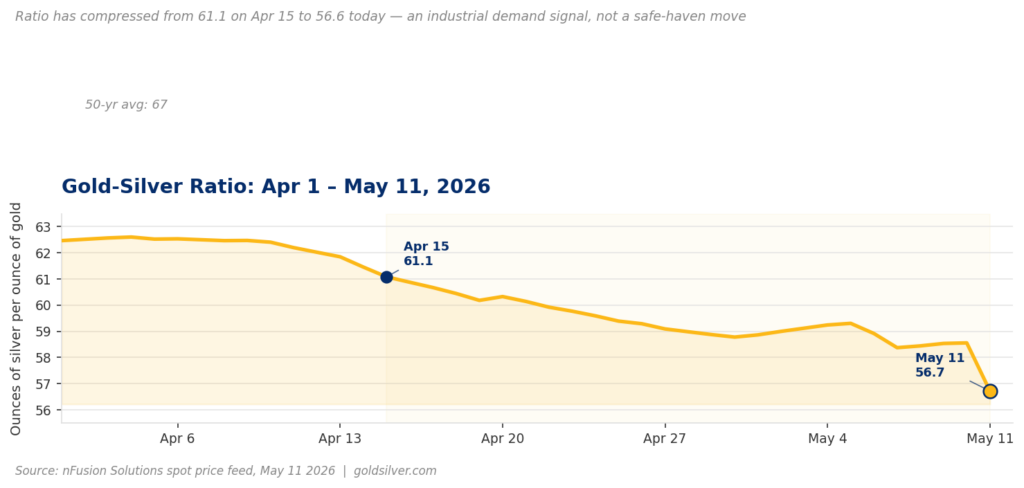
- The gold-silver ratio has compressed to 55.46 from above 61 in mid-April, confirming this is an industrial demand signal, not a safe-haven move
Silver is up 6.15% today — $85.36 per ounce — while gold is up just 0.39% at $4,734. Both metals are rising, but silver is lapping gold by a factor of 16. The reason is straightforward: on Wednesday, Trump lands in Beijing for the first US presidential visit to China in almost nine years. Markets are already pricing in what a deal could mean.
Silver is not gold. Gold responds to fear and monetary stress. Silver has a second engine. Roughly 60% of its demand comes from factories, solar farms, electric vehicles, and semiconductor fabs. Most of those run through Chinese supply chains. When US-China trade is hostile, that industrial engine stalls. When it opens back up, silver has room to run that gold simply doesn’t.
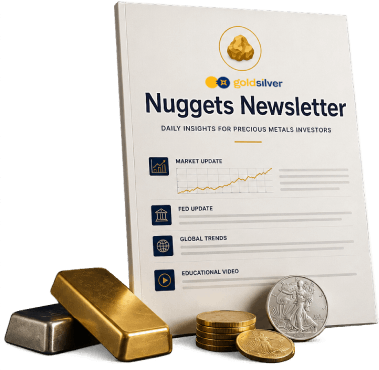
The Edge Every Investor Needs Smarter precious metals investing starts here. The Nuggets Newsletter brings you essential market insights, Fed updates, global trends, educational videos, and much more.
Why Is Silver Rising Ahead of the Beijing Summit?
Silver is rising because roughly 60% of annual demand is industrial — electronics, solar panels, EVs, and semiconductors. According to the Silver Institute’s World Silver Survey 2026, most of those supply chains run directly through US-China trade. When the trade environment between the two countries improves, manufacturers plan more production. That, in turn, lifts silver demand in a way that leaves gold largely unaffected.
For context, solar photovoltaic manufacturing alone accounted for 29% of total silver industrial demand in 2024. That is up from just 11% in 2014, per the Silver Institute and Oxford Economics. In addition, EVs, semiconductor fabs, and AI data centers are growing categories — all dependent on the same US-China supply chain the summit could stabilize.
The May 13–15 meeting is the biggest trade stabilization opportunity since November 2025, when the two sides extended their tariff truce through November 10, 2026. Markets are betting the leaders will either extend it again or announce the “Board of Trade” framework. US Trade Representative Jamieson Greer first proposed that framework in Paris this year. The Council on Foreign Relations described it as a managed trade body: roughly $30 billion in committed US product purchases, with tariff reductions in non-strategic sectors. Even a credible signal of progress would improve the manufacturing outlook — and with it, the silver demand picture.
What Does the Gold-Silver Ratio Tell Us About This Move?
As of Monday, May 11, 2026, the gold-silver ratio has fallen to 55.46 — meaning it now takes just 55.46 ounces of silver to buy one ounce of gold. Six weeks ago, that figure was above 61. The ratio has now shed more than 5% in a single session. That compression is significant.
A falling ratio can signal two things. Either investors are adding silver as a monetary hedge alongside gold, or the market expects stronger industrial demand for silver relative to gold. Today, it is clearly the latter. Gold is up less than half a percent. Silver is up more than 6%. That’s not a flight-to-safety trade — it’s a manufacturing outlook trade.
Notably, J.P. Morgan’s Global Research team has pointed out that silver’s industrial weighting makes it far more sensitive than gold to trade flows and manufacturing expectations. A summit that lifts China’s production outlook moves silver. It does not move gold the same way.
For a deeper look at what the ratio signals for long-term holders, see our analysis: The Gold-Silver Ratio Is Expanding — and Being Misread.
Which Three Summit Outcomes Matter Most for Silver?
Three agenda items have direct implications for silver’s supply chains.
Tariff trajectory. The current US-China truce expires November 10, 2026. What replaces it is unknown. However, extending or formalizing the arrangement removes uncertainty for solar, EV, and semiconductor manufacturers — the industries that consume the most silver.
Rare earth and critical mineral controls. In April and October 2025, Beijing threatened to cut off flows of rare earths and critical minerals to US companies. As a result, industrial supply chains shook across multiple sectors. Silver’s inputs sit in that same web. Any freeze or rollback of those restrictions reduces the risk premium built into industrial metals prices.
Technology sector restrictions. Semiconductors and AI hardware both use significant silver in fabrication. A framework that limits further tech sector separation between the US and China removes a tail risk that markets have quietly been pricing for months.
Isn’t This Just a Summit Bet That Could Easily Unwind?
Fair question. The honest answer is: partly yes.
The Council on Foreign Relations assessed on May 10, 2026 that China enters Beijing with structural leverage. Moreover, the most realistic outcome may be a limited truce extension, not a transformative deal. If the meeting disappoints — no tariff extension, no rare earth commitments, no new framework — silver’s 6% premium should give most of it back quickly. Buying silver ahead of a binary political event is event risk. That’s real.
However, that framing leaves out important context. Silver rose more than 130% in 2025, according to J.P. Morgan Global Research. That rally came from persistent supply deficits, record industrial consumption, and monetary debasement concerns. Furthermore, the Silver Institute projects a sixth consecutive annual supply deficit in 2026. The summit doesn’t create that story — it could accelerate it. If Beijing underwhelms, silver pulls back toward where it was. The structural case remains intact either way.
The summit is a potential accelerant, not the thesis itself.
What to Watch This Week
Wednesday–Friday, May 13–15. The key signal is any joint statement on tariff timelines, rare earth controls, or the Board of Trade framework. Silver’s 6% move today reflects strong optimism — watch whether it holds as details emerge.
The gold-silver ratio. The ratio is already at 55.46 — nearly at the 55 level flagged earlier as a conviction signal. A sustained break below 54 would confirm genuine structural repricing. Conversely, a reversal back above 58 would suggest today’s move was event-driven positioning rather than a durable shift.
Silver’s close today. Silver opened at $80.39 and has surged to $85.36. A close above $85 would be a significant session confirmation. Anything below $83, however, and today starts to look like an intraday spike that ran out of momentum into the close.
Stay On Top of Gold & Silver Prices
Get important market alerts sent straight to your inbox.
SOURCES
1. Silver Institute — World Silver Survey 2026
2. Silver Institute & Oxford Economics — Silver: The Next Generation Metal (December 2025)
3. J.P. Morgan Global Research — How Will Silver Prices Fare in 2026?
4. Council on Foreign Relations — What to Expect Ahead of Next Week’s Trump-Xi Summit (May 8, 2026)
5. Council on Foreign Relations — At the Trump-Xi Summit, China Will Have the Upper Hand (May 10, 2026)
6. nFusion Solutions — Live Spot Price Feed (May 11, 2026, 12:32 UTC)
Disclaimer: This article is for informational purposes only and does not constitute financial or investment advice. Always consult a qualified financial adviser before making investment decisions.
You May Also Like:
- April Jobs Beat 115K. Gold Held. The Dollar Didn’t. Here’s Why
- Jobs Beat, Ceasefire, Deficit: What It Means for Gold
- Gold Price Outlook: Oil Futures Disagree With Stock Markets
- Why Silver Hit $82 Today: Iran, Oil, and the Fed
- Gold Hits $4,746 as Oil Crashes. Here’s Why That’s Bullish
- Gold Price and Nonfarm Payrolls: Why the Fed Is Trapped
- Gold Is Decoupling From Geopolitics. Here’s the Proof
- The Fed Is Frozen. The Debt Is Growing. Gold Is Watching.