Silver Rises Over 120% YTD




Published: 06-01-2026, 10:12 am | Updated: 06-01-2026, 03:58 pm
In the first quarter of 2026, central banks bought a net 244 tonnes of gold — the fastest quarterly pace in over a year. For the first time, that buyer list includes Guatemala, Indonesia, Malaysia, Cambodia, Uganda, and Kenya. These countries have never bought gold before, or not in decades. Here is why that matters.
There is a list you should know about.
Not the usual one. Not China, not Poland, not the large emerging-market central banks whose accumulation since 2022 has become the most-covered story in sovereign finance. That list is important. But there is a second list. It is quietly growing alongside the first, and it tells a more striking story.
Guatemala. Indonesia. Malaysia. Cambodia. Uganda. Kenya.
These are not the institutions you typically see in a precious metals market brief. Some are buying gold for the first time in their institutional history. Others are returning after decades of absence. The World Gold Council’s Q1 2026 Gold Demand Trends report was published April 29, 2026. It shows central banks purchased a net 244 tonnes of gold in Q1 alone. That figure is +3% year-over-year and extends seventeen consecutive months of net purchases.
But Shaokai Fan, the WGC’s global head of central banks, said something in late March worth slowing down for: “A phenomenon we’ve been seeing in the last few months is new central banks, or central banks that have been inactive or absent from the gold market for a long time, entering the gold market.”
A phenomenon. That is an unusual word for a central banker to reach for.
Which Countries Are Buying Gold for the First Time in 2026?
Look at the institutions behind Q1 2026’s 244 tonnes. Poland led with 31 tonnes. That buying is part of a multi-year plan to reach 700 total. Uzbekistan added 25 tonnes. Kazakhstan added 12. Alongside those familiar accumulators sat Czech Republic, Malaysia, and Serbia — institutions ranging from modest to first-time buyers. Also among recent new entrants cited by Fan: Guatemala, Cambodia, and Indonesia. Each made a sovereign decision to hold more gold.
The Bank of Uganda commenced active buying under its domestic gold programme in March 2026. Kenya’s central bank governor publicly signalled similar intentions in early 2026. These are not copycat moves. Each institution is responding to its own reserve management calculus — and arriving at the same answer.
Here is what that answer looks like from the outside. The world’s monetary institutions are choosing to hold an asset no central bank prints. No government controls it. No sanctions regime can freeze it.
Why Are Central Banks Buying More Gold as Prices Rise?
In a normal market, rising prices slow buying. Sellers increase supply. Buyers step back and wait for a pullback.
That is not what is happening.
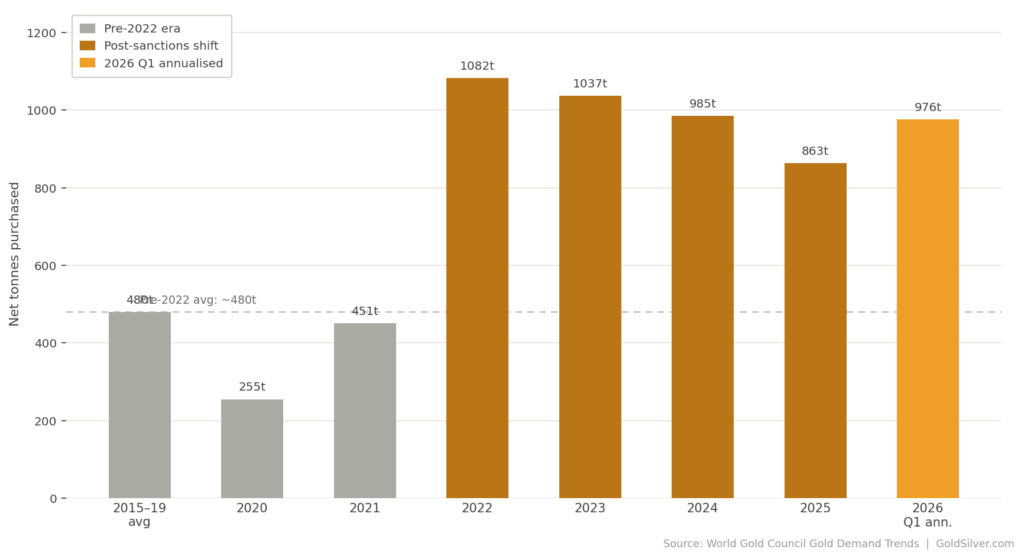
Gold peaked near $5,600 intraday in January 2026 — the highest nominal spot price in history. Central banks did not slow down. Instead, they accelerated. The five-year quarterly average for central bank gold purchases is roughly double the pre-2022 five-year average. That doubling has happened while prices also doubled.
Buying more of something as it becomes dramatically more expensive is not momentum trading. It is structural repositioning. When you are a reserve manager at a central bank, the price you pay for gold matters less than what your reserves are denominated in. The real question is whether those denominations will hold their value over a 10-to-30-year horizon.
The WGC’s 2025 Central Bank Survey found that 95% of respondents expected global official gold reserves to increase over the next 12 months. That was the highest reading in the survey’s eight-year history. Additionally, a record 43% indicated plans to increase their own holdings, up from 29% in 2024. Zero anticipated a reduction.
The Edge Every Investor Needs Smarter precious metals investing starts here. The Nuggets Newsletter brings you essential market insights, Fed updates, global trends, educational videos, and much more.
Why Did Central Banks Double Their Gold Buying After 2022?
The pre-2022 normal was roughly 400–500 tonnes of annual central bank gold buying. The post-2022 normal has been 850–900 tonnes. That shift did not happen because gold became more attractive as an investment. It happened because a geopolitical event demonstrated something that had previously been theoretical: a sovereign nation’s foreign exchange reserves could be frozen overnight.
After that event, every central bank on earth had to ask a new question. One they had never seriously confronted before: how much of our reserves are in assets that someone else controls?
Gold sits outside that question entirely. Gold sits outside that question entirely. It cannot be frozen or sanctioned. No correspondent bank in New York or London stands between you and it. No other government’s permission is required to access it.
Guatemala’s central bank buying gold for the first time is not a macro trade. It is a sovereignty decision.
What This Means for Your Allocation
The individual investor looking at this data is watching something significant. The world’s most sophisticated reserve managers are voting with their balance sheets. These institutions have access to every asset class, every financial instrument, every currency. They are still choosing gold.
The WGC’s full-year forecast for 2026 is approximately 850 tonnes of central bank purchases. That is down slightly from 2025’s 863 tonnes. Even so, it is still more than double the pre-2022 annual average. Unreported buying, tracked through flow discrepancies, points to activity even above the headline figure.
Gold is at $4,507.08 (as of June 1, 2026, approximately 12:26 UTC). The central banks buying it are not doing so for the next six months. They are doing so for the next thirty years.
That is not fear. That is financial sovereignty — expressed at the sovereign level, by the institutions that understand the monetary system from the inside. The individual investor looking at this list is not being told what to do. They are being shown what the world’s most sophisticated reserve managers are already doing.
Stay On Top of Gold & Silver Prices
Get important market alerts sent straight to your inbox.
People Also Ask
Why are new countries buying gold for the first time?
In 2022, roughly $300 billion in Russian central bank reserves were frozen overnight — demonstrating that foreign exchange reserves held in another country’s financial system can be seized. After that event, every central bank had to ask how much of its reserves were in assets someone else controls. Gold cannot be frozen, sanctioned, or accessed without the owner’s permission. For smaller economies like Guatemala, Cambodia, and Uganda, buying gold is a sovereignty decision, not a macro trade.
How much gold are central banks buying in 2026?
According to the World Gold Council’s Q1 2026 Gold Demand Trends report (published April 29, 2026), central banks purchased a net 244 tonnes in the first quarter alone — up 3% year-over-year and the fastest quarterly pace in over a year. The WGC’s full-year 2026 forecast is approximately 850 tonnes, down slightly from 2025’s 863 tonnes but still more than double the 400–500 tonne annual average recorded before 2022.
Is central bank gold buying expected to continue?
All indicators point to yes. The WGC’s 2025 Central Bank Survey found that 95% of respondents expected global official gold reserves to increase over the next 12 months — the highest reading in the survey’s eight-year history. A record 43% indicated plans to increase their own holdings, up from 29% the prior year. Zero anticipated a reduction. Central bank net purchases have now extended seventeen consecutive months, through some of the highest gold prices in history.
Which central banks bought the most gold in Q1 2026?
According to the World Gold Council, Poland led all buyers in Q1 2026 with 31 tonnes — part of a multi-year plan to reach 700 tonnes total. Uzbekistan added 25 tonnes and Kazakhstan added 12. Other buyers during the quarter included Czech Republic, Malaysia, Serbia, and China. New and returning entrants — including Guatemala, Indonesia, and Uganda — represent a broadening of the buyer base beyond the established emerging-market accumulators.
SOURCES
- World Gold Council — Gold Demand Trends Q1 2026
- World Gold Council — Gold Demand Trends Q1 2026: Central Banks
- Mining Weekly — Additional central banks to buy gold on geopolitical risks, WGC says (March 24, 2026)
- Daily Monitor — Bank of Uganda launches three-year pilot to buy domestic gold for reserves (April 21, 2026)
- CNBC — Gold nears $5,600 as safe-haven rush intensifies (January 29, 2026)
- World Gold Council — Central Bank Gold Reserves Survey 2025
- World Gold Council — Gold Demand Trends Full Year 2025: Central Banks
- World Gold Council — Central Bank Gold Statistics: Central banks stay the course on gold in February (April 2026)
Disclaimer: This article is for informational purposes only and does not constitute financial or investment advice. Always consult a qualified financial adviser before making investment decisions.
You May Also Like:
- PCE Hit 3.8%. GDP: 1.6%. Gold Went Up. Here’s the Mechanism.
- Gold Targets Are Falling. The $8,000 Forecast Isn’t.
- Gold Radar: 5 Stories the Price Chart Isn’t Telling You
- Silver Lost 3.3% While Gold Lost 1.6%. That Gap Is Not Random.
- Gold Down 1.2%, Silver Down 2.8% — The Floor Holds
- UBS Just Cut Its Gold Target by $400. The Part They Kept Is the Real Story.
- Why Gold Is Falling Today — And Why $4,500 Is Holding.
- Gold Is Down Today. Here’s Why Smart Money Is Still Buying.