Silver Rises Over 120% YTD




Published: 08-31-2026, 09:42 am | Updated: 08-31-2026, 09:57 am
The Federal Reserve just delivered its most hawkish speech in months. Gold should be falling hard. Instead, it’s down less than 1%, and silver is holding roughly flat. The market that’s supposed to fear a September rate hike doesn’t actually believe one is coming.
Gold trades near $4,440 an ounce today, down modestly from Friday’s close. Silver sits near $67, flat on a choppy session. Two forces are colliding: a fresh US military strike in the Strait of Hormuz, and a Federal Reserve rate-hike story that’s far less settled than this weekend’s headlines suggested.
What Happened Overnight in the Strait of Hormuz?
US forces struck two Iranian rocket launchers on Larak Island on August 30. The Islamic Revolutionary Guard Corps had been preparing to launch rockets carrying sea mines into the Strait of Hormuz. A US Central Command spokesperson called it the first direct US strike on Iranian positions in over a month. Iran’s Revolutionary Guards acknowledged the strike and retaliated overnight, striking US-linked bases in Jordan and the UAE and claiming to down a US drone over the strait. Oil jumped in response. West Texas Intermediate crude rose roughly 1.3% to 2%, since the strait normally carries about a fifth of the world’s oil.
The Edge Every Investor Needs Smarter precious metals investing starts here. The Nuggets Newsletter brings you essential market insights, Fed updates, global trends, educational videos, and much more.
Why Isn’t Gold Rallying on a Fresh Middle East Strike?
A shock like this usually pulls buyers into gold as a store of value. But a bigger force is pulling the other way: rising odds of a Fed rate hike. A hike raises the cost of holding an asset that pays no yield. When two forces point in opposite directions, the net price move shows which force is winning today, not which one matters more over time. Right now, the Fed-odds story is winning.
That story starts with Fed Chair Kevin Warsh’s Jackson Hole speech last Friday. He called inflation “more concerning” than the labor market, pointing to headline Personal Consumption Expenditures inflation, the Fed’s preferred gauge, at 3.7% against the 2% target. Markets called Warsh’s Jackson Hole remarks hawkish. But how hawkish, exactly? That’s the part most coverage got wrong.
How Confident Is the Market That the Fed Will Actually Hike?
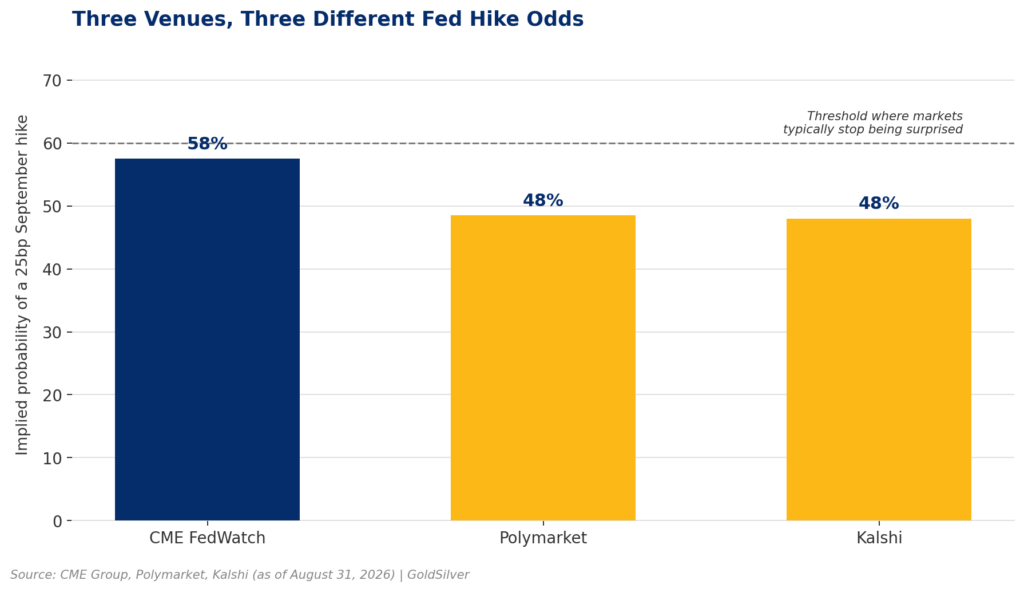
Less confident than the headlines suggest. CME’s FedWatch tool converts fed funds futures into implied probabilities. It shows a 57% to 58% chance of a 25-basis-point September hike, up sharply from roughly 40% before Warsh spoke. That’s a real jump. But it sits far below the 90%-plus reading markets usually treat as a done deal.
The gap widens on prediction markets. Polymarket prices the same hike at roughly 48% to 49%. Kalshi shows nearly identical numbers: 52% for a hold versus 48% for a hike. Three venues offer three readings of the same event. None of them describe a market that has made up its mind.
Jim Bianco, founder of Bianco Research, put it bluntly on social media: “The next Fed meeting is a lean hike not a done deal.” ABN AMRO Investment Solutions and Brandywine Global Investment Management have voiced similar skepticism, part of a pattern this week in which the Fed’s own hike numbers disagree with each other depending on venue and time horizon.
If a Hike Happens, Would It Even Be Bad for Gold?
Robin Brooks disagrees with the simple read. He’s a senior fellow at the Brookings Institution and a former chief economist at the Institute of International Finance. Brooks argues a hike would mostly anchor the 10-year Treasury yield and restore Fed credibility. It would not, in his view, genuinely tighten policy. He points to the bond sell-off after the July 29 meeting as the real trigger, calling the potential move performative: a Fed that keeps financial conditions loose while looking tough on paper.
That distinction matters for savers. Financial repression happens when a central bank holds rates below what real inflation control requires. It quietly erodes purchasing power, even while policy looks strict on the surface. If Brooks is right, a hike would work as theater for the bond market, not a real exit from that environment. The Fed’s dual mandate explains why this ambiguity exists. A central bank juggling price stability and jobs rarely delivers a hike that means only one thing.
What Does This Mean for Gold and Silver Investors?
The deeper story isn’t the Hormuz strike, and it isn’t Warsh’s speech either. Warsh was only one of several signals moving gold and silver this week. The market genuinely doesn’t know what a September hike would signal. That uncertainty tells you more than any single headline. A hike priced as a credibility move rather than real tightening leaves the underlying debasement dynamic fully intact: inflation stuck above target, paired with a Fed managing optics as much as substance. That’s the environment sound money investors have been positioning for, no matter which way one month’s rate decision breaks.
Watch two dates closely. Friday, September 4 brings the August jobs report, the next data point that could swing these odds before the Federal Open Market Committee meets on September 16. Also watch how the Fed frames any hike in its statement. Language about anchoring yields reads very differently from language about genuinely cooling demand, even when the headline decision looks identical.
Stay On Top of Gold & Silver Prices
Get important market alerts sent straight to your inbox.
SOURCES
1. CoinDesk — “Bitcoin and gold may have room to surge further as September Fed rate-hike fears look overblown,” August 31, 2026
2. CoinDesk — “Bitcoin barely blinks, XRP drops as U.S. strikes Iran and oil rallies,” August 31, 2026
3. Associated Press via NBC News — “U.S. forces strike Iranian rocket launchers on the Strait of Hormuz in first military action in weeks,” August 30, 2026
4. CNBC — “September Fed decision is now a coin flip as rate hike odds increase post Warsh,” August 28, 2026
5. Bitcoin.com News — “Fedwatch Turns Hawkish With 57% Odds of September Rate Increase,” August 30, 2026
6. Robin Brooks (Brookings Institution) — “Will a September hike hurt gold?”
7. CME Group — FedWatch Tool, September 2026 FOMC meeting probabilities
Disclaimer: This article is for informational purposes only and does not constitute investment advice. Past performance is not indicative of future results. Always consult a qualified financial advisor before making investment decisions.
You May Also Like:
- Gold and Silver Sink as Warsh Cites AI Boom to Justify More Fed Tightening
- Five Things Moved Gold and Silver This Week. Only One Was Kevin Warsh.
- The Treasury’s Next Move Isn’t a Rate Cut. It’s a $967 Billion Checking Account.
- Six Paper Claims, One Ounce of Silver: What First Notice Day Reveals
- Five Gold Signals Fired This Week. None of Them Are About Today’s Price.
- Gold Fell 9% the Last Time Warsh Spoke. He’s Back Tomorrow.
- Gold Ran Past Wall Street’s Own Price Targets. Four Banks Disagree on What Happens Next.