Silver Rises Over 120% YTD




Published: 09-09-2026, 09:59 am
Gold exchange-traded funds pulled in roughly $2 billion over the past week. Silver’s largest ETF gave money back. Both moves happened while gold’s own price ticked slightly lower. Silver held its ground better. That split is worth explaining. It runs against the simple story most investors tell themselves about precious metals.
What Do This Week’s Gold and Silver ETF Flows Actually Show?
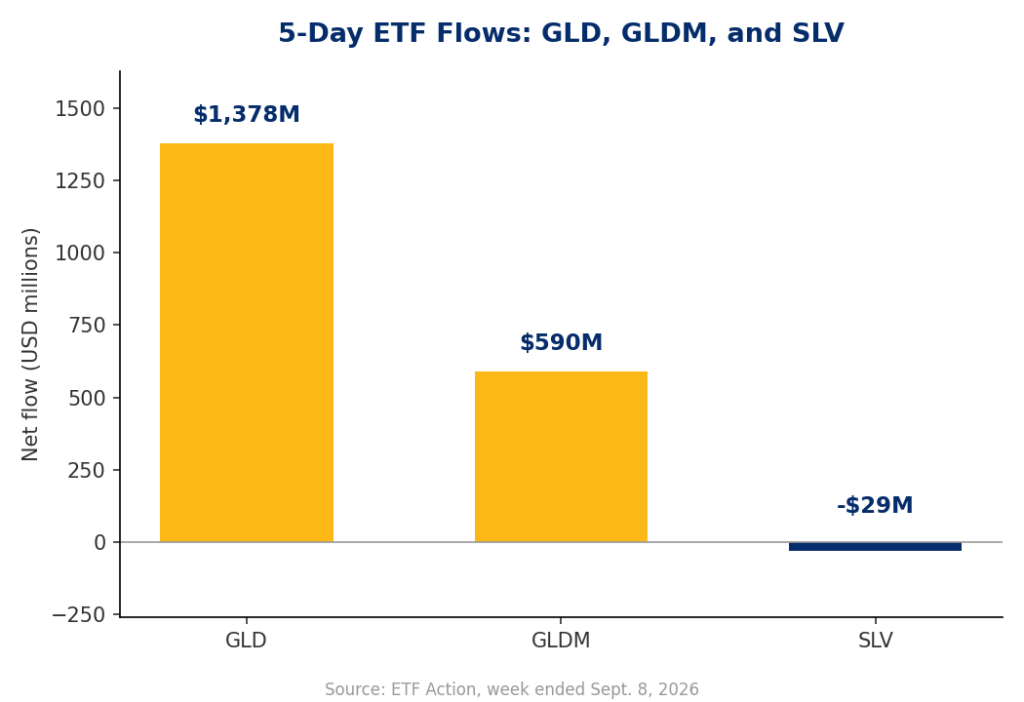
SPDR Gold Shares (GLD) is the largest gold ETF in the world. It took in $1,378 million over five trading days this week [Source: ETF Action, Sept. 8, 2026]. Its smaller sibling, SPDR Gold MiniShares (GLDM), added another $590 million. Together, SPDR’s two gold funds pulled in nearly $2 billion. That is 93.9% of the $2,101 million that flowed into the entire Focused-Precious Metals ETF category that week, the group GLD, GLDM, and SLV belong to.
Silver told a different story. The iShares Silver Trust (SLV) is the largest silver ETF. It recorded a $29 million outflow over the same five days [Source: ETF Action, Sept. 8, 2026]. That is small next to GLD’s haul. But the direction matters: investors were net sellers of the silver vehicle in a week when gold’s vehicles saw some of their strongest buying in months.
The Edge Every Investor Needs Smarter precious metals investing starts here. The Nuggets Newsletter brings you essential market insights, Fed updates, global trends, educational videos, and much more.
Why Does It Matter That Gold Rose in Flows While Its Price Fell?
Here is the part that breaks the simple narrative. The Focused-Precious Metals ETF category holds GLD, GLDM, SLV, and 15 other funds worth $309.73 billion combined. That category actually lost 0.49% in price the same week [Source: ETF Action, Sept. 8, 2026]. The money moving into gold ETFs was not chasing a rally. It was buying into a flat-to-slightly-lower tape.
That distinction matters. When price climbs and money arrives too, the flow could just be momentum trading. When price is soft and money still comes in, that looks more like conviction. Investors were adding a position because they believe the thesis, not because they were chasing a rising chart.
Is a Silver ETF Outflow Actually Bearish for Silver?
Not by itself, and not at this size. A $29 million move in SLV is small next to the fund’s assets. One week of flow data is a data point, not a trend. Silver has also outperformed gold recently, so a pause in ETF buying after a strong run is ordinary, not a reversal signal.
What the split does show is simple: silver and gold are being treated differently by paper investors right now, even though the two metals often move together. Gold’s ETF buyers added exposure into weakness. Silver’s holders trimmed into relative strength. Scale matters too. Gold ETFs still represent only about 0.20% of US financial portfolios, per Goldman Sachs’s most recent available estimate [Source: Goldman Sachs, via ETF Database, March 2026]. A $2 billion week is real money. But it is a shift at the margin, not proof that a new wave of capital just discovered gold.
Does a Week of ETF Flows Predict Where Gold or Silver Go Next?
Not reliably. ETF flows are short-duration decisions. An investor can create or redeem shares in a single session on a headline or a rebalancing rule. Central bank gold buying runs on the opposite timescale. It reflects long-duration reserve policy that rarely reverses on one disappointing data print. That is exactly why it acts as a structural demand floor rather than a sentiment gauge. This week’s GLD/SLV split belongs in the first category. It is real and worth noting. It is not a signal that settles direction.
What Is the Difference Between Owning a Gold ETF and Owning Physical Gold?
This is worth spelling out. ETF flow numbers get treated as gold demand. They are close, but not identical.
GLD and GLDM hold physical gold bullion in vaults. Each share represents a claim on a slice of that gold held by the trust. When money “flows into” GLD, an authorized participant delivers gold, or cash used to buy gold, to the trust for new shares. That is a real transaction. But the buyer owns a security backed by gold, not a specific bar available for delivery under normal circumstances. It is convenient gold price exposure in a brokerage account. It is not the same as allocated bullion held in your own name.
That distinction is why this week’s data rewards a close read. Gold’s paper buyers adding conviction into a soft tape says something real about sentiment among investors comfortable with fund-share exposure. It says nothing about what buyers who want to hold metal directly are doing. It is not a verdict on where either metal’s price goes next. It is one clear, well-sourced signal about how two groups of ETF investors behaved in the same five-day window. Nothing more, nothing less.
Stay On Top of Gold & Silver Prices
Get important market alerts sent straight to your inbox.
SOURCES
1. ETF Action — Gold ETFs Shine with Over $2.1B in Weekly Inflows Amid Mixed Commodity Performance
2. ETF Database, citing Goldman Sachs — After the 2025 Gold Rush: What’s Next for ETFs?
3. GoldSilver — Live Gold and Silver Spot Prices
Disclaimer: This article is for informational purposes only and does not constitute investment advice. Past performance is not indicative of future results. Always consult a qualified financial advisor before making investment decisions.
You May Also Like:
- Gold/Silver Ratio September 2026: What a 12-Week Round Trip Is Telling Holders
- Gold Is Falling Today. Four Other Signals Say the Hard-Assets Trade Isn’t.
- Gold Is Falling for a Reason Most Investors Have Backwards
- Even Central Banks Don’t Trust Someone Else’s Vault Anymore
- Gold’s Dip Below $4,400 Didn’t Scare Wall Street. Here’s Why.
- China Just Broke Its Own Gold-Buying Record. Then Broke It Again.
- The BLS Revised April Up 64,000, Then Down 31,000. Gold Traded the First Print.