Silver Rises Over 120% YTD


Published: 11-23-2026, 03:18 pm

Last verified November 2026.
Gold as emergency fund savings means holding gold, not cash, as your reserve for unplanned costs. Those costs include a job loss, a medical bill or a car repair.
Gold as emergency fund money works poorly as a first line. It works better as a second layer behind cash. Gold trades deeply, with about $361 billion changing hands daily in 2025 [World Gold Council, April 16, 2026]. Its price, however, fell 8.9% in a single week in November 2026 [World Gold Council, November 23, 2026].
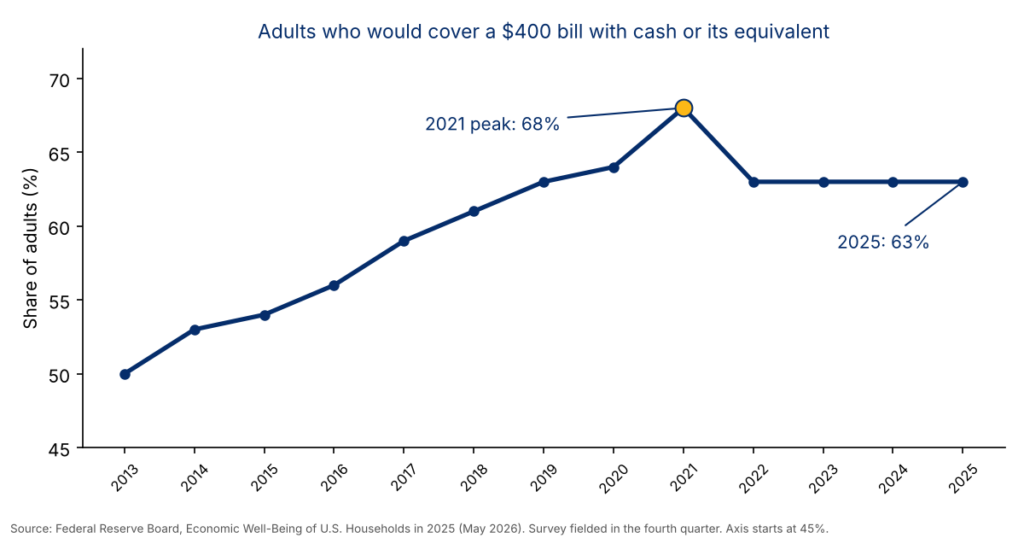
The Federal Reserve’s 2025 household survey found that 63% of US adults would cover an unexpected $400 bill with cash or its equivalent [Federal Reserve Board, May 2026]. The Consumer Financial Protection Bureau (CFPB) says an emergency fund should be safe, accessible and out of reach of casual spending [CFPB, October 29, 2025]. Gold meets the last test but strains the first two. Dealers also buy it back below spot [CFTC and FINRA, March 20, 2024]. As a result, gold suits a long-term reserve better than the first dollars of a safety net.
Key Takeaways:
- Gold trades deeply but not steadily. It fell 8.9% in the week ending November 20, 2026 [World Gold Council, November 23, 2026]. That was its steepest weekly drop since March [ING Think, November 20, 2026].
- Market liquidity differs from retail liquidity. A dealer always buys back below spot, and each dealer sets its own spread [CFTC and FINRA, March 20, 2024].
- The IRS taxes long-term gains on gold coins at up to 28%, and net losses deduct only up to $3,000 a year [IRS, November 9, 2026].
- Cash in an insured bank account carries FDIC protection up to $250,000 per depositor, per bank, per ownership category. Gold is not a deposit, so that protection does not apply [FDIC, April 1, 2024].
What Does an Emergency Fund Need to Do?
It needs to turn into spendable money quickly, at a value you can predict. The CFPB defines an emergency fund as a cash reserve set aside for unplanned expenses [CFPB, October 29, 2025]. Car repairs, medical bills and a loss of income are its examples. The agency adds that the fund should be safe, accessible and hard to spend on everyday wants [CFPB, October 29, 2025].
Many households fall short of that standard. The Federal Reserve Board’s Survey of Household Economics and Decisionmaking (SHED) found that 63% of adults would cover a $400 bill with cash or its equivalent in 2025 [Federal Reserve Board, May 2026]. That share peaked at 68% in 2021. Meanwhile, only 55% of adults said they had set aside three months of expenses [Federal Reserve Board, May 2026].
Why does this matter for gold? Another 7% of all adults said they would sell something to cover that bill [Federal Reserve Board, May 2026]. A working emergency fund removes that step.

The Edge Every Investor Needs Smarter precious metals investing starts here. The Nuggets Newsletter brings you essential market insights, Fed updates, global trends, educational videos, and much more.
What Are the Pros of Using Gold as Emergency Fund Savings?
Gold has real strengths, and they explain its appeal. First, the market is deep. The World Gold Council (WGC) reports that gold trading averaged about $361 billion a day in 2025 [World Gold Council, April 16, 2026]. Volume hit a record in the last week of January 2026, when prices pulled back. The WGC adds that investors sold gold in the 2008 and 2020 sell-offs to meet cash needs, and that gold recovered once those squeezes passed [World Gold Council, April 16, 2026].
Second, physical gold carries no issuer. A bank deposit is a claim on a bank. A coin or bar in your possession is not another party’s liability.
Third, gold has rewarded holders in some stretches. The LBMA Gold Price rose about 63% from January 2 to December 31, 2025 [LBMA, January 7, 2026]. That gain came with a catch, covered next. A fair counterargument also deserves attention. Standard insurance on bank deposits stops at $250,000 per depositor, per bank, per ownership category [FDIC, April 1, 2024]. Savers with balances above that limit may want a store of value outside one institution.
What Are the Cons of Gold as Emergency Fund Savings?
The biggest con is price risk. An emergency fund must hold its value on the day you need it, and gold makes no such promise. The LBMA Gold Price PM fell 9.6% in the week to March 20, 2026, its steepest weekly drop in more than a decade [World Gold Council, March 23, 2026]. Then spot gold fell 8.9% in the week to November 20 [World Gold Council, November 23, 2026]. It closed that week near $3,538 an ounce, and you can follow the live number on the gold price chart.
Price risk gets worse when it overlaps with your own need. After the November drop, the WGC said gold, as a highly liquid asset, appeared to be caught in a broad reduction of risk [World Gold Council, November 23, 2026]. ING commodities strategist Ewa Manthey added that the equity sell-off may have pushed some investors to sell gold to raise cash [ING Think, November 20, 2026]. So a job loss, a falling stock market and a falling gold price may arrive together.
Other costs add up. Gold pays no yield, and higher rate expectations reduced its appeal in November [ING Think, November 20, 2026]. Gold is also not a deposit, so FDIC insurance does not apply to it. Moreover, the CFPB warns that cash kept at home can be stolen, lost or destroyed [CFPB, October 29, 2025]. Home-stored gold faces the same risks. Finally, coins and bars come in fixed sizes, so a small bill may force you to sell more than you need.
Is Gold as Emergency Fund Money Liquid Enough?
Gold is liquid in the market sense but costly in the retail sense. Market liquidity measures how easily the world trades gold. Retail liquidity measures what you net when you sell your own coins. The two differ, and the gap is where the surprises live.
The market side looks strong. Even so, the WGC notes that wholesale bid-ask spreads have risen since 2024, though the widening was short-lived and mostly outside standard trading hours [World Gold Council, April 16, 2026]. The retail side carries a built-in cost. The Commodity Futures Trading Commission (CFTC) and the Financial Industry Regulatory Authority (FINRA) explain that a dealer always sells above the spot price and buys back below it [CFTC and FINRA, March 20, 2024]. Each dealer sets its own spread, so the same coin can fetch different bids. To see how this works in practice, read about how bid-ask spreads work.
Product choice matters too. The same bulletin says collectible-style “semi-numismatic” coins are likely harder to sell than plain bullion [CFTC and FINRA, March 20, 2024]. It also tells buyers to ask for the dealer’s buy-back price before purchase. Vault-stored gold follows a different path, and the guide on what happens when you sell vault-stored gold explains it.
What Does Selling Gold in a Hurry Really Cost?
Consider an illustration, not a forecast. Suppose a household holds $30,000 of gold at spot and spends $5,000 a month on essentials. Then gold falls 9% in a week, close to its 8.9% drop in November 2026. The holding is now worth $27,300 at spot. Next, assume the dealer’s bid sits 3% below spot. That figure is an assumption, because each dealer sets its own spread. The household nets about $26,481.
Here is the comparison in plain terms. The gold reserve starts at $30,000, falls to $27,300 after the price drop and nets $26,481 after the dealer discount. That covers about 5.3 months of essentials. A $30,000 cash reserve stays at $30,000 and covers all six months.
So the six-month buffer has shrunk to about 5.3 months before any tax. Insured cash does not shrink this way. Gold can also rise before you sell. However, an emergency fund should not depend on that outcome.
How Is Gold Taxed When You Sell It for Cash?
The Internal Revenue Service (IRS) taxes net capital gains from collectibles, such as coins, at a maximum rate of 28% [IRS, November 9, 2026]. Short-term gains face ordinary income rates, and a separate net investment income tax may apply to high earners [IRS, November 9, 2026]. Physically backed gold ETFs structured as trusts also fall under the collectibles rule [CNBC, March 14, 2022].
Losses work more slowly. The IRS limits the net loss you can deduct against other income to $3,000 in a year [IRS, November 9, 2026]. The rest carries forward. As a result, a forced sale after a rally can create a tax bill, while a forced sale after a drop may deliver only a slow deduction. For the details, see the explainer on the 28% collectibles rule.
Why Can a Liquid Asset Still Be a Poor Emergency Fund?
The surface take says gold is the most liquid asset you can own, so gold as emergency fund money must work. That take is incomplete. A deep market tells you the world can absorb a sale. It does not tell you the price you will receive.
The deeper dynamic runs the other way. Because gold trades so easily, investors reach for it when they need cash elsewhere. The November episode fits that pattern, according to the WGC and ING. Your need and the market’s need can peak together. The WGC argues gold recovered after earlier squeezes. Recovery only helps if you can wait to sell.
That points to a clear division of labor. Cash handles certainty, and gold handles endurance. Cash answers the question of what you can spend next week. Gold is meant to answer a different question, about what may hold value across decades.
Where Does Gold as Emergency Fund Money Fit in Your Planning?
Layer one is insured cash that covers your essential costs for a period you choose. The CFPB says the right amount depends on your situation [CFPB, October 29, 2025]. The Fed tracks three months of expenses as one common measure of resilience [Federal Reserve Board, May 2026].
Next comes every other source you could tap, and each has a price. For instance, 14% of non-retirees borrowed from, cashed out or reduced contributions to retirement accounts in the prior 12 months [Federal Reserve Board, May 2026]. Layer three is your long-term reserve. Gold can sit here when you hold it for reasons beyond a short-term need.
Three questions test whether a gold holding belongs in the emergency layer:
- Could you wait out a 10% drop before selling?
- Do you know your dealer’s written buy-back price today?
- Have you planned for the tax bill a sale could create?
If any answer is no, the gold likely belongs in the third layer.
Stay On Top of Gold & Silver Prices
Get important market alerts sent straight to your inbox.
People Also Ask
An emergency fund is a cash reserve set aside for unplanned expenses, such as car repairs, medical bills or a loss of income [CFPB, October 29, 2025]. The CFPB says the money should be safe, accessible and kept away from routine spending. In 2025, 55% of US adults said they had three months of expenses saved [Federal Reserve Board, May 2026].
Cash fits the job better because it holds a stable value and moves quickly. Gold offers a deep market and no issuer, but its price fell 8.9% in one week in November 2026 [World Gold Council, November 23, 2026]. Dealers also buy gold below spot [CFTC and FINRA, March 20, 2024].
Get written quotes first. The CFTC and FINRA advise getting all fees, costs and the retail price in writing, asking for the dealer’s buy-back price, and ignoring cold calls [CFTC and FINRA, March 20, 2024]. Compare each bid with the current spot price. Then confirm how and when the dealer pays before you hand anything over.
Three costs matter. The dealer’s spread is the first, because dealers buy below spot [CFTC and FINRA, March 20, 2024]. Tax is the second, with long-term gains on coins taxed at up to 28% [IRS, November 9, 2026]. Price movement is the third. A 9% weekly drop, like the one in November 2026, can cut a reserve before you sell.
No single number fits everyone. The CFPB says the amount depends on your situation [CFPB, October 29, 2025]. The Federal Reserve uses three months of expenses as one common measure of resilience, and 55% of adults met it in 2025 [Federal Reserve Board, May 2026].
You lock in the lower price, and the dealer discount applies on top of it. In the earlier illustration, a $30,000 reserve netted about $26,481. If you hold other cash, you can wait for a recovery. If you do not, the sale may be your only option. Net losses also deduct slowly, at $3,000 a year against other income [IRS, November 9, 2026].
What Is the Bottom Line on Gold as Emergency Fund Savings?
Gold can earn a place in a household’s finances without leading its defense. An emergency fund exists to deliver certainty, and gold exists to endure. Treat gold as emergency fund money only after your cash layer is full and you accept the price risk.
SOURCES
1. Federal Reserve Board — Economic Well-Being of U.S. Households in 2025: Savings and Investments
2. Consumer Financial Protection Bureau — An Essential Guide to Building an Emergency Fund
3. FDIC — Understanding Deposit Insurance
4. Internal Revenue Service — Topic No. 409, Capital Gains and Losses
5. CFTC and FINRA — 10 Things to Ask Before Buying Physical Gold, Silver, or Other Metals
6. World Gold Council — You Asked, We Answered: Has Gold’s Performance Structurally Changed?
7. World Gold Council — Weekly Markets Monitor: Testing Gold’s Resolve
8. World Gold Council — Weekly Markets Monitor: A(I) Reckoning
9. ING Think — Metals Sell-Off Runs Ahead of Physical Markets
10. LBMA — Precious Metals Market Report: Q4 and Full Year 2025
11. CNBC — Gold, Silver ETF Owners Face 28% Top Tax Rate on Profits
Disclaimer: This article is for informational purposes only and does not constitute investment advice. Past performance is not indicative of future results. Always consult a qualified financial advisor before making investment decisions.
You May Also Like:
- Gold Price Outlook November 2026: Yields, Fed and Floors
- Gold to Copper Ratio: Does It Predict Gold or Yields?
- Gold in Retirement: Can It Reduce Sequence Risk?
- Gold and Silver Outlook 2027: Forecasts and Risks
- Gold Vault Storage: Inside a Brink’s Vault
- What Backs the US Dollar Today?
- Silver Price Outlook October 2026: Fed Hold Is Locked