Silver Rises Over 120% YTD


Published: 10-28-2026, 05:28 pm
Nothing redeems a dollar for gold anymore. What actually backs it is a combination of law, taxing power, and global demand. The United States ended the gold-backed dollar in 1971. Since then, a Federal Reserve note has drawn its value from three things: government legal authority, the capacity to tax and borrow, and the world’s continued willingness to hold dollars.
That answer raises more questions than it settles. If gold no longer stands behind the currency, what does? Is any part of the old system still in place? And can the arrangement change again? This piece answers each question directly, with the specific numbers behind it.
What Did the Dollar Used to Be Backed By?
From 1944 to 1971, the dollar was pegged to gold at $35 per ounce under the Bretton Woods system. As a result, foreign governments could exchange their dollar reserves for US gold at that fixed rate. Domestically, Americans had already lost the right to redeem currency for gold decades earlier, in 1933. So Bretton Woods preserved a narrower promise: one made only to other governments, not to individual citizens.
That promise depended on one simple condition. The United States had to hold enough gold to honor every claim against it. By the late 1960s, foreign dollar claims had grown far larger than the US gold stockpile backing them. The arithmetic no longer worked.
The Knowledge That Changes Everything
Two essential guides — yours free. Understand why gold matters and why fiat currencies always fail.
What Changed on August 15, 1971?
On that date, President Nixon suspended the dollar’s convertibility into gold. Analysts now call the move the Nixon Shock. Officials framed it as temporary. It was never reversed.
Even so, two years later, Congress fixed a new official gold price for the Treasury’s own books: $42.2222 per ounce. That price has not moved since 1973, while the market price climbed far beyond it. Keep that number in mind, because it is the clearest illustration of how the old system and the new one now sit side by side.
So What Backs the Dollar Now?
Look at a Federal Reserve note and part of the answer is printed right on it: “This note is legal tender for all debts, public and private.” That exact phrasing dates to the original 19th-century Legal Tender Acts and is still printed on every bill by convention. Nothing about gold. Nothing about silver. The modern codified version of the law, at 31 U.S. Code Section 5103, says much the same thing in updated language: US currency is legal tender for all debts, public charges, taxes, and dues.
Three forces combine to give that statement real weight.
First of all, the law itself. Legal tender status means courts and contracts must treat dollars as valid payment. That is a government guarantee, not a market one.
Second, there is the government’s taxing power. The United States can compel tax payments in dollars across a population of more than 340 million people. Its economy generates more than $31 trillion in annual output. Economists call that combined capacity “full faith and credit”. In short, it is a claim on future government revenue, not a claim on a vault of metal.
Third, and just as important, there is global demand. Even without gold behind it, the dollar remains the currency most governments choose to hold. That demand is not automatic, though, and it is worth examining on its own.
Does the Treasury Still Hold Any Gold?
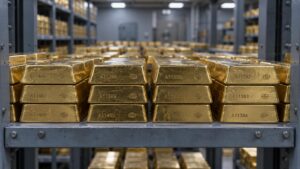
Yes, and this is where the old system and the new one collide on the same balance sheet. The US Treasury owns 8,133.5 tonnes of gold. That is about 261.5 million troy ounces, making the Treasury the largest sovereign gold holder in the world. Under federal law, the Treasury still carries that gold at the frozen 1973 price of $42.2222 per ounce.
For instance, run the math and the gap is stark. At the statutory price, the Treasury’s gold is worth about $11 billion. At the market price in late 2026, the same physical metal is worth more than $1 trillion. In other words, the gold did not change. The official number describing it simply stopped moving in 1973.
Instead, the Federal Reserve inherits the same quirk from a different angle. The Fed holds no gold directly. It holds gold certificates issued by the Treasury, and the law values those certificates at that identical frozen price. So even the institution that manages the dollar’s supply carries a 53-year-old price tag on the one asset still tied to the old monetary order.
Why Does the World Still Use Dollars If Nothing Backs Them?
Because usefulness, not metal, is what makes a currency durable in practice. Oil contracts, trade invoices, and the bulk of global bank lending are priced in dollars. By contrast, central banks hold dollar reserves for a practical reason: dollar assets, above all US Treasury securities, are liquid and widely accepted. They also sit inside deep, predictable capital markets.
That demand shows up directly in reserve data. The dollar made up 56.70% of the world’s allocated foreign exchange reserves as of the second quarter of 2026. That figure comes from the International Monetary Fund’s Currency Composition of Official Foreign Exchange Reserves report. Total global reserves stood at $13.22 trillion at the same point. No other single currency comes close; the euro, the next largest, holds roughly a fifth of that total.
Is the Dollar’s Reserve Status Guaranteed to Last?
No, and the IMF’s own numbers show real movement, not just stability. The dollar’s reserve share has slipped from around 71% near 1999 and 2000 to 56.70% today. That works out to a decline of roughly 14 percentage points over a quarter-century. Central banks drove it by diversifying into euros, gold, and a handful of smaller currencies.
That said, context matters here, and it cuts both ways. A 14-point decline over 25 years is a measurable trend, not a sudden break. Even now, the dollar still holds nearly three times the reserve share of its nearest competitor. Reserve status built on decades of deep capital markets does not unwind quickly. Notably, the IMF’s own analysis attributes part of this quarter’s move to currency valuation effects rather than active reallocation by central banks. The honest reading, then, is a slow structural shift rather than a crisis.
What Would It Take to Change What Backs the Dollar?
Any return to a commodity-backed dollar would require an act of Congress. That is because the legal authority over currency, and the statutory gold price itself, both sit in federal statute rather than executive discretion. Instead, change happens gradually. It comes through the reserve decisions central banks make every quarter, and through the fiscal choices that shape how cheaply the United States can borrow.
What Does This Mean for an Investor Holding Gold or Silver?
The frozen $42.2222 figure is a small, verifiable example of a much larger pattern. Official accounting and market reality can drift apart for decades before anyone reconciles them. GoldSilver’s history of the end of the gold standard explains how that gap first opened in 1971. The fuller case for why a legal-tender currency can lose purchasing power over time is covered separately.
Even so, none of this means the dollar’s current arrangement is fragile or close to failing. The data above shows a currency with real, if slowly eroding, dominance. It does mean something more specific, though: “full faith and credit” is an examinable claim, not a vague reassurance. Gold’s role in the system did not disappear in 1971 so much as move, from the currency itself onto the Treasury’s own balance sheet, at a price nobody has bothered to update in over 50 years. Readers weighing how much to hold in dollar-denominated assets versus physical metal can use that distinction, rather than a slogan, to make the call. A side-by-side look at gold against fiat currency over the past five decades walks through the purchasing-power comparison in full.
Stay On Top of Gold & Silver Prices
Get important market alerts sent straight to your inbox.
People Also Ask
No. The dollar has not been backed by gold since August 15, 1971, when the United States ended dollar-gold convertibility under Bretton Woods.
Federal law that establishes it as legal tender, the US government’s taxing and borrowing capacity, and sustained global demand for dollar-denominated assets.
Yes. The Treasury holds 8,133.5 tonnes of gold. However, it values that gold on its books at a fixed 1973 price of $42.2222 per ounce, not the current market price.
56.70% of global allocated foreign exchange reserves, as of the second quarter of 2026. That is down from about 71% in 1999–2000.
SOURCES
1. Federal Reserve History — Gold Convertibility Ends
2. Cornell Law School, Legal Information Institute — 31 U.S. Code § 5103, Legal Tender
3. Cornell Law School, Legal Information Institute — 31 U.S. Code § 5116, Buying and Selling Gold and Silver
4. Cornell Law School, Legal Information Institute — 31 U.S. Code § 5117, Transferring Gold and Gold Certificates
5. U.S. Department of the Treasury, Fiscal Data — Status Report of U.S. Treasury-Owned Gold
6. Federal Reserve Bank of New York — Fedpoint: Gold Certificates
7. Federal Reserve Bank of St. Louis — What Gives Money Its Value?
8. International Monetary Fund — Currency Composition of Official Foreign Exchange Reserves (COFER) Data Brief, September 30, 2026
Disclaimer: This article is for informational purposes only and does not constitute investment advice. Past performance is not indicative of future results. Always consult a qualified financial advisor before making investment decisions.
You May Also Like:
- Silver Price Outlook October 2026: Fed Hold Is Locked
- Gold Price Outlook October 2026: Pullback & Fed Decision
- Long-Term Gold Ownership: The Case for Holding Gold
- How Higher Silver Prices Can Create a Cash-Flow Squeeze for Recyclers
- Why Are Central Banks Buying So Much Gold in 2026?
- Proof Gold Coins: Same Gold, So Why the Bigger Price?
- Silver Fell Harder Than Gold in September. The Solar Thrifting Story Isn’t Why.
- K-Shaped Economy: Why Asset Owners Win and Wage Earners Don’t