Silver Rises Over 120% YTD




Published: 09-17-2026, 12:58 pm
Key Takeaways
- Junk silver refers to circulated U.S. dimes, quarters, and half dollars struck in 90% silver before 1965, not to low-quality coins.
- The U.S. Mint guarantees a fixed silver content: $1 in face value of 90% coins holds approximately 0.715 troy ounces of pure silver, regardless of denomination mix.
- The Coinage Act of 1965 removed silver from dimes and quarters because the metal’s market value had risen above the coins’ face value.
- Junk silver trades at lower premiums than minted bullion because it carries no collector value and needs no assay to verify.
- A $1,000 face-value bag weighs about 55 pounds, which makes storage a real practical consideration for any meaningful position.
Junk silver is the nickname for ordinary, circulated U.S. dimes, quarters, and half dollars minted in 1964 or earlier. Back then, the U.S. Mint struck them from 90% silver and 10% copper. The coins carry no collector premium. “Junk” refers to their condition, not their metal. So they trade close to melt value: roughly 0.715 troy ounces of pure silver for every $1 in face value.
What Is Junk Silver?
Junk silver is a nickname, not an insult. It refers to common, well-worn U.S. coins struck before 1965 that happen to contain real silver. That’s different from rare or graded coins, which carry a numismatic premium above their metal content. Calling a coin “junk” just means it has no collector value beyond its silver. That is exactly what makes it useful. Buyers pay for the silver, not the coin’s rarity or condition. Pricing stays simple and transparent as a result.
The category includes Mercury dimes (1916 to 1945), Roosevelt dimes (1946 to 1964), and Washington quarters (1932 to 1964). It also includes Walking Liberty, Franklin, and 1964 Kennedy half dollars. All were struck in a 90% silver, 10% copper alloy [US Mint]. The U.S. government minted these coins by the billions for decades. So they remain widely available today. They’re also easy to recognize and easy to verify without special equipment.
The Knowledge That Changes Everything
Two essential guides — yours free. Understand why gold matters and why fiat currencies always fail.
Which Coins Actually Count as Junk Silver?
Not every old-looking coin qualifies. The cutoff dates matter more than the coin’s appearance. Three categories carry real silver content:
- 90% silver (the core category): Dimes, quarters, and half dollars dated 1964 or earlier.
- 40% silver: Kennedy half dollars struck from 1965 through 1970, after the Coinage Act of 1965 reduced (rather than eliminated) the half dollar’s silver content. A small run of special 1976 Bicentennial half dollars and Eisenhower dollars was also 40% silver, struck only at the San Francisco Mint for collectors. This is a narrow exception. The roughly 521 million ordinary 1976 Bicentennial half dollars and dollars struck for circulation at Philadelphia and Denver are copper-nickel clad with no silver at all. So most Bicentennial coins someone finds in change or a coin jar do not qualify.
- 35% silver (“war nickels”): Jefferson nickels struck from 1942 through 1945. You can spot them by the large mint mark placed above Monticello on the reverse.
Everything dated 1965 or later in the standard dime and quarter series is copper-nickel clad. It contains no silver at all, despite looking nearly identical at a glance. That single date, 1965, separates a coin with real bullion value from one worth only its face value.
How Much Silver Is in a Junk Silver Coin?
Each 90% silver coin carries a fixed, mint-guaranteed amount of pure silver [US Mint]:
- Dime: approximately 0.0723 troy ounces
- Quarter: approximately 0.1808 troy ounces
- Half dollar: approximately 0.3617 troy ounces
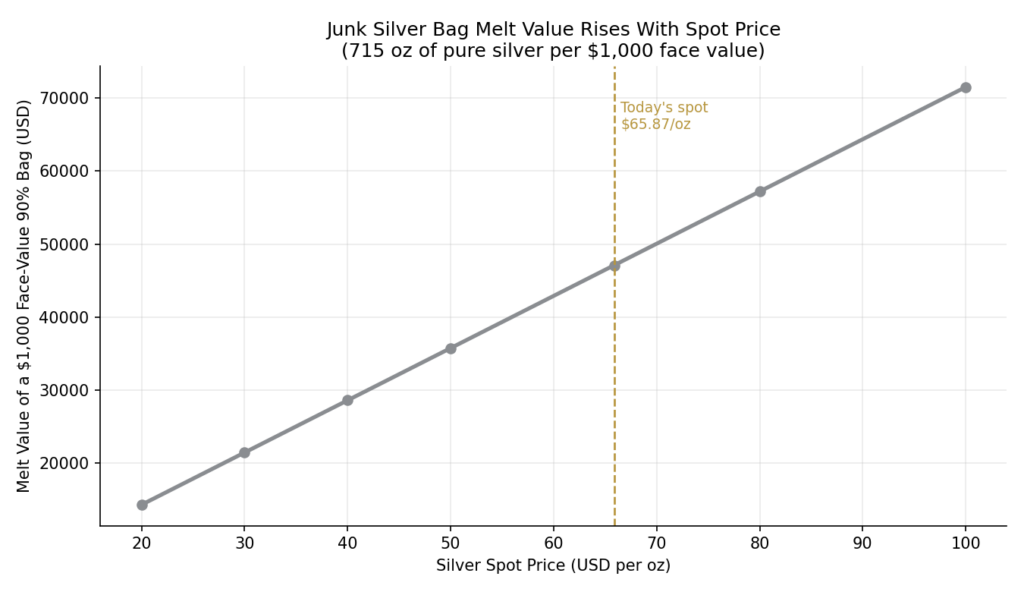
One number ties them all together, and it’s worth memorizing. $1 in face value of 90% silver coins contains approximately 0.715 troy ounces of pure silver. That holds true whether the dollar is made up of dimes, quarters, or half dollars. This constant is what makes junk silver simple to price. A $1,000 face-value bag, the standard trading unit, contains roughly 715 troy ounces of pure silver.
Here is what that means at different silver prices, using the standard 715-ounce-per-$1,000 conversion. At $30 an ounce, a $1,000 face-value bag is worth $21,450. At $50 an ounce, it’s worth $35,750. At today’s spot price of $65.78 an ounce [CME], it’s worth $47,032. At $80 an ounce, it climbs to $57,200, and at $100 an ounce, it reaches $71,500.
Why Did the U.S. Government Remove Silver From Coins?
The short answer: silver became worth more as metal than the coins were worth as money. Industrial and monetary demand for silver rose through the early 1960s. That pushed the metal’s market price toward, and eventually past, the value implied by the coins’ face value at the government’s fixed exchange rate [US Mint]. Melting down a handful of dimes could then produce silver worth more than the dimes’ face value. That created a structural problem for the U.S. Mint. Coins were disappearing from circulation into scrap and hoards faster than the Mint could strike replacements.
Congress addressed this directly. President Lyndon B. Johnson signed the Coinage Act of 1965 (Public Law 89-81) on July 23, 1965. It eliminated silver from the dime and quarter. It also reduced the half dollar’s silver content from 90% to 40% [US Mint]. A follow-up law, the Bank Holding Company Act Amendments of 1970, was signed on December 31, 1970. It removed the half dollar’s remaining silver starting with coins struck in 1971. From that point forward, U.S. circulating coins were struck from a copper-nickel clad sandwich with no silver value at all. That same composition is still used today. It’s also the same monetary pattern that repeats throughout history: whenever a currency’s metal content becomes worth more than its stamped value, the sound money gets pulled from circulation, and the debased version stays behind.
How Is Junk Silver Priced and Traded?
Junk silver typically changes hands in $1,000 face-value bags. Many dealers also offer half-bags, quarter-bags, and smaller increments for buyers who want a lower entry point. A full $1,000 bag weighs about 55 pounds. It can be made up of any mix of dimes, quarters, and half dollars, since the melt-value math works out the same regardless of denomination.
Junk silver carries no collector premium to price in. Verifying a genuine, worn 1964 quarter also takes no special equipment or assay. Because of that, it tends to trade at a lower markup over spot than newly minted silver rounds or bars. That lower friction is a large part of its appeal to buyers who want physical silver without paying extra for a mint mark or a design. The tradeoff runs the other way for anyone who values uniform weight and easy stacking. A bag of mixed, worn coins is bulkier and less standardized than the same dollar amount in bars or one-ounce rounds.
Is Junk Silver a Good Way to Own Physical Silver?
Junk silver earns a place in a physical silver allocation for reasons that have nothing to do with speculation. It is instantly recognizable to almost any American, and that supports liquidity. A coin dealer, pawn shop, or refiner does not need to test or assay a pre-1965 quarter the way it might a private mint’s bar. Junk silver is also naturally divisible. A single dime holds a known, tiny amount of silver. That makes junk silver one of the few silver products genuinely practical for small transactions, unlike a 100-ounce bar that has to be sold or bartered as a single unit.
The honest tradeoffs are weight and bulk. A meaningful position in junk silver weighs and stores less efficiently, ounce for ounce, than the same value in bars. That’s because coins are stamped in an alloy that’s only 90% silver, and because the coins carry dead weight in copper. A buyer trying to store a specific number of ounces in the smallest possible space will usually find bars or rounds more efficient.
What About Taxes and Reporting on Junk Silver Sales?
Selling silver, including junk silver, for a profit generally creates a capital gain. The seller is responsible for reporting that gain on their own tax return, regardless of whether a dealer sends any paperwork. Dealers themselves also have separate reporting obligations to the IRS in certain cases. The IRS updated its instructions for Form 1099-B in early 2026. The update clarified that a precious metals sale is only reportable by the dealer when the product and quantity match a form the Commodity Futures Trading Commission has approved for regulated futures trading [IRS.gov]. Industry practice has long treated a single transaction of more than $1,000 in face value of 90% silver coins as meeting that threshold, since it corresponds to the standard CFTC-linked bag size.
None of this is tax advice. The exact mechanics can turn on details specific to a given transaction. Anyone selling a meaningful amount of junk silver should confirm current reporting rules with a qualified tax professional rather than relying on a dealer’s informal summary.
Where and How Do You Store Junk Silver?
Junk silver’s main practical drawback shows up at the storage stage, not the buying stage. A $1,000 face-value bag weighs roughly 55 pounds. A position large enough to matter for wealth preservation adds up in both weight and physical space faster than the same dollar value in bars would. That makes secure storage a genuine, practical consideration rather than an afterthought. Options range from a home safe rated for the weight, to a bank safe deposit box, to a dedicated storage and vaulting service built for holding physical bullion outside the banking system. Anyone building a meaningful junk silver position should plan for where it will live, and how it will be verified and insured, before accumulating more than a small starter amount.
Stay On Top of Gold & Silver Prices
Get important market alerts sent straight to your inbox.
People Also Ask
No. “Junk” refers to the coins’ worn condition and lack of collector value, not the silver itself. The silver content is exactly as real, and exactly as pure, as silver in a bar or round of the same fineness.
Check the date first. Dimes and quarters dated 1964 or earlier are 90% silver. 1965 or later means copper-nickel clad with no silver. Genuine silver coins also show a visible band of silver on the edge, rather than the copper stripe visible on a clad coin’s edge. They also ring with a longer, higher-pitched tone when tapped.
A standard bag has a face value of $1,000 in dimes, quarters, or half dollars. It weighs approximately 55 pounds. Smaller bags, such as $500, $250, or $100 face value, are widely available for buyers who want a smaller starting position.
Morgan dollars (struck 1878 to 1904 and again in 1921) and Peace dollars (struck 1921 to 1928 and 1934 to 1935) are 90% silver. But they usually carry meaningful numismatic premiums above melt value because of their history and collector demand. Most dealers and buyers treat them as a separate category from the small-denomination junk silver coins covered here. They also contain more silver per dollar of face value than dimes, quarters, and half dollars do. So the 0.715-ounce-per-dollar constant above does not apply to them.
Yes. Every 90% silver dime, quarter, and half dollar remains legal tender at its original face value. Nobody spends them at face value today, since the silver content is worth far more than the printed denomination, but the coins never lost their legal status.
Some sellers use “constitutional silver” as a more polished alternative name for the same coins. The term refers to the U.S. Constitution’s original monetary framework, in which only gold and silver could serve as legal tender. Both names describe the identical pre-1965 90% silver coins.
SOURCES
1. U.S. Mint — Timeline of the U.S. Mint
2. U.S. Mint — One Hundred Years of Silver Dollar Coinage (1878-1978)
3. U.S. Mint — First Striking of New Half Dollars
4. Internal Revenue Service — Correction to the 2025 and 2026 Instructions for Form 1099-B
5. CME Group — Silver Price Reference
Disclaimer: This article is for informational purposes only and does not constitute investment advice. Past performance is not indicative of future results. Always consult a qualified financial advisor before making investment decisions.
You May Also Like:
- Why Is Silver Demand Tied to AI Data Centers?
- The Copper Mine That Isn’t Trying to Mine Silver Just Explained the Whole Deficit
- Inherited Gold IRA: Beneficiary Rules & the Step-Up Basis Gap
- The Cantillon Effect: Why Money Printing Makes Some People Rich First
- Silver Price Outlook September 2026: The Hike Is Priced In. The Positioning Isn’t.
- Gold Is About to Face Its First Rate Hike of the Cycle. Here’s Why It Isn’t Scared.
- How Much Gold Should You Own at 25, 45, or 65?