Silver Rises Over 120% YTD




Published: 08-18-2026, 10:05 am
Key Takeaways:
- The July 29 FOMC vote was 9 to 3. Hammack (Cleveland), Kashkari (Minneapolis), and Logan (Dallas) all preferred a rate hike — the most divided hawkish dissent since September 2016.
- The FOMC minutes drop tomorrow, August 19 at 2:00 p.m. ET. Watch for how explicitly the three dissenters framed their case and whether any majority members signaled sympathy.
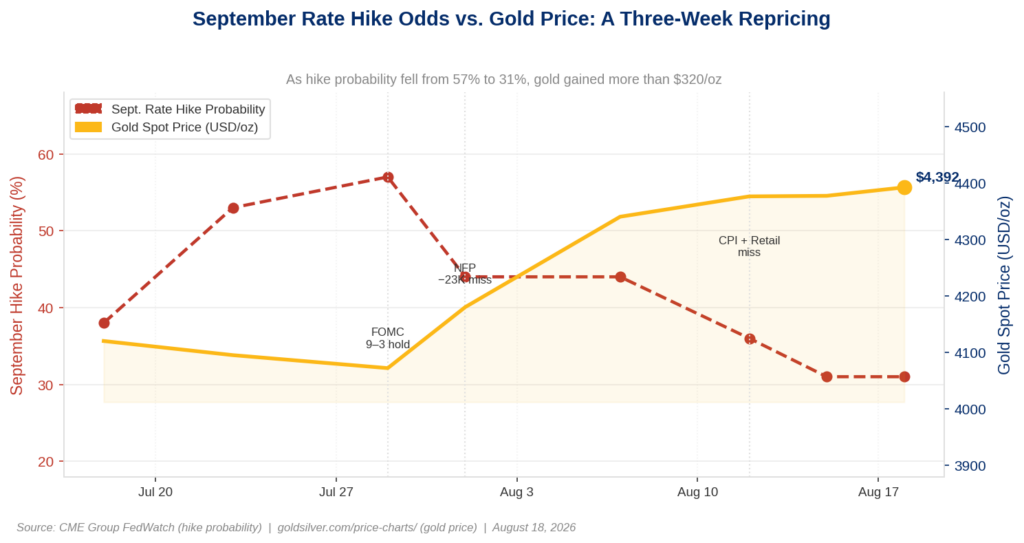
- September hike odds have fallen from 57% to roughly one-in-three since the FOMC decision, driven by three consecutive data misses: a July payrolls contraction of 23,000 jobs, soft CPI, and weak retail sales.
- Gold has gained more than $320 since the post-FOMC low — a move driven by the paper market repricing rate expectations, not by any change in the structural case for physical metal.
- Fed Chair Warsh’s first Jackson Hole keynote on August 28 is the bigger event — 19 days before the September 16 FOMC decision, it is the only official window into his policy framework before September.
At the Federal Reserve’s July 29 meeting, the vote to hold interest rates steady was 9 to 3. That is the most divided hawkish dissent the committee has produced since September 2016.
The three officials who voted against the hold were Cleveland Fed President Beth Hammack, Minneapolis Fed President Neel Kashkari, and Dallas Fed President Lorie Logan. Each formally preferred a quarter-point rate increase. Fed Chair Kevin Warsh — who has abandoned the Fed’s tradition of forward guidance — described the internal deliberations as a “good family fight.”
The minutes from that meeting are released tomorrow, Wednesday August 19, at 2:00 p.m. ET. Before they do, here is what those three votes actually reveal.
The Edge Every Investor Needs Smarter precious metals investing starts here. The Nuggets Newsletter brings you essential market insights, Fed updates, global trends, educational videos, and much more.
What Do Three Fed Dissents Actually Signal?
A single dissent at an FOMC meeting is routine. Two is notable. Three, all pointing in the same direction, is the Fed’s highest internal alarm signal short of an actual hike.
Think of it this way: the committee voted to do nothing. However, exactly 25% of the voting members thought that was wrong. That is not a consensus hold. That is a majority that held the line — barely — against a determined minority.
So the question the minutes must answer is not whether the dissenters disagreed. It is how far their case actually got. Were the nine who voted to hold doing so with conviction, or with reluctance? Did Warsh have to work to keep the majority together?
The specific language matters more than the headline verdict. How dissenters framed their objections — and whether the majority shows any drift toward their view — is what sets the real tone for September.
Why Did September Hike Odds Collapse — and What Does It Mean for Gold?
Since the July 29 meeting, three consecutive data releases have dismantled the case for a September hike:
- July nonfarm payrolls: down 23,000 jobs against a consensus of positive 80,000 — the first monthly contraction in years [Bureau of Labor Statistics, August 7, 2026]
- July CPI: 0.1% monthly, 3.4% annually, core at 2.5% — below estimates
- July retail sales: down 0.6% against an expected gain of 0.1%
As a result, September hike probability has fallen from roughly 57% on the day of the FOMC decision to roughly one-in-three today [CME FedWatch, August 17, 2026]. Meanwhile, gold has moved the other direction. From near $4,072 at the post-FOMC low, spot gold has climbed to $4,392 — a gain of more than $320 in three weeks.
The mechanism is worth understanding clearly, because the news coverage rarely explains it. Paper gold — futures contracts and ETFs — is priced partly on opportunity cost. When a risk-free Treasury yields 4.63%, holding a non-yielding asset like gold carries a real cost. When the probability of that yield going higher in September falls from 57% to 31%, that cost calculation shifts. Futures traders adjust. Gold moves up. If you want to understand the broader yield curve dynamic driving this move, our recent piece on what an inverted yield curve means for gold prices walks through the full mechanism.
Importantly, that mechanism does not affect the structural case for physical metal. Physical gold held outside the financial system has no yield to compare against. Its thesis is monetary debasement and purchasing power preservation on a multi-year timeline. That thesis does not move with every CME FedWatch tick. For more on how the September data chain reshuffled the rate math, see our earlier breakdown of the Fed’s September math.
What Should Gold Investors Watch in Tomorrow’s Minutes?
Five specific signals in the minutes matter more than the overall tone:
- How dissenters framed their case. Did Hammack, Kashkari, and Logan anchor their arguments to energy-driven inflation — the Hormuz risk — or to core inflation persistence? The former weakens if oil stabilizes. The latter is stickier and harder for the majority to dismiss.
- Governor Waller’s language. Waller voted to hold but has publicly flagged inflation concern. If the minutes show he came close to dissenting, that matters significantly for September.
- Any reference to “a range of views” in the majority. FOMC minutes signal internal drift through careful phrase choice. A majority described as “generally comfortable” holding is meaningfully different from one described as “watching incoming data closely.”
- The energy inflation framing. Iran talks have stalled and the Strait of Hormuz risk remains live. If the committee was already factoring renewed energy price pressure in July, that hawkish tail has not disappeared. It is simply waiting on an oil price.
- What is absent. Warsh has removed forward guidance from Fed communications entirely. Therefore, the absence of any language about the rate path — no “maintaining the current stance,” no “appropriate to proceed carefully” — is itself a signal. Silence from a Fed Chair who chooses silence deliberately is worth reading carefully.
Why Does Jackson Hole Matter More Than These Minutes?
There is useful historical context here. The last time three officials dissented in the same direction at an FOMC, the eventual outcome matched the dissenters: in September 2016, the committee held, three dissented for a hike, and rates went up in December. History does not repeat directly, but the pattern is worth knowing.
For gold investors, however, the more consequential event is not tomorrow’s minutes. It is Warsh’s first Jackson Hole Economic Policy Symposium keynote on Friday, August 28 — ten days from now and 19 days before the September 16 FOMC decision. We covered what Warsh is likely to signal and why it could move gold more than any single data print in our Jackson Hole preview.
Warsh has shown no interest in telegraphing policy before acting. That makes Jackson Hole the only official window into his thinking before September. Ben Bernanke used his first Jackson Hole as a watershed moment to signal QE2. Jerome Powell’s 2022 Jackson Hole speech delivered one of the sharpest hawkish pivots in modern Fed history. Warsh’s first keynote carries similar weight of expectation.
There are two scenarios gold investors should understand. First, if Warsh signals that the Fed needs sustained progress on core inflation before changing stance, September becomes a genuine hold and the current repricing holds. Second, if he signals concern about the Hormuz situation and energy prices, September becomes live again. In that case, the data arriving before September 16 carries significant weight: the August jobs report is scheduled for September 4 [Bureau of Labor Statistics], and August CPI follows on September 10.
In other words, the minutes tomorrow are one data point. Jackson Hole is the whole picture.
What Does Not Change?
The strongest near-term bear case for gold is straightforward: the August jobs report or CPI comes in hot, September hike odds reverse sharply, real yields climb, and paper gold sells off. That is a genuine possibility — not a warning, just an honest acknowledgment of the risk.
What remains constant through that scenario is the reason to hold physical gold in the first place. A 25-basis-point hike into supply-side inflation driven by a Middle East oil shock is not a monetary solution to a supply problem. Furthermore, the structural forces behind monetary debasement run on a timeline measured in years, not rate decisions. The federal government’s trillion-dollar annual interest expense, the Federal Reserve’s accumulated deferred asset of approximately $243 billion [Federal Reserve financial statements, Q3 2025], and the dollar’s long-term decline as a share of global reserves — none of those are resolved by a single FOMC vote.
Stay On Top of Gold & Silver Prices
Get important market alerts sent straight to your inbox.
SOURCES
1. Bureau of Labor Statistics — The Employment Situation, July 2026 (August 7, 2026)
2. CME Group — FedWatch Tool: Federal Funds Rate Probabilities (August 17, 2026)
3. Federal Reserve — Annual Report: Financial Statements, Q3 2025
4. GoldSilver — Gold and Silver Spot Price Charts (August 18, 2026)
Disclaimer: This article is for informational purposes only and does not constitute investment advice. Past performance is not indicative of future results. Always consult a qualified financial advisor before making investment decisions.
You May Also Like:
- Why Is Gold Not Going Up? The Bears Vanished in June
- JP Morgan Just Flagged a Silver Demand Warning. Silver Rose Anyway. Here Is Why
- Gold Needed One Thing to Break $4,400. It Just Got Five of Them.
- Zero Tankers Crossed Hormuz on Sunday. Oil Hit $89. Gold Barely Moved.
- Gold Rebounds to $4,392 as Sentiment Crashes to 51 and Inflation Expectations Rise
- Gold Price and the September Fed Pivot: Five Data Prints Rewrote the Odds This Week