Silver Rises Over 120% YTD




Published: 10-01-2026, 09:39 am
On Wednesday, the Federal Reserve’s favorite inflation gauge came in soft. Gold spiked on the news. By Thursday morning, it had given the entire move back, and then some. The reason is a number almost nobody outside a trading desk noticed.
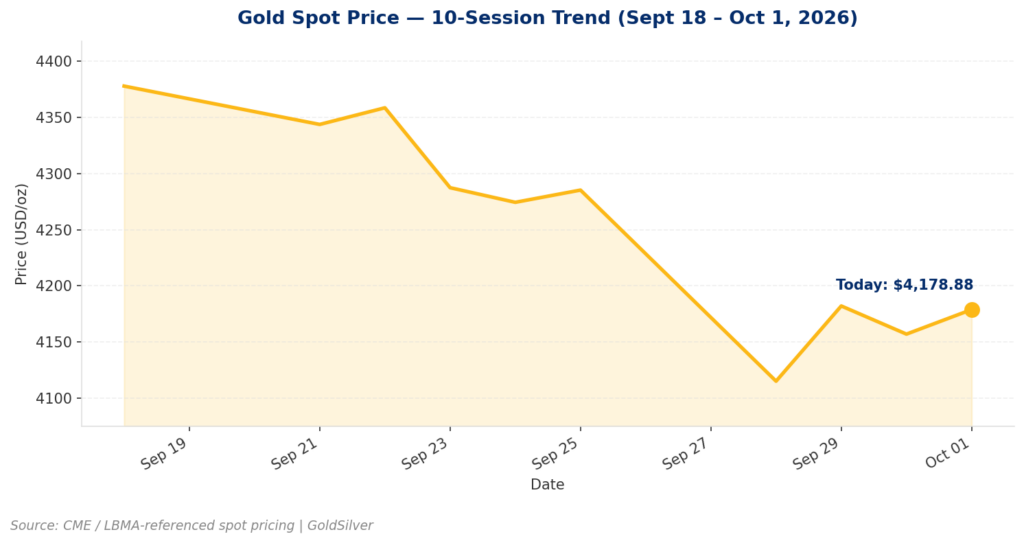
Gold is trading near $4,178.88 an ounce this morning. That’s a partial recovery after a round trip. The metal spiked toward $4,220 on Wednesday afternoon, right after the inflation data landed. It then reversed hard to roughly $4,139 during Thursday’s Asian session, before stabilizing. Silver is holding near $61.13, broadly flat on the week. Both metals are digesting one release that pulled the Fed’s next move in two directions.
Why Did a Softer Inflation Print Fail to Keep Gold’s Rally Going?
The U.S. Bureau of Economic Analysis reported Wednesday that core PCE, the Fed’s preferred inflation measure, rose 3.0% year-over-year in August. That matched July’s downwardly revised rate and missed the 3.3% consensus forecast. Headline PCE, which includes food and energy, told a similar story: up 3.4% against a 3.7% forecast. A softer-than-expected inflation print should keep a gold rally going, because it lowers the cost of holding a metal that pays no yield. That’s what happened within minutes, when gold jumped toward $4,220.
It didn’t hold. As we covered in that same morning’s muted reaction to the ADP and PCE data, gold’s response to this data cycle was never cleanly bullish. The reason the spike reversed is simple: the same 8:30 a.m. release also carried an upward revision to second-quarter GDP growth, from 1.5% to 2.2% annualized. Societe Generale economist Jan Groen captured the tension well. He noted the inflation revisions were “modestly favorable.” But he said the growth revisions mattered more. The economy entered the second half of 2026 with more momentum than traders had priced in.
Here is why that swings gold. A dovish inflation surprise lowers the opportunity cost of holding a non-yielding asset. That’s because it raises the odds the Fed holds or cuts rates. That keeps real yields, the return on cash after inflation, from climbing further. An upside growth surprise does the opposite: it tells the Fed the economy can absorb tighter policy without breaking, so a hike stays on the table. Both signals came from the same report. Growth won the argument.
The Edge Every Investor Needs Smarter precious metals investing starts here. The Nuggets Newsletter brings you essential market insights, Fed updates, global trends, educational videos, and much more.
What Is the Fed Actually Pricing Right Now?
The reaction was sharp. CME Group’s FedWatch tool showed October hike odds fall from roughly 51% the prior session to about 38% once the release was digested. Goldman Sachs pushed its own forecast for the Fed’s next hike from October to December the same day, citing the softer print. But the hike didn’t disappear. It just moved later. FedWatch still shows better than an 85% cumulative probability of a hike by year-end, since traders now expect it in December instead. Groen’s note concluded a pause in October remains possible, but a hike stays on the table pending September’s CPI and PPI data.
This is the mechanism every gold investor should keep fluent. It explains why the metal can spike on a seemingly bullish headline and still finish the week lower. Gold is priced off the real-yield channel, the gap between nominal rates and expected inflation. When that gap narrows, gold gets cheaper to hold. When it widens, gold gets more expensive to hold.
What’s the Real Story Behind This Week’s Price Action?
The deeper story this week is not the inflation miss. It is that growth data, not inflation data, is now the swing factor. That’s a reversal from 2022 and 2023, when nearly every hot CPI print moved the metal on its own. The shift matters: a soft patch in upcoming growth data, not simply a soft CPI print, would most reliably put a floor under gold from here.
Silver tells the same story. It showed the same real-yield sensitivity in its sharper September pullback. Both metals are tracking the rate-path mechanism now, not the safe-haven narratives getting more attention elsewhere today. One line on the geopolitical backdrop, for completeness: the unresolved US-Iran standoff has added a modest, separate dollar tailwind in recent weeks, but that predates this week and is not what moved gold on Wednesday. The growth-versus-inflation tug-of-war was.
What Should Investors Watch Next?
The next test arrives quickly. Weekly jobless claims land at 8:30 a.m. Eastern today, followed by the final September Manufacturing PMI at 9:45 a.m. Fed Governor Christopher Waller speaks and the ISM Manufacturing PMI lands at 10 a.m. September’s nonfarm payrolls report arrives Friday. Until then, the question isn’t whether inflation runs hot or cold. It’s whether growth keeps surprising to the upside. For now, gold near $4,178.88 says the market is still deciding, with a December hike now doing the work an October one was supposed to do.
Stay On Top of Gold & Silver Prices
Get important market alerts sent straight to your inbox.
SOURCES
1. U.S. Bureau of Economic Analysis, Personal Consumption Expenditures Price Index release (core and headline, August 2026 data), as reported by FXStreet, Oct 1, 2026 and Invezz, Sep 30, 2026
2. U.S. Bureau of Economic Analysis, Q2 2026 GDP revision (1.5% to 2.2% annualized), as reported by FXStreet, Oct 1, 2026
3. Societe Generale (Jan Groen), client research note on August PCE and Q2 GDP revisions, as quoted in FXStreet, Oct 1, 2026
4. CME Group, FedWatch Tool, Fed rate-hike probability (October-specific and year-end cumulative), as reported by Reuters via U.S. News, Oct 1, 2026
5. FXStreet, “News tsunami continues,” today’s U.S. economic calendar, Oct 1, 2026
Disclaimer: This article is for informational purposes only and does not constitute investment advice. Past performance is not indicative of future results. Always consult a qualified financial advisor before making investment decisions.
You May Also Like:
- BlackRock Called It a Supercycle Today. The Mines and Vaults Already Agree.
- Gold Jumps as Core PCE Cools More Than Expected, Overshadowing the ADP Jobs Beat
- Job Openings Missed Today. That’s Exactly Why Gold Caught a Bid.
- Gold Fell Again. Five Wall Street Desks Can’t Agree on Why.
- Gold Just Hit a Two-Month Low. Yields, Not Iran, Are Why.
- Gold’s 7-Week Low: What the Chart Says Happens Next
- Gold Sank 4% Today. Five Other Signals Point to a Steadier Market Underneath.
- Gold Fields’ $27 Billion Bid Got Rejected. The Reason Is a Risk Bullion Doesn’t Carry.
- Gold Falls 3% as Hormuz Standoff Lifts Fed Hike Odds to 66%