Silver Rises Over 120% YTD




If it feels harder to get ahead — even on a six-figure income — you’re not imagining it.
In a recent episode of The GoldSilver Show, Mike Maloney and Alan Hibbard unpack an investigative report that leads to a startling conclusion: in today’s economy, the real poverty line may be closer to $140,000 a year.
Not because people are spending recklessly. But because the cost of participation in modern life has quietly exploded — while the benchmarks used to measure hardship are still stuck in the 1960s.
The Broken Promise Behind the Frustration
The anger people feel today isn’t really about “stuff.” It’s about a breach of contract.
For generations, the American deal was simple: put in the effort, and you’d earn stability and security. Today, that relationship is breaking down. Effort no longer guarantees progress — it often brings more risk, exhaustion, and debt.
Mike uses a powerful analogy: imagine you’re drowning, and the lifeguard throws a life vest to someone next to you who isn’t swimming as hard. You don’t feel relief — you feel rage. Not at the person, but at the system.
That’s what’s happening to the middle class. Survival increasingly requires being poor enough to qualify for aid, or wealthy enough to ignore the cost. Everyone in between gets squeezed.

Get Expert Insights from Alan Hibbard Learn from Alan Hibbard, a trusted voice in precious metals delivering clear, actionable analysis on gold, silver and the global economy.
Why the Official Poverty Line Is Way Off
The modern poverty line is still based on a formula created in 1963. Back then, families spent about one‑third of their income on food. So economists took the cost of a basic food budget and multiplied it by three.
That logic hasn’t changed — but the world has.
Today, food is just 5–7% of household spending. Meanwhile:
- Housing can consume 35–45% of income
- Healthcare runs 15–25%
- Childcare alone can reach 20–40%
When you update the math using today’s spending reality, the multiplier isn’t three anymore — it’s closer to five or even six. That pushes the true poverty threshold for a family of four into the $130,000–$150,000 range.
Which explains why so many families earning $80,000 or $100,000 still feel like they’re barely treading water.
The Real Cost of “Just Existing”
The investigation Mike and Alan review doesn’t look at luxury. It looks at what the author calls the cost of participation — the bare minimum required to hold a job and raise a family.
No vacations. No streaming services. No extras.
Just housing, transportation, healthcare, childcare, food, and taxes.
When you add it up, a conservative estimate shows a family of four needs roughly $118,000 after tax just to break even. Include taxes, and the gross income required jumps to about $136,000.
This reframing matters. We’re not talking about cost of living — we’re talking about the cost of existing in modern society.
Why CPI Misses the Real Story — and Gold Doesn’t
One reason this squeeze feels invisible is because CPI doesn’t track it well. Housing costs, healthcare, and other essentials have risen far faster than official inflation metrics admit.
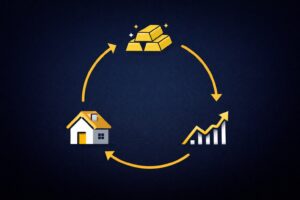
Mike points out something even more revealing: when you measure many of these costs in gold, not dollars, they actually fall over time.
That’s why gold matters in this conversation. It exposes what currency‑based measurements hide — and why so many people feel like they’re running harder just to stay in place.
The Takeaway
If you’re feeling stretched, frustrated, or confused about why your income doesn’t seem to go as far as it should, this isn’t a personal failure. It’s a systemic one.
The benchmarks are broken. The math has changed. And understanding that is the first step toward protecting yourself.
Investing in Physical Metals Made Easy

People Also Ask
What is the real poverty line in the U.S. today?
The official U.S. poverty line is based on a formula from 1963 and severely understates today’s costs. When updated for modern expenses like housing, healthcare, childcare, and taxes, the real poverty line for a family of four may be closer to $130,000–$150,000 a year. Mike Maloney and Alan Hibbard break down the math in detail in this episode of The GoldSilver Show.
Why does $100,000 a year no longer feel like enough?
Because the biggest household expenses — housing, healthcare, childcare, and taxes — have risen far faster than wages or official inflation statistics. Many families earning six figures lose subsidies while facing full market prices, leaving them worse off month to month. The video explains why effort no longer guarantees security.
How is the U.S. poverty line calculated?
The poverty line is still calculated as three times the cost of a minimum food budget from 1963, adjusted for inflation. Back then, food made up about one-third of household spending; today it’s closer to 5–7%. This outdated benchmark is a key reason millions of Americans feel poorer than official data suggests.
What does “cost of participation” mean?
The cost of participation refers to the minimum expenses required to function in modern society — holding a job, raising children, and accessing basic services. This includes housing, transportation, healthcare, childcare, internet, and taxes — not luxuries. Mike and Alan show why this cost has exploded while benchmarks stayed frozen in time.
Why does gold tell a different story than CPI?
CPI often understates real-world inflation by excluding or smoothing major costs like housing and asset prices. When measured in gold instead of dollars, many long-term costs — including housing — actually decline over time. That’s why GoldSilver emphasizes gold as a clearer measuring stick for real purchasing power.