Silver Rises Over 120% YTD




Published: 03-23-2026, 03:45 pm | Updated: 03-23-2026, 03:47 pm
Gold and silver mining stocks give you exposure to precious metals… but not in the way most investors think.
When you buy a miner, you’re not buying ounces in a vault — you’re buying a management team, a balance sheet, and a complex operation that has to execute flawlessly in a volatile environment. And that introduces risks that have nothing to do with the price of gold itself.
That’s why two companies can mine the same metal… and deliver completely different outcomes for investors.
GoldSilver founder Mike Maloney sat down with Brien Lundin last year to unpack this exact issue — where mining stocks shine, where they break down, and why many investors misunderstand the trade-off.
Do Mining Stocks Outperform Gold When Prices Rise?
They can — and that’s the main draw. Because a miner’s profit margin expands when gold prices rise faster than production costs, earnings can jump dramatically on a relatively modest move in the metal. This is called leverage.
Brien Lundin, who has tracked precious metals markets for over four decades, puts the current opportunity in historical context:
“We know we’re in a bull market. Gold has already moved — that risk factor has been removed. And yet we still have laggards like silver and mining stocks. If you look at standard metrics like price-to-NAV and price-to-earnings, miners are making money right now with margins that have never been seen in history before — and yet they still are lagging behind by all these valuation metrics.”
That gap between fundamentals and price is precisely what attracts investors looking for catch-up potential. The gold/silver ratio — which has been extremely volatile in 2026 — tells a similar story for silver.
Can You Earn Dividends From Gold Mining Stocks?
Yes. Major miners like Newmont and Agnico Eagle pay dividends, which physical gold does not. For income-focused investors, that cash flow can make precious metals exposure feel more like a traditional equity holding — you’re getting paid while you wait for the metal price to move.
That said, mining dividends come with an important caveat: they’re discretionary, not guaranteed. When gold prices dip or production costs spike, dividends are typically the first thing management cuts to protect the balance sheet. Several major miners slashed or suspended dividends entirely during the margin compression of 2012–2015, leaving income-focused investors with neither the yield nor the capital appreciation they’d expected.
Some miners have tried to address this with “gold-linked” dividend policies that tie payouts to the gold price — rising when the metal rises, falling when it falls. It’s a more honest structure than a fixed dividend, but it also means your income stream is as volatile as the commodity itself. If stable, predictable income is your goal, mining dividends are a shakier foundation than they appear on a fact sheet.

Get Expert Insights from Alan Hibbard Learn from Alan Hibbard, a trusted voice in precious metals delivering clear, actionable analysis on gold, silver and the global economy.
Are Mining Stocks More Liquid Than Physical Gold?
For large institutional positions, yes — and it’s one of the more legitimate arguments for miners over bullion. A pension fund or family office moving tens of millions of dollars can execute a mining stock trade in seconds during market hours, whereas moving an equivalent position in physical gold involves logistics: finding a dealer, arranging storage or delivery, and navigating bid-ask spreads in the physical market.
For most retail investors, however, the liquidity advantage is largely theoretical. Physical gold from a reputable dealer like GoldSilver can typically be sold quickly through established buyback programs, and the spread between buy and sell prices on physical bullion is often narrower than investors expect. The more relevant liquidity question isn’t speed — it’s what happens during a crisis.
In sharp market downturns, mining stocks can become highly illiquid in practice even if they’re technically exchange-traded. Bid-ask spreads widen, trading halts occur, and institutional sellers can overwhelm the market. Physical gold, by contrast, has demonstrated consistent demand and liquidity across centuries of economic disruptions — because the buyer of last resort for gold is never just a financial market. It’s a global network of central banks, jewelers, and private savers who want the metal itself.
Why Don’t Mining Stocks Always Follow Gold Prices?
This is the question that catches many new investors off guard — and the answer reveals something fundamental about what mining stocks actually are.
Mining stocks are equities first and gold proxies second. When you buy a miner, you’re buying into the same capital markets that price tech stocks, bank stocks, and consumer goods companies. That means mining stocks are subject to all the forces that move equities broadly: interest rate expectations, credit conditions, risk appetite, margin calls, and investor sentiment. Gold, held physically, sits outside that system entirely.
The 2008 financial crisis is the clearest illustration. As the global financial system seized up, gold held its value better than virtually any asset — it was exactly the safe haven it’s supposed to be. Mining stocks, despite their connection to gold, collapsed alongside the broader equity market. Investors who needed liquidity sold whatever they could, and miners went with everything else.
What Are the Hidden Costs of Running a Gold Mine?
This is where the business gets complicated. A miner’s profitability depends on the gap between the gold price and its All-In Sustaining Cost (AISC) — the true cost of producing an ounce, including:
- Labor and energy
- Equipment maintenance and replacement
- Environmental compliance
- Royalties and taxes
- Corporate overhead
- Capital expenditures for mine development
AISC for major producers currently runs roughly $1,200–$1,500 per ounce. That leaves meaningful margin at today’s gold prices. But costs are not fixed. Energy prices, labor shortages, and regulatory changes can compress margins fast — and investors absorb those losses.
How Does Management Risk Affect Mining Stock Returns?
Physical gold doesn’t have a board of directors. Mining companies do.
This is a point Mike Maloney is direct about: when you invest in a mining stock, you’re investing in the team running it as much as the mine itself.
“If you just go into the precious metals mining sector and start investing willy-nilly — without the knowledge of somebody who knows how to analyze the claims, mines, and management teams — you’re taking on risk that most people don’t see. You’re investing in the team basically as much as you are in the mine.”
Management decisions — acquisitions, hedging programs, capital allocation, debt levels — can destroy shareholder value even when gold is performing well. History is full of mining companies that locked in future production at below-market prices through hedging contracts, leaving shareholders unable to benefit from a bull market. Investors in physical gold face no such counterparty.
What Is Geopolitical Risk for Gold and Silver Mining Stocks?
Most of the world’s gold and silver deposits are in jurisdictions with meaningful political risk — Mexico, Peru, West Africa, the Democratic Republic of Congo, parts of Central Asia. Tax regime changes, permitting disputes, nationalization threats, and community opposition can halt production, impair assets, or trigger write-downs.
These aren’t hypothetical risks. They’re regular headlines in mining investor reports.
Do Junior Mining Stocks Carry More Risk Than Major Producers?
Yes, significantly more. Junior miners are typically pre-production or early-stage. Many never build a working mine. They depend on capital raises — which dilute existing shareholders — and their share prices are driven heavily by exploration results and sentiment rather than cash flow.
For speculative investors who understand the space, juniors offer asymmetric upside. For most investors, they carry risk well beyond what’s visible in the share price.
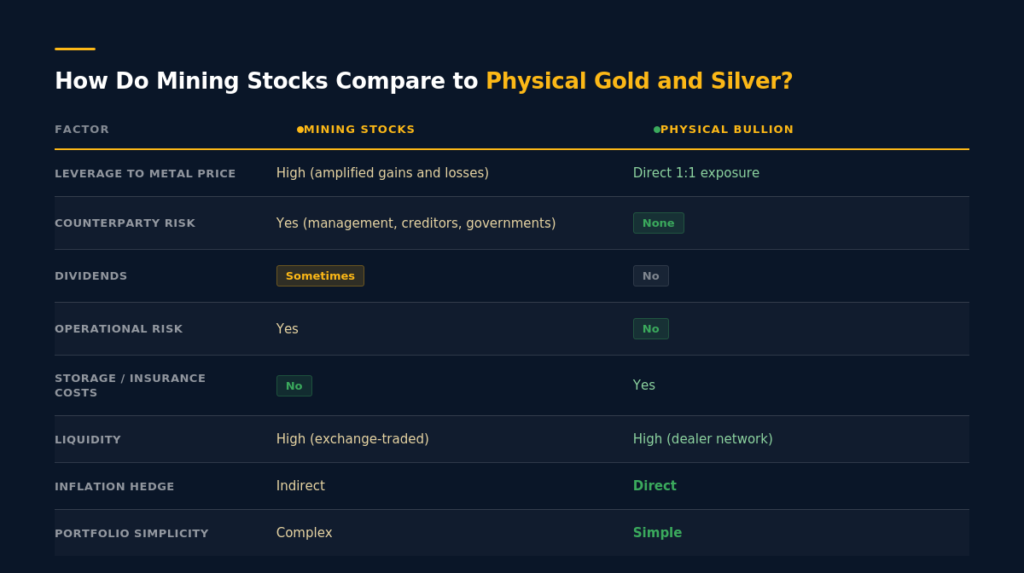
Brien Lundin frames this distinction simply: there are two reasons to own gold — insurance and investment. Physical gold handles the insurance role. Mining stocks, for those willing to accept the complexity, are the investment vehicle.
“The first thing you do is ensure your wealth. By buying gold and silver, you take whatever currency you convert into precious metals and protect it from the depreciation you know is going to happen… it’s not like fire insurance where you hope you never need it. This is something you know is going to happen.”
Mike Maloney takes that thought even further:
“With precious metals, there is a 100% certainty that you are going to be using this insurance policy — and you’re going to win.”
Physical gold and silver are claims on the metal itself — no counterparty risk, no management decisions, no geopolitical mine exposure. That simplicity is exactly why many investors hold bullion as the core of their precious metals allocation, with miners as a satellite position if they want additional leverage.
Should You Invest in Mining Stocks, Physical Gold, or Both?
There’s no single right answer — it depends on what you’re trying to accomplish.
Mining stocks may make sense if:
- You want leveraged exposure to rising gold prices and accept higher volatility
- You’re comfortable analyzing individual companies or using a diversified ETF
- You have a longer time horizon and can ride out operational setbacks
- You want the possibility of dividend income from your precious metals exposure
Physical gold and silver may make more sense if:
- Your primary goal is wealth preservation and inflation protection
- You want direct ownership of the metal with no counterparty risk
- You’re building a core position that doesn’t depend on any company’s decisions
- You want an asset that doesn’t correlate with equity market volatility
Many investors hold both — physical bullion as the foundation, with a measured allocation to miners for upside leverage when conditions favor it. As Brien Lundin puts it, that combination lets you build wealth even while you’re protecting it.
What Should You Watch Before Buying Mining Stocks?
If you’re evaluating a miner, these are the metrics that matter most:
- AISC (All-In Sustaining Cost): Lower is better. The gap between AISC and the spot price is the margin.
- Reserve life: How many years of production does the company’s reserve base support?
- Debt levels: High debt amplifies losses when margins compress.
- Jurisdiction: Where are the mines? What’s the regulatory and political track record?
- Hedging policy: Is management locking in future production at fixed prices? That limits your upside.
- Management track record: Have executives created or destroyed shareholder value in previous cycles?
Given that complexity, Mike recommends working with a professional resource before entering the mining space — someone who can analyze company fundamentals, management teams, and reserve quality. Going in without that guidance, he warns, significantly increases your odds of getting it wrong even in a strong bull market.
Final Thoughts on Gold and Silver Mining Stocks
Gold and silver mining stocks offer a legitimate way to gain leveraged exposure to precious metals — but they’re not a substitute for owning the metal itself. They’re businesses, with all the operational complexity, management risk, and market correlation that equity ownership entails.
For investors who understand the trade-offs and are willing to do the research, miners can complement a physical position. For those who want the inflation hedge, wealth preservation, and simplicity that precious metals are known for, physical gold and silver remain the more direct path.
New to buying physical gold? Here’s a step-by-step guide to getting started.
Stay On Top of Gold & Silver Prices
Get important market alerts sent straight to your inbox.
People Also Ask
Are gold and silver mining stocks a good investment?
Gold and silver mining stocks can be a strong investment when metal prices are rising, because miners offer leveraged exposure — meaning their profits can grow faster than the gold price itself. However, they carry risks that physical bullion doesn’t, including management decisions, operational costs, and geopolitical exposure. Most investors use miners as a complement to a core physical gold and silver position, not a replacement for it.
What is the difference between buying gold mining stocks and buying physical gold?
When you buy a mining stock, you’re buying a business that produces gold — not gold itself. That means your returns depend on management quality, production costs, and equity market conditions, not just the gold price. Physical gold gives you direct 1:1 exposure to the metal with no counterparty risk. GoldSilver’s guide on paper gold vs. physical gold breaks down the full comparison.
Do gold mining stocks outperform gold when prices rise?
They often can, because miners have a fixed cost structure — when gold prices rise faster than production costs, profit margins expand dramatically. This leverage cuts both ways, though: when gold falls, mining stocks typically fall harder and faster. Investors who want pure price exposure without the amplified downside tend to prefer physical gold.
Why have gold mining stocks underperformed gold in recent years?
If you divide the HUI mining index by the gold price, you can see a persistent downtrend going back to roughly 2007–2008 — miners have lagged the metal they produce for nearly two decades. Rising energy costs, labor inflation, and operational setbacks have compressed margins even as gold moved higher. Some analysts now see this gap as a potential opportunity, since miners are currently generating profit margins near historic highs while still trading at historically low valuations relative to gold.
What is AISC and why does it matter for mining stock investors?
AISC stands for All-In Sustaining Cost — the true per-ounce cost of producing gold, including labor, energy, equipment, environmental compliance, royalties, and corporate overhead. It’s the single most important number for evaluating a miner’s profitability, because the gap between AISC and the spot gold price is the margin.
Disclaimer: This article is for informational purposes only and does not constitute investment advice. Past performance is not indicative of future results. Always consult a qualified financial advisor before making investment decisions.