Silver Rises Over 120% YTD




Published: 04-23-2026, 11:31 am | Updated: 04-23-2026, 11:36 am
When the dollar crashes, gold rises. Every major dollar devaluation cycle since 1971 has produced a significant rally in gold — and the current environment is no exception. With the U.S. Dollar Index down roughly 14% from its 2022 peak, gold has climbed more than 43% over the past year. The relationship is not coincidence. A weaker dollar erodes the purchasing power of paper currency, making gold — which cannot be printed — the natural destination for capital seeking real, lasting value.
When the dollar loses purchasing power, gold rises — often sharply. The two assets have moved in opposite directions for over five decades, since the U.S. severed its link to gold in 1971. Today, with the U.S. Dollar Index down roughly 14% from its 2022 peak and gold up more than 43% over the past year, that relationship is playing out in real time. Fiscal deficits, monetary expansion, and eroding reserve currency confidence are the forces driving dollar weakness — and history shows they are the same forces that push gold to all-time highs.
As of April 23, 2026, gold is trading around $4,746 per ounce — up more than 43% year-over-year, even after pulling back from its all-time high. [Trading Economics] Meanwhile, the U.S. Dollar Index (DXY) is hovering near 98.3, weighed down by persistent inflation, expanding federal debt, and an accelerating global shift away from dollar-denominated reserves.
This is not coincidence. It is cause and effect. Understanding why gold responds to dollar weakness — not just that it does — is what separates investors who act from those who watch.
What Does a Dollar “Crash” Actually Mean?
A dollar crash does not require a single catastrophic event. In fact, purchasing power can erode steadily over years. What matters, therefore, is the direction of travel.
The DXY tracks the dollar against a basket of six major currencies. The dollar fell 9.4% in 2025 — its worst annual performance since 2017. Furthermore, major banks project a further 3% to 5% decline through 2026. [U.S. Bank] [TradingKey]
Three structural forces are driving that direction:
- Monetary policy easing. The Federal Reserve cut rates three times in 2025, bringing the federal funds rate to 3.50–3.75%. As a result, the yield advantage that makes dollar assets attractive to foreign investors has narrowed considerably.
- Policy preference for a weaker dollar. The Trump administration is not defending a strong dollar. Analysts argue the White House is actively seeking dollar weakness to reduce the trade deficit and boost exports.
- Improving global growth. Growth elsewhere is improving, consequently pulling capital away from safe-haven dollar assets.
A dollar under structural pressure is not just a forex story. It is, fundamentally, a gold story.
Your Gold Buying Guide Most investors overpay when they buy gold. Then overpay again when they sell. This guide shows you exactly what to own — and why.
Why Does Gold Rise When the Dollar Falls?
Gold is priced in U.S. dollars globally. When the dollar weakens, each ounce automatically costs more in dollar terms — even if demand stays flat. Add rising demand on top, and prices move fast.
Since being fixed at $35 per ounce under Bretton Woods, gold has climbed to over $5,000 per ounce. That rise represents a decline in the dollar’s purchasing power of more than 98% over five decades. [Federal Reserve History] That is not noise. It is the signal — and the gold-dollar relationship runs deeper than most investors realise.
A weaker dollar also signals that something is wrong with the monetary system. When the value of paper currency feels uncertain, gold — which cannot be printed — becomes the natural destination for capital seeking real, lasting value.
Gold prices rose approximately 65% in 2025 — the strongest annual gain since 1979. [World Gold Council] Notably, both the 1979–80 surge and the current rally unfolded alongside heightened geopolitical tensions and a weakening U.S. dollar.
What Does History Say? The Record from 1971 to Now
On August 15, 1971, President Nixon ended dollar convertibility to gold. As a result, foreign governments could no longer exchange dollars for gold, and the international monetary system became a fiat one. [Federal Reserve History] Gold, previously fixed at $35 per ounce, was suddenly free to find its real price.
What followed was an 85% surge within two years. By January 1980, gold had climbed to $850 per ounce — a 2,300% gain from the 1971 peg. [Investing News Network] Freed from gold discipline, the dollar lost purchasing power rapidly as inflation took hold.
The pattern then repeated in the 2000s. From 2001 to 2008, the dollar fell roughly 40% in trade-weighted terms — driven by low rates, twin deficits, and foreign military costs. Consequently, gold rose from around $270 to over $1,000 per ounce. After the 2008 financial crisis, furthermore, another round of monetary expansion sent gold to $1,921 by 2011. [Investing News Network]
Each time the dollar came under systemic pressure, gold responded. Moreover, the magnitude grew with each cycle, because the underlying imbalances were never fully resolved.
Why Is Gold Pulling Back Even as the Dollar Stays Weak?
Gold has pulled back roughly 15% from its all-time high of $5,589.38, set on January 28, 2026. [Investing News Network] The dollar, meanwhile, remains near multi-year lows. That apparent contradiction deserves a direct answer.
Dollar weakness does not guarantee rising gold prices at all times. Short-term pullbacks happen — from profit-taking after a major run, a temporary surge in competing safe-haven assets like the yen or Swiss franc, or geopolitical optimism that briefly reduces demand for hedges.
However, when gold holds elevated levels despite dollar weakness, its floor has risen. The metal is no longer supported purely by dollar depreciation. Instead, it is held up by independent structural demand — from central banks, ETF investors, and retail buyers worldwide. Gold that doesn’t need a falling dollar to stay elevated has graduated to a new, higher base. That is consolidation, not weakness.
What Are Central Banks Telling Us?
Price charts show sentiment. Central bank behaviour, however, shows conviction.
Total central bank gold buying reached 863 tonnes in 2025 — well above the 2010–2021 annual average of 473 tonnes — even as gold traded near record highs. [World Gold Council] These institutions are not momentum traders. Instead, they are deliberately building reserves and reducing dependence on the dollar, at prices most retail investors would balk at. The strategic reasons behind that conviction go well beyond diversification.
Goldman Sachs puts a sharper number on it: central bank purchases are now averaging around 60 tonnes per month — far above the pre-2022 average of 17 tonnes — with emerging-market central banks leading the shift into gold. [CNBC]
This is not marginal diversification. Rather, it is a structural repositioning away from fiat reserves and toward hard money. As a result, it creates an enormous price floor regardless of where the DXY trades on any given day.
Is Now a Good Time to Buy Gold?
Gold is currently around $4,746 per ounce — approximately 15% below its January 2026 all-time high of $5,589.38. [Trading Economics] Importantly, the forces that drove it to that high — dollar weakness, fiscal deficits, central bank demand, and monetary uncertainty — remain fully intact. This pullback, therefore, looks like consolidation inside a continuing bull market, not the end of one.
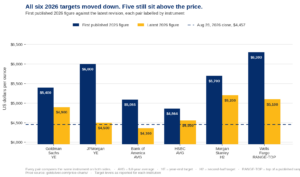
J.P. Morgan projects gold prices toward $5,000 per ounce by Q4 2026, with $6,000 per ounce a longer-term possibility. The bank also expects central bank and investor demand to average 585 tonnes per quarter in 2026. [J.P. Morgan Global Research] Similarly, Goldman Sachs has set its December 2026 forecast at $5,400 per ounce, noting that macro and policy risk hedges have become “sticky” — effectively raising gold’s starting floor. [CNBC]
The dollar’s long-term trajectory — nearly $39 trillion in federal debt, structural trade deficits, accelerating de-dollarization — makes the structural case for gold difficult to argue against. Those who wait for certainty tend to buy after the move has already happened.
Stay On Top of Gold & Silver Prices
Get important market alerts sent straight to your inbox.
People Also Ask
Does gold go up when the dollar crashes?
Historically, yes. Gold and the dollar have a well-documented inverse relationship. When the dollar loses purchasing power — through inflation, fiscal expansion, or loss of reserve currency confidence — gold rises in dollar terms. Since the end of the Bretton Woods system in 1971, the dollar has lost more than 98% of its purchasing power relative to gold.
Why does gold rise when the dollar weakens?
Gold is priced globally in U.S. dollars. A weaker dollar, therefore, means each ounce costs more in dollar terms, even if global demand stays flat. Beyond the mechanics, a weak dollar signals monetary instability — pushing investors toward gold as a store of value that cannot be debased by central bank policy.
Will gold protect me if the dollar collapses?
Gold has historically served as one of the most reliable stores of value during currency crises. Physical gold is not a counterparty liability — it cannot default, be frozen, or printed into worthlessness. During every major dollar devaluation cycle since 1971, gold has not just held purchasing power but significantly increased it.
What happened to gold after Nixon ended the gold standard?
Gold was fixed at $35 per ounce under the Bretton Woods system. After Nixon closed the gold window in August 1971, gold was free to find its market price. Over the following nine years, it rose more than 2,300%, reaching $850 per ounce in January 1980. That rally was driven by the same forces active today: inflation, fiscal excess, and loss of confidence in fiat currency.
Can gold fall even when the dollar is weak?
Yes, and it does occasionally — usually due to short-term profit-taking, competing safe-haven demand, or geopolitical optimism. However, when gold maintains elevated prices despite dollar weakness, it signals that support is coming from independent structural demand — central banks, ETF buyers, and retail investors — rather than dollar mechanics alone. That is a constructive signal for gold’s next move higher.
The Dollar Is the Risk. Gold Is the Response.
Every major dollar devaluation cycle since 1971 has produced a significant, sustained rally in gold. The current environment — dollar down nearly 14% from its 2022 peak, federal debt approaching $39 trillion, central banks buying gold at twice their historical average, DXY near multi-year lows — is not a rehearsal. It is the real thing.
Gold’s pullback from its January 2026 all-time high of $5,589 is a pause, not a reversal. The forces driving this market do not resolve quickly: structural deficits, monetary expansion, and a slow but accelerating global shift away from dollar reserves. The case for gold is not built on fear. It is built on fifty years of evidence.
Physical gold and silver remain the most direct way to protect purchasing power from dollar debasement. Explore your options at GoldSilver.com.
SOURCES
1. Trading Economics — Gold Price, Historical Data and News
2. Trading Economics — United States Dollar Index
3. U.S. Bank — The U.S. Dollar’s Fluctuating Value and What It Means for Investors
4. TradingKey — USD Dollar Index Forecast: Will the Dollar Continue to Fall in 2026?
5. Federal Reserve History — Nixon Ends Convertibility of U.S. Dollars to Gold
6. World Gold Council — Gold Demand Trends: Full Year 2025
7. World Gold Council — Central Banks: Full Year 2025
8. Investing News Network — What Was the Highest Gold Price Ever?
9. CNBC — Gold Surges Past $5,100 as Investors Seek Shelter from Global Risks
10. J.P. Morgan Global Research — A New High? Gold Price Predictions
11. Trading Economics — Gold Price, Historical Data and News (April 23, 2026)
Disclaimer: This article is for informational and educational purposes only. It does not constitute investment advice. Please consult a qualified financial adviser before making any investment decisions.
You may also like:
- Gold Fell During a War. So Is It Really a Safe Haven?
- Is Gold at Fair Value? What Three Models Say — and Where They Disagree
- Silver Price Predictions for the Next 5 Years: Data-Backed Scenarios
- Tariff Refunds, Dollar Weakness, the AI Bust: Gold’s Case
- How to Buy Gold for Beginners: Step-by-Step Guide (2026)
- Silver Price Forecast 2026-2027: The bull case and bear case laid out
- How to Buy Silver Bars: The Investor’s Guide
- Why Silver Falls While Gold Rises: What It Means for You
- Why Are BRICS Countries Buying So Much Gold?