Silver Rises Over 120% YTD




Published: 08-28-2026, 12:42 pm | Updated: 08-28-2026, 12:44 pm
Kevin Warsh had one job at his first Jackson Hole keynote as Fed chair: tell markets which side of the dual mandate worries him more. He answered directly. “On the price-stability side of our mandate, the numbers are more concerning,” he said Friday, and gold sold off within minutes of hearing it.
What Did Warsh Actually Say About Inflation?
Gold is trading near $4,469.61 an ounce today, down roughly 2.9% from this morning’s open of $4,601.10. The decline accelerated right after Warsh’s remarks and has kept widening through the session. Silver has fallen even harder, near $66.74, down about 3.7%. The gold-silver ratio has widened to 66.97, above the roughly 60 long-run average. Silver’s heavier industrial-demand exposure makes it the more sensitive metal in a rate-hike repricing.
The reason is Warsh’s own words. “We must be confident that underlying inflation is moving to our objective, clearly and at sufficient speed,” he told the Kansas City Fed’s symposium. It was his first extended remarks since taking the chair in May. “Otherwise, we have work to do.” This summer’s inflation readings were “better than expected,” he said. But they “do not tell me that underlying trends have meaningfully improved.”
That’s about as close as Warsh has come to naming his reaction function since taking office. September rate-hike odds jumped to more than 55%, up from roughly 35% the day before, according to CME FedWatch data reported by CNBC and Reuters.
The Edge Every Investor Needs Smarter precious metals investing starts here. The Nuggets Newsletter brings you essential market insights, Fed updates, global trends, educational videos, and much more.
Why Did Warsh Say Financial Conditions Aren’t Restrictive?
The evidence he cited is the part most coverage is skipping past. Business investment in equipment and intangibles is growing near 9%, the fastest pace since 2021, with more than half of that growth tied to the AI buildout. S&P 500 profits are up over 20% on the year, and credit spreads sit near the low end of their historical range, not at an outright record. Unemployment at 4.1% is, in his framing, “consistent with full employment.”
A Fed chair just cited the AI capex boom as a reason inflation-fighting has room to continue. That is an unusual data point for a central banker to lean on. It says more than the generic “hawkish speech” framing most headlines are running today.
Warsh also doubled down on his signature break from recent Fed tradition: no forward guidance, no explicit reaction function. “We should not indulge a regime in which market participants are looking primarily to the Fed for their next trade,” he said. That is his case for a quieter Fed. That stands in contrast to predecessors who used Jackson Hole to signal a coming pivot.
What Happened to Treasury Yields After the Speech?
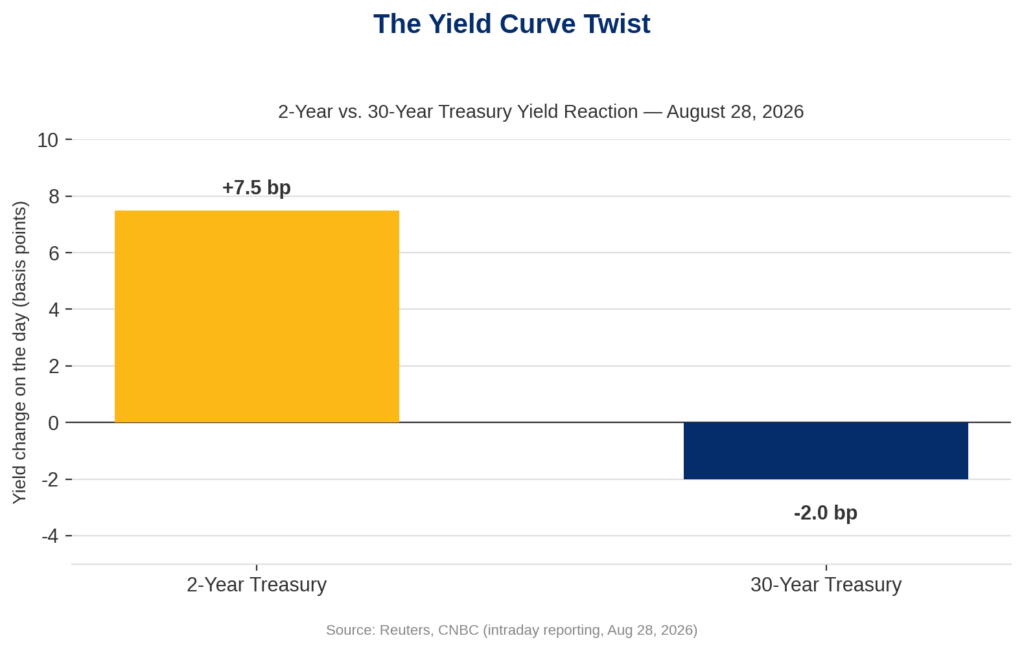
The more interesting mechanism sits in the bond market, and it isn’t a simple “yields up” story. The 2-year Treasury yield jumped to a one-month high, up roughly 7–8 basis points to around 4.30%, as traders repriced hike odds higher. The 30-year yield actually fell 1–3 basis points the same day. That is a curve twist, not a uniform move.
That divergence lines up with a quieter story underneath the speech. The U.S. Treasury has spent this month expanding its buyback program for older, long-dated bonds. The goal is to hold down long-end borrowing costs directly. Ahead of the speech, Fed watchers at JPMorgan, Apollo, and Morgan Stanley said Warsh had a chance to prove inflation-fighting is his priority. If he did, said JPMorgan Investment Management’s Priya Misra, “some of the angst on Fed credibility will reduce.” A hawkish Fed chair and a yield-suppressing Treasury sound like they should conflict. On Friday, they moved in the same direction.
What Does This Mean for Gold and Silver Investors?
None of this changes the structural case for holding gold and silver. It is a reminder of what that case was always about. The dollar index rose about 0.4% to 99.55, and gold’s opportunity cost rose in the short run because a non-yielding asset competes worse against higher-for-longer rates. That mechanism is real.
But there is a deeper story. A Fed chair talking tough on inflation is one arm of government. A Treasury directly intervening in bond markets to manage its own borrowing costs is the other. Both are pulling in different directions at once. That tension, not one day’s rate-hike odds, is financial repression in practice. Policy tools work against each other while the purchasing power sitting in the middle absorbs the volatility. A hawkish speech that knocks gold down several percent in a single session isn’t evidence against that thesis. It is what the thesis predicted the day-to-day would look like.
What Should Investors Watch Next?
The Fed’s next decision lands September 15–16, and Friday gave no explicit signal either way. Warsh was careful to say his remarks “don’t necessarily signal” a hike is coming. Watch CME FedWatch odds over the next few sessions, and watch whether the Treasury’s buyback program needs to expand further if long-end yields climb again. The next PCE print is the real test. It is the Fed’s preferred inflation gauge, and it will show whether “we have work to do” holds up against the data, or gets revised again.
Stay On Top of Gold & Silver Prices
Get important market alerts sent straight to your inbox.
SOURCES
1. Federal Reserve Board — official transcript of Chairman Warsh’s keynote remarks
2. Associated Press (via US News) — Warsh’s direct quotes on inflation and “work to do”
3. CNBC — full speech recap, 2-year yield move, and rate-hike odds shift
4. Reuters (via Yahoo Finance) — Treasury yield curve moves and dollar index
5. CNBC — updated September rate-hike odds (>55%, up from 35.4%)
6. Yahoo Finance Jackson Hole live blog — Priya Misra (JPMorgan Investment Management) on Fed credibility, in original context
Disclaimer: This article is for informational purposes only and does not constitute investment advice. Past performance is not indicative of future results. Always consult a qualified financial advisor before making investment decisions.
You May Also Like:
- Five Things Moved Gold and Silver This Week. Only One Was Kevin Warsh.
- The Treasury’s Next Move Isn’t a Rate Cut. It’s a $967 Billion Checking Account.
- Six Paper Claims, One Ounce of Silver: What First Notice Day Reveals
- Five Gold Signals Fired This Week. None of Them Are About Today’s Price.
- Gold Fell 9% the Last Time Warsh Spoke. He’s Back Tomorrow.
- Gold Ran Past Wall Street’s Own Price Targets. Four Banks Disagree on What Happens Next.
- Silver Beat Gold in August. Almost Nobody Said So.