Silver Rises Over 120% YTD




Published: 09-22-2026, 04:30 pm
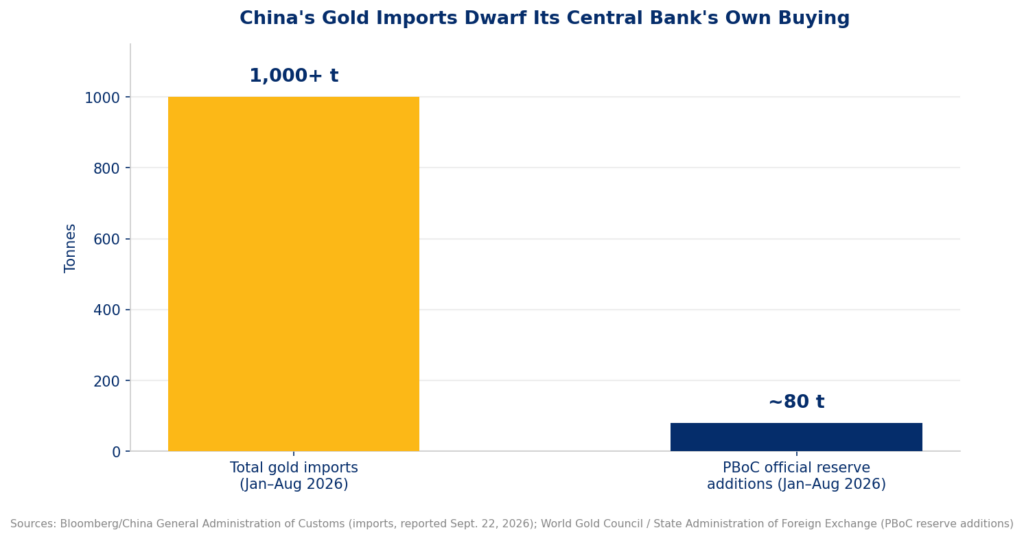
Bloomberg reported on September 22, 2026, that China’s gold bullion imports topped 1,000 tonnes through August 2026. The figure comes from China’s General Administration of Customs, in a data series that goes back to 2017. That already beats everything China imported in all of 2025, at the fastest pace on record.
How Much Gold Has China Imported in 2026?
China imported more than 1,000 tonnes of gold in the first eight months of 2026, per Bloomberg customs data (Sept. 22, 2026), spending roughly $158.8 billion. That eclipses the 866 tonnes, worth about $96.5 billion, China imported in all of 2025, per Financial Times data cited the same day. Other outlets tracking the same customs series put the 2026 tally as high as 1,100 to 1,200 tonnes so far. That gap is a reminder: this is a fast-moving monthly count, not one fixed number. Every version tells the same story. More gold. Arriving faster than at any point since customs records began.
Is China’s Central Bank Buying All of It?
No. The People’s Bank of China (PBoC) added roughly 80 tonnes to its own reserves over the same eight months, per World Gold Council and State Administration of Foreign Exchange data (both Sept. 22, 2026). Its August addition was about 20 tonnes, the bank’s largest single month since 2023. That keeps a streak of monthly increases alive, now 22 months running. Even that figure may understate things. Goldman Sachs analysts estimated in September 2026 that the PBoC’s real July buying was 35 tonnes, well above the 20 tonnes it reported. Either way, 80-odd tonnes of disclosed official buying can’t explain 1,000-plus tonnes of imports. Most of that gold moved through a different channel: bars, coins and gold-backed ETFs, bought by households, jewelers and fund managers, not the state.
That distinction changes what the number means. Central-bank buying is a reserve-diversification decision, made once a month, by one institution. Import volume this large is a price signal instead.
The Edge Every Investor Needs Smarter precious metals investing starts here. The Nuggets Newsletter brings you essential market insights, Fed updates, global trends, educational videos, and much more.
Why Is China Importing So Much Gold Right Now?
Gold pulled back sharply from January 2026’s record high. The correction made bullion cheap enough, against a persistently firm yuan, that Chinese buyers stepped in at scale. Analysts tied to the customs release point to a specific mechanism: onshore prices trading at a premium to the world benchmark. That premium pulls more metal into the country and rewards anyone licensed to import it. Chinese gold ETFs moved the same direction on a smaller scale. Holdings rose roughly 44 tonnes through August, an 18% increase since January, according to Shanghai Gold Exchange data (Sept. 22, 2026), while global gold ETF flows stayed close to flat over the same period.
Zoom out and the two channels point to the same structural case, even though they are not the same number. Central banks bought more than 1,000 tonnes of gold a year in three of the last four years (2022, 2023 and 2024), absorbing close to a quarter of annual global mine production, according to World Gold Council data (2022-2025). That buying has tracked the US dollar’s declining share of global reserves, down to roughly 58-60% by 2024 from about 72% in 2000, according to IMF COFER data (2024, latest available). China’s private and institutional buyers are making a related but separate bet: that gold priced in a currency system under this kind of structural pressure is worth owning now, not later.
What Does This Mean for Gold and Silver Investors?
Gold traded near $4,358 an ounce and silver near $67.09 as this published, both higher on the day. Neither number depends on China’s import data to matter. But the transmission is direct: every tonne pulled into the world’s largest gold-consuming market is a tonne unavailable to the rest of global demand. The customs data shows that pull accelerating even as the price corrected, not after it recovered.
That is generally how a floor gets built under a market. Not by one buyer, but by several different kinds of buyer reaching the same conclusion for different reasons, at the same time. A central bank spreading out its reserves and a household in Shenzhen buying a cheap gold bar have different reasons. They land on the same decision. Gold has functioned as money across governments and generations for exactly that reason. It doesn’t require you to trust the same institution the buyer next to you trusts. It only asks that both of you trust the metal.
Stay On Top of Gold & Silver Prices
Get important market alerts sent straight to your inbox.
SOURCES
1. Bloomberg – China’s Gold Imports Top 1,000 Tons on Strong Investment Demand
2. Benzinga – China’s $159 Billion Gold Rush Reveals Where the Money Is Moving
3. World Gold Council – Gold Demand Trends and Central Bank Gold Reserves Data
4. International Monetary Fund – Currency Composition of Official Foreign Exchange Reserves (COFER)
Disclaimer: This article is for informational purposes only and does not constitute investment advice. Past performance is not indicative of future results. Always consult a qualified financial advisor before making investment decisions.
You May Also Like:
- Fed Officials Turn Hawkish. Gold’s Iran-Diplomacy Bounce Can’t Hold.
- Bernstein Just Cut Its Gold Forecast — By Breaking Gold’s Oldest Rule to Defend It
- The Fed Just Hiked. Wall Street Keeps Getting More Bullish on Gold Anyway.
- Gold Dips, Silver Holds as Iran Diplomacy Hopes Sink Oil Before a Bigger Week
- Silver Round-Tripped a 6.8% Shock in Nine Days. Real Yields Did It, Not Inflation.
- Iran Hit a Tanker in Hormuz and Trump Threatened Iran. Oil Isn’t Reacting.
- Rates Just Went Up Twice. Five Reasons Gold Didn’t Care.
- The Bank of Japan Just Hiked to a 31-Year High. Gold Barely Noticed.