Silver Rises Over 120% YTD




Published: 09-17-2026, 01:28 pm
Last verified: September 2026
Foreign ownership of US Treasury debt means the share of America’s bonds held by investors outside the country. Specifically, the Treasury tracks it every month through a system called TIC. It matters because who holds that debt shapes both interest rates and the dollar’s credibility over time.
Who owns US debt? The textbook answer describes a contest between governments. China buys. Japan holds. The Gulf states trim their positions. That answer made sense in 2014. However, it has gotten less true every year since.
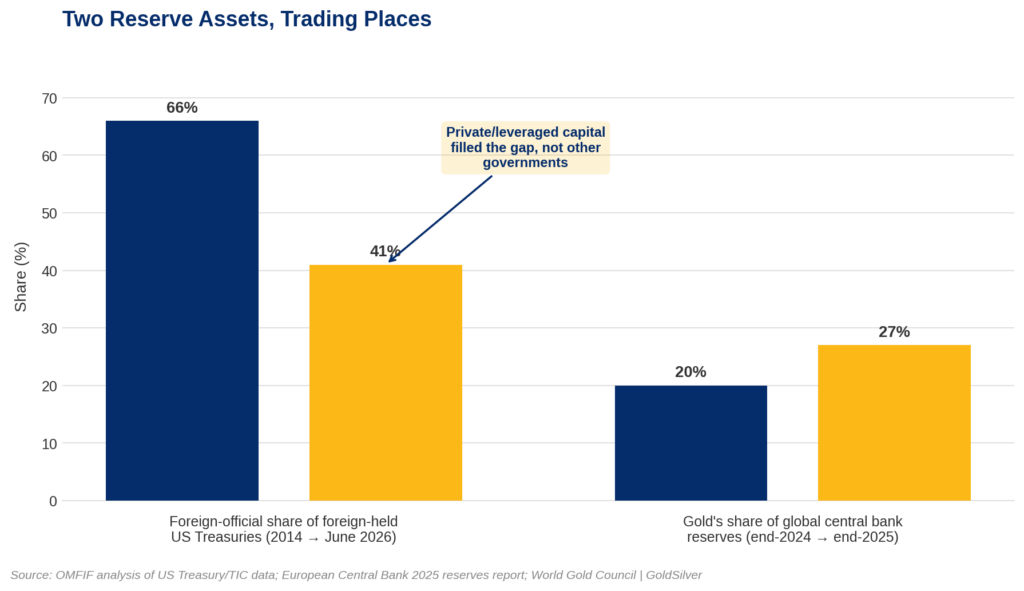
As of June 2026, foreign investors hold $9.3 trillion of US Treasury securities. Only 41% of that is held by foreign central banks and other official institutions. Notably, that is down from roughly two-thirds in 2014. The figure comes from OMFIF’s September 17 analysis of Treasury International Capital data. Meanwhile, the rest is increasingly leveraged private capital, not other governments.
However, here is the nuance most coverage skips. Official holders have not sold off their Treasuries in any dramatic way. In fact, in dollar terms, their holdings sit only about 8% below the 2014 level. Instead, two things happened at once. First, the market around them roughly tripled, from $12.5 trillion to near $30 trillion. Second, the reserve-building boom that ran through 2014, led by China, stalled out. China’s own reserves later fell by roughly $1 trillion, and no other country stepped in to fill that gap. So the 66%-to-41% shift is real, but it is a story about growth and stagnation, not a mass exit.
That said, the country-by-country tables are still misleading in a different way. Treasury holdings booked in the Cayman Islands reached $453 billion in June 2026. Notably, that is up 67% since 2022. It makes the Cayman Islands the sixth-largest reported foreign holder of US debt. In fact, this is not offshore savings at all. Instead, it is mostly the US hedge fund community running trades through Cayman-domiciled vehicles. Those vehicles file Form PF with the Securities and Exchange Commission. Specifically, TIC data records where a security is custodied. It does not, however, record who owns the risk. As a result, a leveraged domestic trade shows up as “foreign” demand. So for anyone asking who really owns US debt today, that distinction changes the picture entirely.
Key Takeaways
- Foreign official institutions, mostly central banks, held roughly two-thirds of foreign-owned US Treasuries in 2014. That share is 41% as of June 2026, per OMFIF. Notably, official holdings are only about 8% below their 2014 dollar level. In fact, the market around them simply tripled in size.
- Cayman Islands-booked Treasury holdings hit $453 billion in June 2026, up 67% since 2022. Largely, this is US hedge fund basis trades reporting as “foreign.”
- Central banks bought 863 tonnes of gold in 2025 (World Gold Council). Gold ended the year at 27% of global official reserves versus 22% for Treasuries. Notably, that is the first time gold has led since 1996 (European Central Bank).
- The Federal Reserve’s own research staff dispute the “gold overtook Treasuries” framing on a foreign-only basis. They call it closer to a tie, a caveat this piece discloses rather than omits.
Gold is trading near $4,368 an ounce today, up 2.4% on the session. Silver sits near $65.80, up 4.5%. In fact, both are part of a broader rebound already covered in GoldSilver’s same-day news coverage. This piece sets that daily noise aside instead. The OMFIF report, and the reserve-composition data behind it, describe a decade-long structural shift. That shift will still be true next month, no matter where gold closes today.
Who Actually Owns US Debt Right Now?
The familiar answer sorts foreign Treasury holders by country. China, Japan, the United Kingdom, Luxembourg, the Cayman Islands. That table is real, and the Treasury publishes it every month. However, a country ranking was only ever a proxy for the split that actually matters. Instead, the real divide is simple. Some holders buy Treasuries for policy reasons. Others buy them purely for return. Foreign official institutions, meaning central banks and sovereign reserve managers, held roughly two-thirds of the foreign-owned total in 2014. In fact, private holders overtook them in 2023, and the gap has widened every year since.
However, reading that shift as a retreat by foreign governments gets the mechanism backwards. For example, a government can reduce its Treasury holdings for policy reasons. It might be diversifying into gold instead. That does not mean a private buyer replaces the demand in any meaningful sense. Instead, TIC data increasingly counts a different kind of buyer altogether. Its presence in the “foreign” column is a filing quirk, not a vote of confidence in US fiscal policy. So the honest answer to who owns US debt today is less about which nations are buying. It is more about which type of buyer is left.
The Knowledge That Changes Everything

Two essential guides — yours free. Understand why gold matters and why fiat currencies always fail.
What Is a Treasury Basis Trade, and Why Does It Count as Foreign Demand?
A cash-futures basis trade exploits the small price gap between a Treasury bond and its futures contract. For example, a fund borrows cash. It buys the bond and sells the future. It pockets the spread, often many times over, using leverage. None of that requires the fund to be foreign in any real sense. Instead, it only requires the fund to be domiciled somewhere favorable for tax and legal purposes. The Cayman Islands has long filled that role for the US hedge fund industry.
Notably, the managers running these trades are part of the US hedge fund industry itself. They report to the SEC on Form PF. In other words, the capital is American. Similarly, the risk is American. The decision to open or close the trade is made in an American office. Only the legal wrapper is Cayman-domiciled. That wrapper, notably, is exactly what TIC data measures. Consequently, the country tables show the Cayman Islands as the sixth-largest foreign holder of US debt. Clearly, something else is going on. They are not describing a small Caribbean economy’s confidence in the dollar. Instead, they are describing a leveraged arbitrage position that can unwind within days.
Has Gold Really Overtaken Treasuries as the World’s Top Reserve Asset?
By one measure, yes. Notably, the European Central Bank’s 2025 reserves report puts gold at 27% of global central bank reserves at year-end. Notably, that is up from 20% twelve months earlier. Meanwhile, the Treasury share fell from 25% to 22% over the same stretch. That is the first time gold has outweighed Treasuries in official reserves since 1996. It also lines up with the retreat OMFIF documents on the Treasury side of the ledger.
That said, the honest counterargument deserves equal space. The Federal Reserve’s own research staff published a note this month pushing back on the “gold overtook Treasuries” framing. Specifically, their point is simple. Comparing world gold reserves, which include US holdings, against foreign Treasury holdings mixes two different totals. On a foreign-only basis, the Fed puts the two assets closer to a tie than a clean crossover. Notably, that caveat does not undo the trend. If anything, it actually sharpens it. Even by the Fed’s more conservative math, gold has closed a multi-trillion-dollar gap with the world’s benchmark risk-free security. Notably, it is an asset with no coupon and no issuer. It did so in under three years.
Why Are Central Banks Buying Gold Instead of More Treasuries?
Central banks bought 863 tonnes of gold in 2025, according to World Gold Council data. That is the fourth straight year above 800 tonnes. Notably, it follows three consecutive years above 1,000 tonnes. Notably, that buying accelerated after 2022. That year, the United States and its allies froze roughly $300 billion in Russian central bank reserves. Understandably, a reserve manager who watched that happen does not forget it easily. GoldSilver has covered this mechanism directly. A Treasury held abroad sits inside a jurisdiction that can freeze it by executive order. A gold bar in a domestic vault does not carry that same risk, whatever else it lacks in yield.
That is the missing half of OMFIF’s story. The foreign-official retreat from Treasuries is not primarily about governments losing interest in lending to the United States. Instead, it is a story about where new reserve capital went. The central bank gold-buying data answers that question directly.
What Does a Thinner Official Buyer Base Mean for US Debt Markets?
Total foreign holdings of Treasuries kept rising, reaching that $9.3 trillion figure in June. Instead, the composition changed, not the total. So this is not a story about the United States struggling to find buyers for its debt today. Instead, the more precise read is that the buyer of last resort has changed character. By contrast, a patient reserve manager holds a Treasury position for decades. It does not sell because a Fed meeting went a particular way. By contrast, a leveraged basis trade unwinds fast. Funding costs can move against it. A repo market can seize. A fund’s risk model can flag too much exposure in one place. None of that requires bad news about the United States specifically. It only requires the trade to stop paying.
As of September 2026, no evidence points to that unwind being imminent. The point here is structural, not predictive. In other words, “foreign demand for US debt” increasingly describes a basis trade with a funding cost. It is not a government’s considered judgment about where to park its reserves. Gold does not carry that same ambiguity, since no leveraged wrapper stands between the asset and whoever holds it. That is ultimately the cleanest way to answer who owns US debt today versus who merely appears to.
What This Means for Gold and Silver Investors
None of this requires a view on whether the United States can keep financing its deficits. That, however, is a separate and more complicated question. It does establish something else, however. The reserve-diversification argument for gold has kept strengthening, even as headline Treasury demand looked stable. Specifically, the buyers walking away from a policy-driven Treasury allocation are the same ones buying the most gold. In fact, they have been the single largest source of gold demand for four straight years. Clearly, that is not a coincidence. It is also a more durable signal than any single data release. It has held across three different Fed rate cycles since 2022.
Watch two things next. First, the next Treasury International Capital report will show whether the official share keeps falling. Second, watch the World Gold Council’s Q4 2025 data. It is already running at 230 tonnes for the quarter. That will show whether 2025’s slower buying pace holds into 2026, or speeds up again.
Stay On Top of Gold & Silver Prices
Get important market alerts sent straight to your inbox.
People Also Asked
Who owns the most US debt?
As of June 2026, the largest single reported foreign holders are Japan and China, but together they hold a shrinking share of the total. The more important shift is structural: foreign official institutions (mostly central banks) now hold only 41% of foreign-owned Treasuries, down from about two-thirds in 2014, with leveraged private capital making up the difference.
Has gold really overtaken US Treasuries as the world’s largest reserve asset?
By the European Central Bank’s 2025 reserves report, yes on one measure: gold reached 27% of global central bank reserves at year-end 2025 versus 22% for US Treasuries, the first time gold has led since 1996. The Federal Reserve’s own research staff dispute the framing on a foreign-only basis, calling it closer to a statistical tie. Both things are true at once.
Why has the foreign-official share of US Treasury holdings fallen since 2014?
OMFIF’s analysis of Treasury International Capital (TIC) data shows foreign official institutions, mostly central banks, held about two-thirds of foreign-owned Treasuries in 2014. That share fell to 41% by June 2026. Private holders overtook official holders in 2023. The shift reflects central banks diversifying reserves, partly toward gold, rather than a single dramatic sell-off.
If central banks aren’t buying as many Treasuries, who is?
Increasingly, leveraged private capital reported through offshore jurisdictions. Cayman Islands-booked Treasury holdings reached $453 billion in June 2026, up 67% since 2022, making Cayman the sixth-largest reported foreign holder. This is largely US hedge funds running cash-futures basis trades through Cayman-domiciled vehicles that file Form PF with the SEC, not genuine foreign savings.
What is a Treasury cash-futures basis trade, and why does it show up as foreign demand?
It’s a leveraged arbitrage strategy exploiting the small price gap between a Treasury bond and its futures contract, typically run through offshore-domiciled fund vehicles for tax and legal reasons. Because the vehicle is legally domiciled in a place like the Cayman Islands, the Treasury holding is recorded as ‘foreign’ in TIC data even though the fund’s managers, capital, and risk decisions are based in the United States.
How many tonnes of gold did central banks buy in 2025?
863 tonnes, according to the World Gold Council, the fourth consecutive year above 800 tonnes, though down from more than 1,000 tonnes annually in 2022 through 2024. The National Bank of Poland was the largest single buyer, adding roughly 100 tonnes. The World Gold Council attributed the year-over-year slowdown partly to central banks’ caution around record-high prices, not a loss of strategic interest.
Does a falling foreign-official share of Treasuries mean the US will struggle to finance its debt?
Not directly, and this article doesn’t make that claim. Total foreign holdings of Treasuries kept rising, to $9.3 trillion in June 2026; the composition shifted, not the total. The more precise read is that the buyer of last resort for US debt is increasingly a leveraged private trade rather than a patient official reserve manager, which changes the stability profile of that demand more than its current size.
SOURCES
1. OMFIF – America’s Largest Foreign Creditor Is American (Sept. 2026)
2. World Gold Council – Gold Demand Trends: Full Year 2025 (Jan. 2026)
3. European Central Bank – The International Role of the Euro (June 2026)
4. Federal Reserve Board – Why Gold Didn’t Actually Overtake Treasury Securities as the World’s “Favorite” Reserve Asset (Sept. 2026)
5. GoldSilver – Why Central Banks Are Moving Gold to Domestic Vaults (July 2026)
Disclaimer: This article is for informational purposes only and does not constitute investment advice. Past performance is not indicative of future results. Always consult a qualified financial advisor before making investment decisions.
You May Also Like:
- What Is Junk Silver? The Old Dimes and Quarters Worth Nearly 50x Their Face Value
- Why Is Silver Demand Tied to AI Data Centers?
- The Copper Mine That Isn’t Trying to Mine Silver Just Explained the Whole Deficit
- Inherited Gold IRA: Beneficiary Rules & the Step-Up Basis Gap
- The Cantillon Effect: Why Money Printing Makes Some People Rich First
- Silver Price Outlook September 2026: The Hike Is Priced In. The Positioning Isn’t.
- Gold Is About to Face Its First Rate Hike of the Cycle. Here’s Why It Isn’t Scared.