Silver Rises Over 120% YTD




Published: 04-23-2026, 03:15 pm
The best gold investment in 2026 depends on your priorities. Physical bars offer the lowest ongoing costs and zero counterparty risk, making them ideal for long-term wealth preservation. Coins add flexibility and liquidity at a slightly higher premium. A gold IRA gives you physical metal inside a tax-advantaged retirement account. ETFs, on the other hand, provide instant, storage-free exposure but carry annual fees and no ownership of the underlying metal. The strongest portfolios tend to combine formats — a physical core for direct ownership, a gold IRA for tax efficiency.
Gold has surged roughly 41% over the past year, touching an all-time high of $5,589 per ounce in January 2026. It now trades near $4,720 — down about 15% from that peak, but still up more than 40% year-over-year [Trading Economics]. Meanwhile, J.P. Morgan has revised its year-end 2026 forecast to $6,300 per ounce, driven by central bank buying and investor demand averaging 585 tonnes a quarter [J.P. Morgan Global Research]. The case for owning gold is well established. However, what’s less obvious is which format actually suits your situation — and the difference is not trivial.
What is the best way to invest in gold in 2026?
Choosing the best gold investment in 2026 comes down to three things: your investment timeline, how much you value direct physical ownership, and whether tax-advantaged structure matters to you. No single format wins on all three. Physical bars and coins give you direct ownership with no counterparty. ETFs, in contrast, give you frictionless access inside a brokerage account. A gold IRA wraps physical metal in retirement account tax treatment. Ultimately, the cost and structural differences between these options are where most investors make their best — or worst — decision.
Your Gold Buying Guide Most investors overpay when they buy gold. Then overpay again when they sell. This guide shows you exactly what to own — and why.
Are gold bars the cheapest way to buy gold?
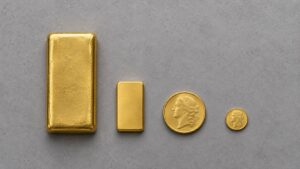
Gold bars are the most cost-efficient way to buy physical gold. Bars from accredited refiners — PAMP Suisse, Valcambi, the Perth Mint — typically carry premiums of 1–3% over spot, lower than virtually any other physical format [GoldSilver.com]. In other words, you pay once, own outright, and have no annual fees eating into your position.
That said, the trade-off is inflexibility. A 1-oz bar needs secure storage, insurance, and logistical planning when you eventually sell. Larger bars (10 oz, kilo) offer even tighter premiums, but they create a liquidity problem — you can’t sell a fraction of a kilo bar the way you can divide a coin holding. As a result, bars suit long-term, buy-and-hold investors who want capital efficiency above everything else. Furthermore, they qualify for gold IRA inclusion — provided they meet the IRS minimum fineness standard of 99.5% purity — which makes them more versatile than they first appear.
Are gold coins better than gold bars for most investors?
Coins cost more upfront, but that premium buys something real: flexibility. Government-minted bullion coins — American Gold Eagles, Canadian Maple Leafs, South African Krugerrands — carry premiums of 3–8% over spot [GoldSilver.com]. That markup reflects universal recognisability, and recognisability drives resale ease. Any dealer worldwide knows a Gold Eagle on sight. A fractional bar from an unfamiliar refiner, however, does not command the same confidence.
Beyond liquidity, fractional coins (1/4 oz, 1/10 oz) make dollar-cost averaging in smaller increments practical, though premiums rise as size decreases. American Gold Eagles also carry a unique IRS advantage: they qualify for gold IRA inclusion despite their 91.67% fineness, which falls below the standard 99.5% threshold. That statutory exception — unique to Eagles among gold coins — makes them the most versatile physical gold product on the market. For most individual investors, therefore, a mix of 1-oz coins across a few mint varieties is the right starting point. If you’re still weighing the two formats, our full breakdown of gold coins vs. gold bars covers liquidity, storage, and resale in more detail.
Gold ETFs: low friction, but what’s the real long-term cost?
ETFs are the lowest-friction route into gold. You can buy through any brokerage in seconds, no storage is required, and selling is as fast as any stock trade. The major physically-backed funds — SPDR Gold Shares (GLD), iShares Gold Trust (IAU), and SPDR Gold MiniShares (GLDM) — each hold allocated gold bullion in institutional vaults. Specifically, GLD charges 0.40% annually [SPDR Gold Shares], IAU charges 0.25% [iShares], and GLDM charges 0.10% [SPDR Gold MiniShares].
Those numbers look small. Over time, however, they don’t stay small. At 0.40%, GLD costs approximately 4% of your position over ten years — not as a lump sum, but through the slow dilution of shares as the trust sells gold to cover expenses. Over 20 years, that figure becomes nearly 8%. In fact, a physical gold coin’s one-time 3–8% premium often becomes cheaper than an ETF’s cumulative drag somewhere between year five and six.
There’s also a tax consideration worth noting. GLD and IAU are grantor trusts, taxed at up to the 28% collectibles rate — the same maximum applied to physical gold, with no advantage for holding paper over the real thing [IRS]. This is one of the least understood costs of paper gold. For a deeper look, see our guide on the tax impact of gold investments.
Overall, ETFs make sense for tactical allocation inside a brokerage, or when adding gold exposure to a larger portfolio without the overhead of storage. However, when the goal is long-term wealth preservation, the cost math increasingly favours physical.
How does a gold IRA work — and is it worth the complexity?
A gold IRA is a self-directed retirement account that holds IRS-approved physical gold instead of — or alongside — conventional assets. Essentially, it gives you the protective qualities of physical ownership inside the tax structure of a traditional or Roth IRA.
The rules are specific. Gold must meet a 99.5% minimum purity standard — American Gold Eagles are the key exception — and all metal must be held at an IRS-approved third-party depository. Home storage is prohibited; attempting it triggers a taxable distribution. In addition, the 2026 annual contribution limit is $7,500 ($8,600 for investors aged 50 and over) [IRS Publication 590-A]. Annual fees — covering custodian, storage, and amortised setup — typically run $200–$500, which makes small accounts less efficient but larger ones increasingly attractive as tax-deferred compounding takes hold.
It’s also worth noting how the two IRA types differ in retirement. Traditional gold IRAs require minimum distributions starting at age 73. Roth gold IRAs, however, carry no RMD requirement — a meaningful advantage for investors focused on estate planning or who simply don’t need the income in retirement. If you’re in the early accumulation phase, a Roth structure lets gold’s gains compound entirely tax-free. Ready to take the next step? Our step-by-step guide on how to set up a precious metals IRA walks you through custodian selection, funding, and storage.
Which gold investment format is right for you?
Your best format follows directly from your priorities:
You want maximum purchasing power protection with no ongoing fees: Physical bars or coins, stored securely. The one-time premium is your only acquisition cost — no counterparty, no annual drag.
You want gold inside a retirement account with tax benefits: A gold IRA — ideally a Roth structure if you qualify. The custodial overhead is the price of the tax wrapper. For a long-term position where gains could be substantial, that price is worth paying.
You want gold exposure with zero storage friction inside a brokerage: ETFs. Choose GLDM (0.10% expense ratio) over GLD (0.40%) if you’re a long-term holder. Active traders may prefer GLD’s deeper liquidity.
You want maximum flexibility to start small and scale: Coins. American Gold Eagles in 1-oz increments are the most liquid, most universally recognised physical gold product available.
Most serious investors don’t choose one format exclusively. In practice, pairing a physical position with a gold IRA is how you get direct ownership and tax-advantaged compounding without having to choose between them. Read more about building a balanced precious metals strategy at GoldSilver.com.
Stay On Top of Gold & Silver Prices
Get important market alerts sent straight to your inbox.
People also ask
Is gold a good investment in 2026?
Gold has risen more than 40% over the past year and hit a record $5,589 in January 2026, driven by central bank buying, inflation persistence, and geopolitical uncertainty. Furthermore, J.P. Morgan has revised its year-end 2026 forecast to $6,300 per ounce. The fundamental case — monetary debasement, sovereign debt expansion — remains intact for long-term investors.
What is the safest way to invest in gold?
Physical gold — bars or coins stored securely and fully owned by you — carries zero counterparty risk. There is no fund sponsor, custodian bank, or brokerage that must remain solvent for you to access it. By contrast, ETFs and gold IRAs introduce at least one institutional layer between you and the metal.
Are gold coins better than gold bars?
Coins carry higher premiums (3–8%) than bars (1–3%) but offer greater flexibility and liquidity. A 1-oz American Gold Eagle is universally recognisable and easy to sell anywhere. Larger bars, on the other hand, offer better per-ounce pricing but less divisibility. For most individual investors, coins offer the better practical balance.
Can I hold physical gold in an IRA?
Yes. A self-directed gold IRA allows IRS-approved bars and coins — meeting 99.5% purity standards, with an exception for American Gold Eagles — to be held inside a retirement account through an approved custodian at a licensed depository. It’s important to note that home storage of IRA gold is prohibited and constitutes a taxable distribution.
What is the minimum investment for a gold IRA?
Most custodians require a minimum initial investment of $5,000–$25,000 to make the annual fee structure cost-effective. However, the IRS itself sets no minimum — only the $7,500 annual contribution cap (or $8,600 for those 50 and older in 2026).
Format first: the gold decision that actually determines your returns
Gold in 2026 isn’t a niche speculation — it’s a $4,700-per-ounce asset backed by record central bank demand, persistent inflation, and institutional capital flows that J.P. Morgan expects to reach $6,300 by year-end. Deciding to own gold is the easy part. Deciding how to own it, however, is where most investors leave money on the table.
Ultimately, the format you choose determines how much of gold’s performance you actually keep — after fees, after taxes, after the friction of eventually selling. Physical ownership eliminates the annual drag entirely. A gold IRA, meanwhile, captures the gains inside a tax-efficient structure. ETFs serve a purpose, but that purpose is convenience, not optimisation. Start with the format that matches your timeline, your liquidity needs, and how much of your gold you want entirely outside the financial system.
Explore GoldSilver.com’s full range of gold bars, coins, and IRA-eligible products to find the format that fits your portfolio.
SOURCES
1. Trading Economics — Gold price and year-over-year performance data
2. J.P. Morgan Global Research — 2026 gold price forecast ($6,300) and central bank demand (585 tonnes/quarter)
3. GoldSilver.com — Gold bar premiums (1–3%) and coin premiums (3–8%)
4. SPDR Gold Shares — GLD annual expense ratio (0.40%)
5. iShares — IAU annual expense ratio (0.25%)
6. SPDR Gold MiniShares — GLDM annual expense ratio (0.10%)
7. IRS — 28% collectibles tax rate on grantor trust ETFs
8. IRS Publication 590-A — 2026 IRA contribution limits ($7,500 / $8,600)
Disclaimer: This article is for informational and educational purposes only. It does not constitute investment advice. Please consult a qualified financial adviser before making any investment decisions.
You may also like:
- What Happens to Gold When the Dollar Crashes?
- Gold Fell During a War. So Is It Really a Safe Haven?
- Is Gold at Fair Value? What Three Models Say — and Where They Disagree
- Silver Price Predictions for the Next 5 Years: Data-Backed Scenarios
- Tariff Refunds, Dollar Weakness, the AI Bust: Gold’s Case
- How to Buy Gold for Beginners: Step-by-Step Guide (2026)
- Silver Price Forecast 2026-2027: The bull case and bear case laid out
- How to Buy Silver Bars: The Investor’s Guide
- Why Silver Falls While Gold Rises: What It Means for You