Silver Rises Over 120% YTD




Published: 04-27-2026, 09:40 am
Gold and silver market update — April 27, 2026
Key Takeaways
- First Notice Day is Thursday, April 30. It falls the same morning as the BEA’s Q1 2026 GDP advance estimate (8:30 a.m. EDT) and weekly jobless claims. The FOMC rate decision drops one day earlier, on April 29.
- 134.8 million ounces of May contracts remain open as of April 27, per CME Group futures data. However, only 77–80 million ounces of registered silver sit in those warehouses and are immediately available for delivery.
- The coverage ratio is approximately 13–14% — below the 15% stress threshold for six consecutive months, per CME Group data tracked by goldsilver.ai.
- Most May contracts will roll to July as normal. What matters is what the physical delivery pace on and after April 30 reveals about genuine demand for deliverable metal.
- 762 million ounces have been drawn from above-ground stocks across five straight deficit years, per the World Silver Survey 2026. The 2026 projected shortfall is 46.3 million ounces — the sixth in a row. The COMEX coverage ratio reflects that cumulative tightness directly.
The COMEX May 2026 silver contract reaches First Notice Day this Thursday, April 30. Holders of open contracts must close, roll, or accept physical delivery — starting that morning. As of April 27, 26,963 May contracts remain open, representing 134.8 million ounces. However, only 77–80 million ounces of registered silver sit in CME Group-approved warehouses — the only metal immediately available for delivery, per CME Group daily warehouse reports. The coverage ratio across all COMEX silver open interest is approximately 13–14%. It has held below the 15% stress threshold for six consecutive months.
Silver is near $75.67 this morning. Three major market events converge on Thursday. That timing, against the current physical supply picture, is worth understanding now.
What Is COMEX Silver First Notice Day?
First Notice Day is the first day a futures holder can be required to take or make physical delivery. After April 30, holders must close, roll to July, or accept physical delivery of silver bars. Each contract represents 5,000 troy ounces.
In practice, most contracts never reach delivery. Historically, 97–99% of COMEX silver contracts settle without physical delivery. May is likely to follow that pattern. In fact, open interest in the May contract has already been falling sharply. Per CME Group open interest data, 4,016 contracts closed in a single session. More than half of those rolled to July, which now carries 62,108 contracts.
What matters isn’t whether the exchange handles the month — it will. The question is what the pace of physical deliveries reveals about real demand for metal versus a paper claim.

The Edge Every Investor Needs Smarter precious metals investing starts here. The Nuggets Newsletter brings you essential market insights, Fed updates, global trends, educational videos, and much more.
Why Is COMEX Registered Silver So Low Right Now?
Registered silver is metal held in CME Group-approved warehouses with an active warrant — immediately available for futures delivery. As of late April, that pool stands at approximately 77–80 million ounces, per CME Group daily warehouse reports.
However, total COMEX silver open interest across all delivery months runs roughly 550–575 million ounces. That produces a coverage ratio of approximately 13–14%. Below 15% is where COMEX analysts define stress territory. Moreover, the market has sat below that threshold for six consecutive months without improvement, per the goldsilver.ai COMEX inventory tracker.
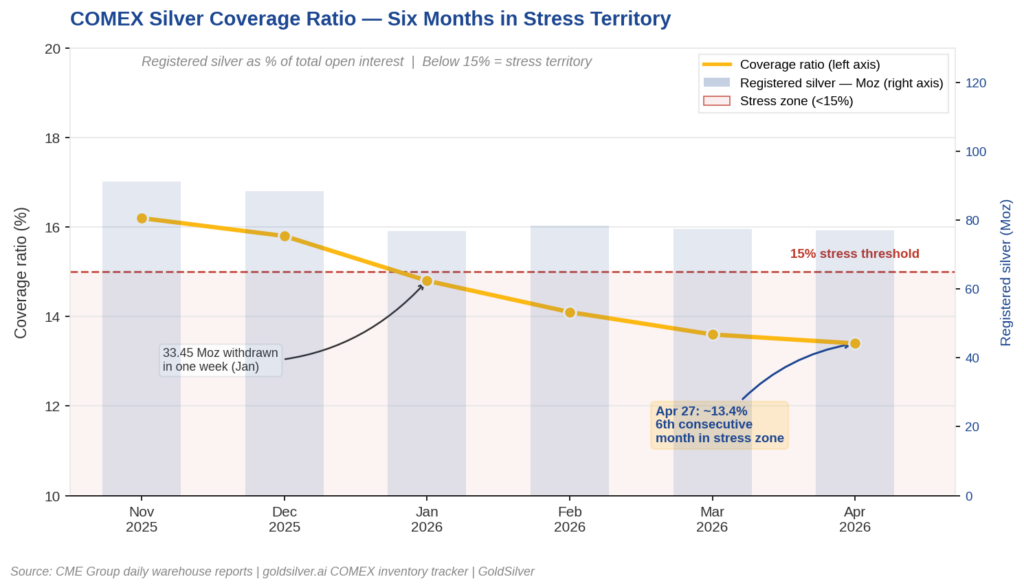
January set a critical precedent. In early 2026, 33.45 million ounces disappeared from registered inventory in one week. That was roughly 26% of the entire deliverable pool, per CME Group warehouse data. Nobody expects May to repeat that. Nevertheless, that pool was never refilled. It is smaller going into this First Notice Day than it was then.
Each 1% rise in delivery rate on the May contract alone requires 1.3–1.4 million additional ounces of registered metal. Across all active delivery months, that figure rises to 5–6 million ounces per percentage point. Neither number is catastrophic in isolation. Both become significant if sustained across several delivery days into a pool that has not grown.
What Other Data Lands on April 30?
Two additional market-moving releases hit the same morning as First Notice Day.
The Bureau of Economic Analysis publishes its Q1 2026 GDP advance estimate at 8:30 a.m. EDT — the first hard official read on whether oil-driven inflation has slowed US growth. The Atlanta Fed’s GDPNow model tracked Q1 growth at just 1.2% annualized as of April 21. Additionally, the IMF cut its full-year 2026 US forecast to 1.8% in April. A weak number would reinforce stagflation fears — historically one of the strongest environments for physical precious metals. A stronger number would clear the path for Fed rate cuts later in 2026. Rate cuts also tend to support gold and silver prices.
Weekly initial jobless claims land the same morning, adding another read on labor conditions heading into the Fed’s June meeting.
In short: three inputs, one morning. The GDP number and the physical delivery picture get resolved simultaneously.
What Does the Coverage Ratio Signal for Physical Silver Holders?
Physical silver — coins, bars, allocated vault storage — sits entirely outside the COMEX numbers. It carries no rolling pressure and no margin requirements. No warehouse warrant changes hands when you own it outright. The coverage ratio is not a direct threat to physical holders. It is their clearest real-time signal about what is happening in the market underneath them.
When the ratio holds below 15% for six straight months, one thing is clear. Market participants who need deliverable metal are competing for a steadily shrinking pool of it. That is a structurally different market. Three years ago, COMEX registered stocks were three times larger.
Thursday will almost certainly resolve quietly. Most May contracts roll to July. That’s almost certainly what happens.
Still, the day after matters more than the day itself. The World Silver Survey 2026 confirms the cumulative drawdown: 762 million troy ounces. That spans five straight annual deficits, per the Silver Institute and Metals Focus (April 15). Furthermore, the 2026 shortfall is projected at 46.3 million ounces — the sixth straight deficit year. That structural drawdown does not pause for a quiet First Notice Day.
Watch the coverage ratio on Friday, May 1. Thursday’s delivery headline count will be low and unremarkable. The coverage ratio will tell you whether the registered pool held or shrank. More importantly, watch for whether physical pressure is building. That is the shift that turns a structural story into a price story.
Stay On Top of Gold & Silver Prices
Get important market alerts sent straight to your inbox.
SOURCES
1. CME Group — COMEX Silver Warehouse Stocks and Delivery Notices
2. CME Group — Silver Futures Contract Specifications
3. GoldSilver.ai — COMEX Silver Inventory Tracker
4. Bureau of Economic Analysis — Gross Domestic Product, Q1 2026 Advance Estimate
5. Federal Reserve Bank of Atlanta — GDPNow Model, Q1 2026
6. IMF — World Economic Outlook, April 2026: Global Economy in the Shadow of War
7. Silver Institute and Metals Focus — World Silver Survey 2026
8. Federal Reserve — FOMC Meeting Calendar 2026
By the GoldSilver Editorial Team — helping investors understand sound money since 2005. This article is for informational purposes only and does not constitute financial, investment, or tax advice. Always consult a qualified financial advisor before making investment decisions.
You May Also Like:
- What Warsh as Fed Chair Means for the Gold Price
- 5 Signals the Mainstream Gold & Silver Narrative Missed
- Before the Fed Speaks, Watch This Number for Gold
- Gold Price Today: What to Watch Before the April 29 FOMC
- What’s Driving Gold Prices? Oil, PMI, and Newmont
- Dollar Weakens, Gold Falls — and That’s Actually Bullish
- Why Chinese Silver Imports Hit a Record in 2026
- What Drives Gold Prices? 5 Forces Investors Are Watching Now