Silver Rises Over 120% YTD




Daily News Nuggets | Today’s top stories for gold and silver investors
February 26th, 2026 | Brandon Sauerwein, Editor
Tariff Whiplash: What the Legal Chaos Means for Markets
The trade policy whiplash continues — and it’s adding fresh fuel to the gold price rally. Last Friday, the Supreme Court struck down Trump’s sweeping “Liberation Day” tariffs. Hours later, the president signed a new 10% global import tariff under Section 122 of the Trade Act of 1974.
That provision has never been used for broad tariff imposition. It took effect Tuesday. By Wednesday, the administration was already pushing higher. US Trade Representative Jamieson Greer confirmed duties will rise to 15% on certain countries “where appropriate.” China tariffs stay near 35–50%.
Section 122 runs on a 150-day clock — after which Congress must approve an extension. Democrats have already pledged to block it.
The fallout is widening fast. Over 900 companies have sued over the original tariffs. Potential refund obligations top $160 billion. The EU has paused ratification of its US trade deal pending clarity on what comes next.
Markets hate uncertainty more than bad news. Right now, they have both.

Stay Ahead with Gold & Silver News The most important market insights, Fed updates, and global trends — everything investors need to make smarter, safer decisions.
Eight Months and Counting: Gold’s Historic Run
The gold price rally is gaining momentum, with the metal now on track for what could become the longest sustained winning streak in modern market history. The metal has posted eight consecutive higher monthly closes — a stretch of consistency that’s rare for any asset, let alone a commodity.
Commodities typically trade in volatile cycles. This steadiness signals something deeper than short-term speculation.
The drivers are well-documented but worth naming: falling yields, persistent geopolitical tension, elevated sovereign debt, continued central bank buying, and a softening dollar. Together, they’ve reinforced gold’s role as a portfolio stabilizer — not just a trade, but a macro hedge.
Extended streaks do attract momentum flows and speculative positioning. That’s worth watching. But the more important question is whether this represents a structural shift toward hard assets — or simply a long run approaching natural consolidation.
History suggests the former. The conditions driving this rally haven’t resolved. They’ve deepened.
The Gold-Silver Ratio Just Hit a 10-Year Low. Here’s Why It Matters.
Gold pushed higher today as weaker data fueled Fed pivot speculation. At time of writing, gold trades around $5,175, up 0.2%. Silver sits at $86.75, down 2.90%.
The gold price rally has been well-covered. But the gold-silver ratio may be the more telling signal right now.
Gold Silver Ratio 10 Year Chart: Still at Historic Lows
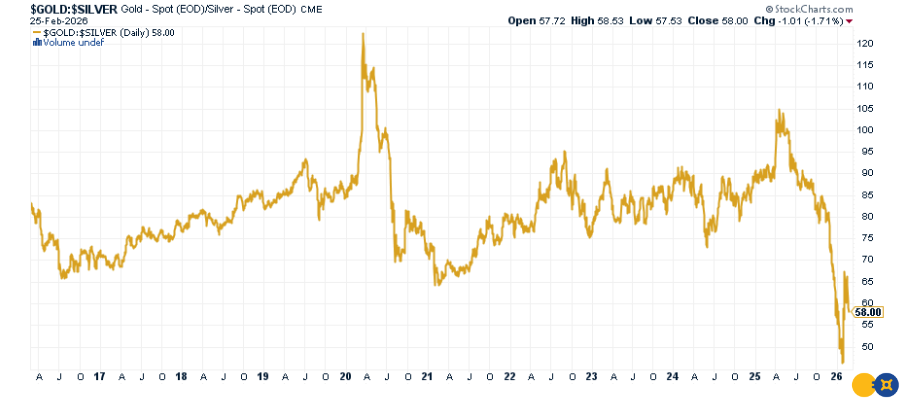
The gold-silver ratio — simply gold’s price divided by silver’s price — stands near 60-to-1, well below the 80–90 range that has dominated most of the past decade. Historically, sustained breaks below long-term averages have often coincided with powerful silver-led rallies.
That said, extreme moves tend to revert. A low ratio can signal strong silver momentum — but it also brings the metals complex closer to levels where profit-taking historically emerges.
With inflation data and labor reports due soon, the next leg may hinge on one question: does this cycle accelerate, or is consolidation already quietly building?
India Just Opened a $385 Billion Door for Gold
India’s market regulator is broadening rules for the country’s $385 billion mutual fund industry. Equity-focused funds can now hold greater exposure to gold through ETFs and gold-backed instruments. For portfolio managers, it’s a new tool for navigating market stress and currency volatility.
India has always been one of the world’s largest physical gold markets. But this is different. It’s not cultural demand or household savings driving the move — it’s formal policy. Gold is being written into equity investment mandates, shifting from jewelry boxes and bullion vaults into structured portfolios alongside stocks and bonds.
The implications reach well beyond India. Institutional capital allocated to gold through regulatory frameworks is stickier and more systematic than sentiment-driven buying. It doesn’t panic-sell. It rebalances.
As more regulators take this step, gold’s demand base becomes less cyclical — and more structural. That’s a slow-moving shift. But it’s exactly the kind that reshapes markets over time.
Turkey Is Building a Gold Exchange. Istanbul Wants to Be the Next Financial Hub.
Turkey is preparing to launch a centralized commodities exchange in 2026. The goal: consolidate fragmented markets, improve price transparency, and attract international participants across gold, agriculture, and raw materials.
Gold will be central to it. Turkey is already one of the world’s most active gold markets, with deep retail demand and significant bullion imports. A structured exchange would bring standardized contracts, stronger oversight, and improved liquidity — all critical for a country that has weathered serious currency volatility in recent years.
The strategic ambition is larger than the exchange itself. Turkey wants Istanbul positioned as a regional financial hub connecting Europe, the Middle East, and Asia. A formal commodities market is a key piece of that infrastructure.
Taken alongside India’s regulatory shift, a pattern is emerging. Emerging markets aren’t just consuming gold — they’re building the institutional architecture around it.
Daily price charts show the gold rally. Stories like these explain why it may last.