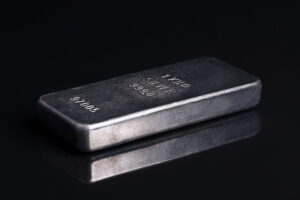
Silver Rises Over 120% YTD




🌅 Morning News Nuggets | Today’s top stories for gold and silver investors
March 24th, 2026 | Brandon Sauerwein, Editor
The Treasury just released numbers that raise a question most media won’t ask: is the US government insolvent? Plus — why gold is selling off during a war, what’s really happening to oil prices, and why one major ETF CEO is going all in on hard assets.
Chevron’s Warning: What if the Strait of Hormuz Stays Closed?
Oil markets whipsawed again Tuesday. Brent crude rebounded 1.3% to around $101 a barrel and WTI gained 2.3% to $90.19, paring losses after Brent had fallen about 11% on Monday — from a Friday high above $112. The Monday plunge came after Trump announced what he called productive talks with Iran toward a full resolution of hostilities. Markets moved fast — then pulled back as doubts set in.
The underlying supply problem hasn’t gone away. Iranian state media said Tehran would permit safe transit through the Strait of Hormuz, except for ships linked to its “enemies” — a caveat that leaves most of the market uncertain. Chevron’s CEO said the physical consequences of the Hormuz closure are still working their way through the global system and aren’t fully reflected in futures prices.
Goldman Sachs warns that if Hormuz flows remain near 5% of normal for 10 weeks, Brent could surpass its 2008 record high. That record: roughly $147 a barrel. Energy markets — and inflation — aren’t out of the woods yet.

Stay Ahead with Gold & Silver News The most important market insights, Fed updates, and global trends — everything investors need to make smarter, safer decisions.
Gold’s Losing Streak Snaps — But the Pressure Isn’t Gone
Gold snapped a near-record 10-day losing streak Tuesday. It had fallen more than 15% since the Middle East war broke out. The rebound was modest — the pressure isn’t gone.
The selloff follows a counterintuitive but familiar wartime script. War drives energy prices higher. Higher energy prices stoke inflation fears. That leads the Fed toward rate hikes — a direct headwind for gold, which yields nothing. Meanwhile, traders sitting on profitable gold positions are selling to cover losses elsewhere. The metal becomes a source of funds, not a refuge.
Spot gold touched $4,425 an ounce in London trading. Silver climbed to $70.06. The numbers look ugly in the short term. But analysts point to 2022, when gold sold off sharply after Russia invaded Ukraine — then resumed its climb once the dust settled. The monetary drivers haven’t changed. The selloff may be the story today. The recovery may be the story that matters.
Why Is Russia Selling Gold at a 23-Year High?
Most central banks are buying gold right now. Russia is selling it. That contrast tells you something important about the state of its finances.
Russia sold roughly 15 metric tons from its reserves in the first two months of 2026. That’s the largest drawdown since 2002. The driver is a widening fiscal hole: Russia’s federal budget deficit has exceeded $183 billion over 2022–2025. Another $42.7 billion was added in just January and February of this year.
But the sales aren’t only about plugging the deficit. Analysts say Russia is also trying to conserve yuan — one of the few foreign currencies it can still access. Western sanctions froze roughly $300 billion in Russian assets abroad. That leaves Moscow with limited options and a shrinking toolkit.
The irony is sharp. Gold now makes up 47% of Russia’s reported international reserves. But much of that total includes frozen assets it can’t touch. The world’s most prominent gold-selling nation right now is also one of its largest gold holders — on paper.
Is Gold a Better Bet Than Bitcoin Right Now?
WisdomTree CEO Jonathan Steinberg has a clear answer: yes. Speaking with Barron’s, Steinberg argued that gold and metals are a stronger alternative to the U.S. dollar than Bitcoin — a pointed claim from someone who has spent years building out digital asset products.
His reasoning cuts against a popular narrative. Bitcoin is often called “digital gold.” Steinberg rejects that framing. Tokenized, fully-backed gold already exists on blockchain networks. The comparison, in his view, is obsolete.
The timing of his comments matters. Gold posted its strongest calendar-year performance since 1979 in 2025. Central banks are accumulating it. Institutional allocations are rising. And with U.S. fiscal deficits widening and dollar confidence slipping, the case for hard assets isn’t a fringe view anymore — it’s becoming consensus.
Did the U.S. Government Just Admit It’s Insolvent?
The question of whether the US government is insolvent used to sound fringe. The Treasury’s own balance sheet is making it harder to dismiss. The FY 2025 consolidated financial statements were released last week to near-total media silence. They show $47.78 trillion in liabilities against just $6.06 trillion in assets. That’s a net position of negative $41.72 trillion. It deteriorated by $2.07 trillion in a single year.
The biggest drivers: a $2 trillion increase in federal debt and interest payable, and a $438.8 billion rise in federal employee and veteran benefits.
That’s just the official balance sheet. Off it, the 75-year unfunded social insurance gap surged $10.1 trillion in a single year — reaching $88.4 trillion, driven by Medicare Part B and Social Security shortfalls. Add it together and total federal obligations top $136 trillion. That’s roughly five times U.S. GDP. The GAO has declined to certify these statements for 29 consecutive years.
Here’s what those numbers look like at human scale. Divide everything by 100 million and federal finances resemble a household budget in freefall. That household earns $52,000 a year. It spends $73,000. It owes $1.36 million — against $60,000 in assets. That is not merely debt trouble. It is insolvent. So is the government whose math it mirrors.
Investing in Physical Metals Made Easy