Silver Rises Over 120% YTD




Published: 06-23-2026, 04:42 pm | Updated: 06-23-2026, 04:58 pm
KEY TAKEAWAYS
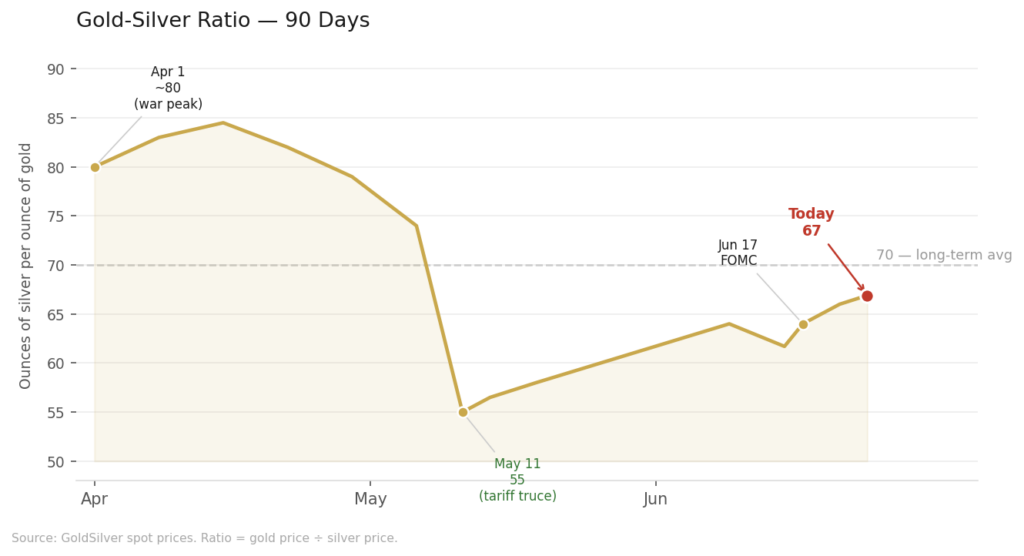
- The gold-silver ratio hit approximately 67:1 on June 24, 2026 — the widest level since the Iran war’s peak weeks.
- Gold is down 1.7%. Silver is down 5.4%. The gap reveals rate-hike fears dominating the Iran peace dividend.
- Nine of 18 FOMC officials project at least one rate hike before year-end. CME FedWatch prices roughly two-thirds odds of a hike. Gold’s central-bank demand floor is absorbing the same pressure that is stalling silver.
- May PCE drops Thursday, June 25, at 8:30am EDT. Consensus: 4.1% YoY. The print determines whether rate-hike odds extend or reprice.
- The structural case — six consecutive supply deficits, industrial demand, fiscal dominance — is unchanged. The ratio is measuring short-term monetary headwinds, not long-term fundamentals.
Gold is down 1.7% today. Silver is down 5.4%. The difference is sitting in plain sight. The gold-silver ratio just hit 67 — and if you know how to read it, it’s telling you precisely which force is dominating the market right now. Not as a valuation call. As a diagnostic. The Iran peace deal should have been good for silver. Thursday’s PCE report is why it isn’t yet.
In this article: why silver is falling harder than gold today, what the gold-silver ratio at 67 is actually measuring, and what Thursday’s PCE print changes.
Why Are Gold and Silver Moving in Opposite Directions?
Most investors read the gold-silver ratio as a valuation gauge. It tells you whether silver is cheap relative to gold, or vice versa. That is a useful tool — and GoldSilver covered exactly that framework last week when the ratio stood at 64 [World Gold Council; GoldSilver.com, June 19, 2026].
Today, however, the ratio is doing something different. It hit approximately 67:1 on June 24, 2026. That means it now takes roughly 67 ounces of silver to buy one ounce of gold [GoldSilver.com spot prices; TradingEconomics, June 23, 2026]. Moreover, that number is a live diagnostic of a very specific market tension playing out in real time.
Two forces are currently pulling precious metals in opposite directions. Understanding which one is winning explains the price gap.
The Edge Every Investor Needs Smarter precious metals investing starts here. The Nuggets Newsletter brings you essential market insights, Fed updates, global trends, educational videos, and much more.
What Happened to the Iran Peace Deal — and Why Didn’t It Help Silver?
First, the good news. The US and Iran agreed to a 60-day peace roadmap [TradingEconomics, June 2026]. The US subsequently granted Iran a license to sell oil on international markets. Shipping through the Strait of Hormuz is recovering. As a result, oil prices are declining.
Lower oil prices should be bullish for silver specifically. Here is the mechanism: lower oil reduces inflationary pressure, which eases the Fed’s hand, which compresses real yields, which consequently makes non-yielding assets like silver more attractive relative to Treasury yields. That is the theory.
However, a complicating reality arrived on June 17. The Federal Reserve’s FOMC meeting — its first under Chair Kevin Warsh — revised inflation projections significantly higher. Nine of 18 officials now project at least one rate hike before year-end [Federal Reserve, Summary of Economic Projections, June 17, 2026]. Warsh did not submit his own projection. Deutsche Bank and BofA Global Research have since formally revised their forecasts to include a rate hike. CME FedWatch now prices roughly a two-thirds probability of at least one hike before year-end [CME FedWatch, June 2026].
Therefore, the ratio is telling you one thing clearly: the rate-hike narrative is winning. The Iran peace dividend is real. It is not, however, enough to overcome the weight of a Fed that has signaled it may need to tighten.
Why Is Silver Falling More Than Gold?
Silver runs on two engines simultaneously. The monetary engine — driven by real yields, inflation expectations, and dollar direction — moves alongside gold. The industrial engine — solar panels, electric vehicles, AI data center components, semiconductors — follows manufacturing cycles rather than central bank policy.
When rate-hike fears dominate, silver’s monetary engine stalls. Holding silver carries an opportunity cost. Specifically, a 4.50% 10-year Treasury yield is real competition for a metal that pays no interest [US Treasury, June 2026]. That engine is stalling right now. Consequently, silver is down 5.4% while gold is only down 1.7%.
Gold does not face that problem to the same degree. Central banks do not hold silver in reserve. They hold gold — and they have been buying it continuously. A record 45% of central banks surveyed by the World Gold Council plan to add more gold in 2026 [World Gold Council, Central Bank Gold Reserves Survey 2026]. That institutional bid comes from buyers who make decisions across decades, not quarters. It provides a structural floor that silver’s more price-sensitive investor base does not offer.
The result is a ratio at 67. It is not saying silver is dramatically cheap. It is saying the rate-driven pressure on silver is real, and it is measurable.
What Does Thursday’s PCE Report Mean for Silver?
May PCE inflation data drops Thursday morning at 8:30 a.m. EDT. The consensus forecast is 4.1% year-over-year — the highest reading since April 2023 [FactSet consensus, June 2026]. Core PCE, which strips out food and energy, is expected at 3.3–3.4%.
Here is the mechanism worth understanding. This PCE reading captures May data, when oil was still elevated from the Iran conflict. The relief from the peace deal — lower oil prices — will flow through to the June PCE print, released in late July. In other words, Thursday’s report is backward-looking.
That means Thursday could look hot even as the underlying pressure is easing. The market’s reaction will depend on whether investors treat it as a signal for what the Fed must do next, or as a backward-looking artifact of a conflict that is now de-escalating.
A hot print — at or above 4.1% — will likely extend rate-hike pressure, keep the dollar firm, and hold the ratio at 67 or higher. In contrast, a soft print — below 3.4% on core — could quickly reprice year-end hike odds and give silver room to recover.
What Does the Gold-Silver Ratio at 67 Not Tell You?
The ratio at 67 is not saying the structural case for silver is broken. Six consecutive annual supply deficits do not reverse on a Fed dot plot. Industrial demand from solar and AI infrastructure does not stop because nine officials penciled in a hike.
What the ratio is saying: the rate-driven pressure on silver right now is real. It is specifically suppressing silver more than gold. And Thursday’s PCE print is the number most likely to move it.
For the long-term holder who already owns physical silver — your ounces carry no counterparty risk. They cannot be margin-called. They are not diluted by rate expectations. What changed is the paper price. The structural reasons to hold physical silver did not change.
Finally, here is the second corner most investors miss. A widening gold-silver ratio in a rate-fear environment is historically not a signal to exit silver. It is a signal that the Fed has temporarily become the dominant force. And when that force shifts, silver tends to reprice faster than gold.
Thursday morning will give you the first read on how long that force has to run.
Stay On Top of Gold & Silver Prices
Get important market alerts sent straight to your inbox.
SOURCES
1. GoldSilver.com spot prices; TradingEconomics — Gold & Silver Spot Prices, June 23, 2026
2. Federal Reserve — Summary of Economic Projections, June 17, 2026
3. Federal Reserve — FOMC Statement, June 17, 2026
4. US Treasury; FRED/St. Louis Fed — 10-Year Treasury Constant Maturity Yield
5. CME FedWatch — Year-End Rate Hike Probability, June 2026
6. Morningstar; FactSet — May PCE Consensus Forecast, June 22, 2026
7. Bureau of Economic Analysis — Personal Income and Outlays, April 2026
8. World Gold Council — Central Bank Gold Reserves Survey 2026
9. TradingEconomics — US-Iran 60-Day Peace Roadmap & Oil License, June 2026
Disclaimer: This article is for informational purposes only and does not constitute financial or investment advice. Always consult a qualified financial adviser before making investment decisions.
You May Also like:
- BofA Says Three Rate Hikes. Silver Just Priced In the First One.
- Iran Deal. Oil Falling. A PM Out. Gold Still Above $4,100.
- PCE Drops Thursday. Here’s What It Means for Gold.
- Goldman Sachs Gold Target Cut: What the $1,400 Gap Means
- Gold Price Today, June 19: What Juneteenth Trading Tells You
- Half the Fed Wants a Hike. 45% of Central Banks Are Buying More Gold.
- Silver Hit $69.85 This Morning. Then the FOMC Took It All Back.
- The Fed Went Silent. Gold Holders Don’t Need It to Speak.