Silver Rises Over 120% YTD




De-dollarization isn’t coming. It’s already happening.
For decades, the global financial system has depended on the U.S. dollar to price the world’s most important commodity: oil. Today, that foundation is showing cracks — not through formal announcements, but through real-world trade decisions being made right now at one of the world’s most critical shipping lanes.
When GoldSilver analyst Alan Hibbard appeared on the Big Biz Show, he explained what most investors overlook about moments like this. When a monetary reset occurs, gold doesn’t gradually rise to reflect the new reality. It gets repriced — all at once. And that scenario is no longer theoretical.
Is the Strait of Hormuz the Starting Gun for De-Dollarization?
The Strait of Hormuz is one of the world’s most critical trade routes. Roughly 20% of global LNG and 25% of seaborne crude oil passes through it every year. When it’s open, the global economy barely notices. When it’s not, everything from gas prices to grocery bills feels it.
Right now, Iran isn’t just controlling who passes through. It’s controlling the currency they pay in.
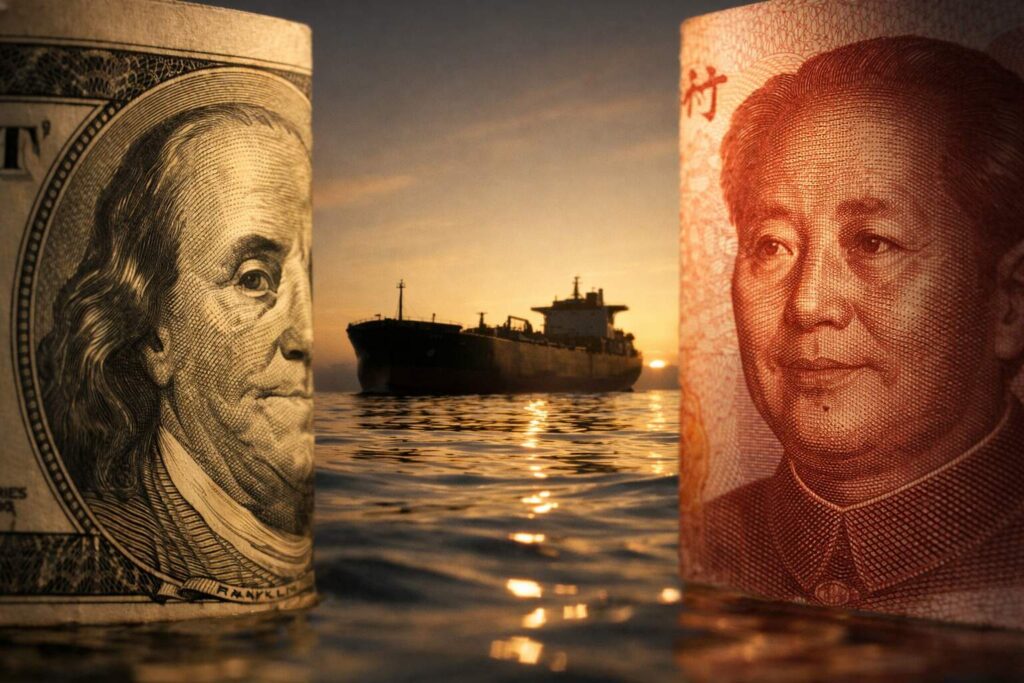
A senior Iranian official told CNN that Tehran is considering allowing tankers through — but only if oil cargo is settled in Chinese yuan, not US dollars. Chinese-flagged vessels are already transiting freely. Other ships are being told the price of passage is yuan.
This may seem like a regional dispute. It isn’t.
Why Does It Matter Which Currency Oil Is Traded In?
The yuan condition strikes directly at the petrodollar system — the post-1974 arrangement under which oil is priced in dollars, creating permanent global demand for the currency. If energy importers begin settling in yuan, that structural demand shifts away from the dollar and toward China’s currency. The foundation of U.S. financial dominance weakens — not through a treaty, but through transaction by transaction.
The infrastructure for this is already in place. China’s cross-border payment system processed the equivalent of $245 trillion in yuan-denominated transactions in 2025 — a 43% increase year over year. This isn’t a future capability. It’s an active system handling real volume.
Markets are treating this as a geopolitical story. It’s also a monetary one. And monetary systems don’t need a majority shift to start breaking down. They only need a credible alternative — and enough participants willing to use it. The relationship between de-dollarization and gold has never been more direct — or more visible.
Has a Reserve Currency Ever Collapsed Gradually? History Says No.
Most investors assume the de-dollarization and gold story would unfold slowly, with plenty of warning. History suggests the opposite.
Reserve currency transitions follow a recognizable pattern. They start at the margins: bilateral trade deals, regional alliances, sanctions workarounds. Each one looks small in isolation. But the changes accumulate, quietly eroding reliance on the dominant currency. Then confidence breaks faster than anyone expected, and the system adjusts in a hurry.
That early-stage pattern is visible right now. Central banks are buying gold at historically high levels. Emerging markets are negotiating trade outside the dollar system. Energy transactions — including at Hormuz — are being settled in alternative currencies. A broad geopolitical realignment is underway, and monetary independence is increasingly part of the agenda.
None of these signals, alone, is decisive. But investors waiting for a single, obvious trigger may be waiting for something that never comes. By the time the shift is undeniable, the repricing will already be happening.
Why Gold Responds Differently — and Why It Can Happen Overnight
Most investors think of gold as a slow-moving hedge. It rises with inflation. It climbs during uncertainty. That’s the normal-market version of gold. Monetary transitions work differently.
Gold isn’t tied to any currency or government. That makes it a neutral reserve asset — one that doesn’t just trend higher when confidence in fiat systems weakens. It gets repriced. Not gradually, but all at once.
GoldSilver analyst Alan Hibbard put it plainly on the Big Biz Show: “If gold is ever revalued — if we get a new monetary system — gold could double overnight, or triple overnight, literally in a day.”
That’s not a hypothetical. It’s happened before.
The 1971 Nixon shock — when the U.S. severed the dollar’s link to gold — was announced on a Sunday night. Markets opened Monday to a new reality. There was no gradual climb, no warning window. Investors who already held physical gold were already positioned. Everyone else was scrambling.
The Hormuz situation won’t necessarily trigger that kind of event. But it belongs to the same category of forces that can.

Get Expert Insights from Alan Hibbard Learn from Alan Hibbard, a trusted voice in precious metals delivering clear, actionable analysis on gold, silver and the global economy.
What Happens to Your Gold ETF When the System It Runs On Is Breaking?
A gold ETF tracks the price of gold. In normal markets, it does that job well. But the scenario we’re describing isn’t a normal market.
Hibbard is direct: “If there’s ever a power outage — or simply your internet doesn’t work on an important day where you’re trying to make a trade — you’re going to be locked out.”
That’s not a fringe scenario. Brokerage platforms go down during ordinary volatility. Circuit breakers halt trading during sharp moves. In a genuine monetary shock, those failure points don’t disappear — they compound. The window between a repricing event and your ability to act on it could be very narrow. Or it could be closed entirely.
The deeper issue is structural. ETFs depend on custodians, fund managers, and clearing houses functioning normally. In a monetary disruption, that infrastructure is exactly what comes under stress. It’s the same system that’s being challenged.
Physical gold has no counterparty. It doesn’t need a solvent custodian, an open fund, or a functioning brokerage. It isn’t a claim on gold — it is the gold.
As Hibbard puts it: “If you already have physical and you got it ahead of time, you’re good.”
That last part matters: ahead of time. Not during the event. Not after the headlines. Before.
Preparation, Not Prediction
The dollar remains the world’s primary reserve currency. It’s backed by deep capital markets and decades of institutional trust. An imminent collapse isn’t the thesis here.
But a full collapse isn’t required for gold to matter. A credible shift is enough — and credible shifts are already underway. Central banks are buying gold at record levels. Energy trade is moving outside the dollar system. The Strait of Hormuz is being used as a currency lever in real time.
You don’t need to know how this ends. You only need to recognize that the system is no longer as static as it was.
Gold exists outside that system. It isn’t a bet on any single outcome — it’s a position that holds value across multiple ones. Whether the dollar weakens gradually, gets repriced in a shock event, or simply loses its monopoly on oil settlement, gold benefits.
The investors who have historically done best in monetary transitions weren’t the ones who called the exact moment. They were the ones who stopped waiting for certainty before acting.
That window — between “this is beginning” and “this is obvious” — is where preparation happens.
Investing in Physical Metals Made Easy

People Also Ask
What is de-dollarization and why does it matter for gold?
De-dollarization refers to countries reducing their reliance on the U.S. dollar for trade and reserves. As this shift accelerates, confidence in fiat currencies can weaken, which historically drives demand for gold as a neutral, non-political asset. Many investors turn to physical gold to hedge against these systemic changes.
How does the Strait of Hormuz impact global markets and gold prices?
The Strait of Hormuz handles about 20% of global oil supply, making it a critical chokepoint for energy trade. If oil transactions begin shifting away from the dollar in this region, it could accelerate de-dollarization. That kind of shift can increase demand for gold as a stable store of value.
Why are countries moving away from the U.S. dollar?
Countries are seeking greater financial independence and protection from sanctions or currency volatility. By trading in alternative currencies like yuan or local currencies, they reduce reliance on the dollar-based system. This trend often coincides with increased central bank gold buying.
Is gold a good hedge against a currency reset?
Gold has historically performed well during periods of monetary instability and currency transitions. Because it has no counterparty risk and is globally recognized, it serves as a form of financial insurance. Many investors include physical gold in their portfolio to prepare for potential resets.
What’s the difference between owning physical gold and a gold ETF?
Gold ETFs offer convenience and liquidity but rely on financial intermediaries and market access. Physical gold, on the other hand, is a tangible asset you own directly, without counterparty risk. During systemic disruptions, many investors prefer physical ownership for added security.