Silver Rises Over 120% YTD


Published: 11-09-2026, 03:39 pm
Gold fell 43% between 2011 and 2015. Gold mining stocks fell 77% over the same stretch. Same metal, completely different outcome.
That gap exposes something every gold investor needs to understand. Where you hold your gold changes what you actually own. A coin, an ETF share, and a mining stock all represent exposure to the same metal. However, each one carries its own costs, risks, and exit speed.
This guide breaks down the three main ways to own gold. You’ll see what each one actually costs and how fast you can turn it into cash. Then you can decide which holding fits your goals.
Where Should Your Gold Actually Live?
Every ounce of gold you own lives at one of three “addresses”. First, physical metal: coins and bars you hold directly, or store in a vault under your name. Second, a gold ETF: a brokerage share backed by bullion sitting in someone else’s vault. Third, a mining stock: a share in a company that digs up gold and sells it for profit.
Each “address” decides what you pay going in, how fast you can get out, and what happens when prices turn. Here’s how that plays out at each one.
The Knowledge That Changes Everything
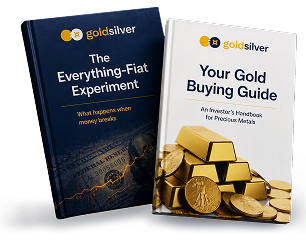
Two essential guides — yours free. Understand why gold matters and why fiat currencies always fail.
What Does Physical Gold Really Cost You?
Physical gold means a coin, a bar, or a vault account that belongs to you outright. Nothing stands between you and the metal. There’s no fund, no issuer, and no counterparty risk. That independence, however, comes at a price.
Dealers sell bullion above the spot price, and that markup is called the premium. When you sell, a dealer buys it back below spot, and that gap is the spread. Together, the premium and the spread mean the price has to rise before you break even.
Storage and insurance add further costs on top of that. At GoldSilver, for example, allocated vault storage runs 0.18% of your account value per quarter. Selling from storage typically settles within one to eight business days once the vault confirms receipt. Taking delivery to your door, meanwhile, carries no fee beyond shipping and insurance.
In short, physical gold rewards independence and patience, but it moves slower than a storage account.
How Do Gold ETFs Work, and What Do They Really Cost?
A gold ETF trades like a stock, but each share represents a slice of real bullion. Large financial firms, called authorized participants, create and redeem shares in blocks of 100,000. That mechanism keeps the share price close to the value of the underlying gold.
State Street’s flagship GLD fund charges 0.40% a year [State Street SPDR Gold Shares]. Its lower-cost sibling, GLDM, charges just 0.10%. That is the trade-off ETFs offer: speed and low cost, in exchange for direct ownership of your bar. Shares trade in seconds during market hours, with spreads of a fraction of 1%.
However, the fund pays its management fees by selling a small amount of gold every month. As a result, the bullion behind each share quietly shrinks over time. Custodians insure their own vaults, not necessarily the trust’s full holdings [State Street SPDR Gold Shares]. In other words, convenience carries a quiet cost of its own.
Why Do Mining Stocks Move More Than Gold Itself?
A mining stock is not a claim on gold. It is a claim on a company that finds, extracts, and sells gold for a profit. That distinction matters, because mining profit moves faster than the gold price itself.
Miners report an all-in sustaining cost, the full price of pulling one ounce from the ground. Subtract that cost from the gold price, and what remains is profit per ounce. In the year to the first quarter of 2026, the average gold price rose 70%. Meanwhile, the average mining cost rose only 16%, to $1,785 per ounce [World Gold Council]. As a result, the average profit margin per ounce jumped 134%, to a record $3,076.
That is the magnifier effect: a move in gold shows up in mining profits at a larger scale. The same magnifier, though, works in reverse. Between 2011 and 2015, that mechanism ran backward. Gold fell 43%, but GDX, then the largest gold miners fund, fell 77% [VanEck].
Rising royalties add another layer of cost. Several West African gold producers now charge royalty rates that climb alongside the gold price. Average mining royalties have roughly doubled over the past five years.
Mining stocks can still pay you directly, something an ounce of gold never does. Dividends and buybacks are part of the appeal. Many investors access miners through a fund like GDX. Its top 10 holdings make up close to 59% of the fund, and nearly half sit in Canadian companies.
Which Gold Investment Fits Your Strategy?
Taxes and liquidity separate these three holdings even further. Physical gold and physically-backed gold ETFs are both taxed as collectibles, at a top rate of 28%. Mining stocks, on the other hand, are taxed like ordinary equities. Long-term gains there face rates of 0%, 15%, or 20%, depending on your income.
Liquidity varies just as much. The global gold market traded roughly $163 billion a day in 2023, among the deepest markets anywhere [World Gold Council]. A coin sells through a dealer’s quote; an ETF share sells on an exchange within seconds; a mining stock answers to the gold price and the stock market’s mood.
None of these three options are automatically the right one. Many investors hold a mix of all three. Coins or bars provide direct ownership, an ETF adds speed, and mining stocks add dividends and extra upside. The ounce is the same everywhere. What changes is the baggage that comes with it.
Watch the Full Breakdown
The full video walks through the exact math behind each option. You’ll see how the premium and spread combine to set your breakeven price. You’ll also learn why silver’s industrial demand makes it an even stranger case than gold. Watch The GoldSilver Show above to see Megan King Diaz break down all three “addresses” in full.
Stay On Top of Gold & Silver Prices
Get important market alerts sent straight to your inbox.
SOURCES
1. World Gold Council — Record Gold Prices Outpace Rising Mining Costs in Q1’26
2. State Street Global Advisors — SPDR Gold Shares (GLD) Fund Overview
3. VanEck — Gold Miners ETF (GDX) Fact Sheet
Disclaimer: This article is for informational purposes only and does not constitute investment advice. Past performance is not indicative of future results. Always consult a qualified financial advisor before making investment decisions.
You May Also Like:
- Michael Oliver: Is Gold’s 29% Drop Just Like 2008?
- Gold Broke $4,000. The Fed Just Proved Him Right.
- Why Isn’t Gold at $6,000 Yet? Gerald Celente Explains
- Peter Grandich: What Happens to Gold When Stocks Fall?
- Peter Grandich Sold Gold, But He’s Buying On the Dip
- Ronnie Stoeferle’s $8,900 Gold Forecast Comes With a Warning
- US May be on Brink of Massive Gold Revaluation
- Why Gold Ignored the Fed’s Fastest Rate Hikes in 40 Years