 Silver Rises Over 120% YTD




- Gold became the world's first standardized money around 650 BC in the ancient kingdom of Lydia (World History Encyclopedia).
- The United States operated on a bimetallic gold-and-silver standard from 1792; the Gold Standard Act of 1900 formalized gold's dominance (US Mint; Encyclopedia.com).
- FDR's Executive Order 6102 (April 5, 1933) made private gold ownership illegal for US citizens — a ban that lasted 41 years until December 31, 1974 (National Archives; Public Law 93-373).
- Nixon's August 15, 1971 decision to end dollar-gold convertibility launched the modern fiat era; gold has risen more than 12,700% since (Federal Reserve History).
- Gold is trading at $4,468 per troy ounce as of June 1, 2026, while the dollar has lost roughly 87% of its purchasing power since 1971 (nFusion Solutions; BLS CPI data).
Gold became money more than 5,000 years ago — not because a government declared it valuable, but because people kept choosing it. Every time a society traded it away for paper promises, the promises eventually ran out. The gold didn't.
Today's price of $4,468 per troy ounce measures the gap between a metal that has passed every monetary test in history and the fiat currencies competing to replace it. Here's the complete story: how gold became money, why it stayed money, and what happened every time someone tried to say it wasn't anymore.
The First Gold Coins: Lydia, 650 BC
The world's first standardized coins appeared around 650 BC in Lydia, a kingdom in what is now western Turkey. King Alyattes issued coins of electrum — a natural alloy of gold and silver — stamped with the royal seal. His son Croesus went further: rather than continue with variable electrum, he replaced it with pure gold and silver coins of standardized weight and purity — the world's first true bimetallic coinage.
Before coins, trade ran on barter, grain weights, and lumps of unverified metal. The Lydian coin changed that: it standardized what money was worth through the authority of a government guarantee. The merchant across the market didn't need to weigh your metal. He just needed to see the king's stamp.
Why gold was uniquely suited to this role — and why nothing has changed: Scarcity — gold can't be conjured from nothing; roughly 216,000 tonnes have been extracted across all of human history. Durability — it doesn't corrode, rust, or degrade; a Roman gold coin buried for 2,000 years emerges chemically unchanged. Divisibility — it can be cut, melted, and reminted without losing value per unit weight. Portability — its high value-to-weight ratio means a small amount stores significant wealth. Uniformity — one troy ounce of .999 gold is identical to any other, anywhere on Earth.
The Knowledge That Changes Everything
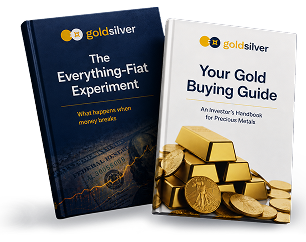
Two essential guides — yours free. Understand why gold matters and why fiat currencies always fail.
The Roman Empire and the First Debasement Lesson
Rome built its monetary system around the aureus — a gold coin standardized by Julius Caesar around 49 BC at approximately 8 grams of pure gold. At the empire's height, the aureus circulated from Britain to Mesopotamia. It was the ancient world's first genuinely international reserve currency.
Then Rome discovered what every empire since has rediscovered: when you can't pay your bills, you can debase your currency. Emperors began reducing the gold content of coins by mixing in cheaper metals. Emperor Constantine introduced the solidus in approximately 312 AD as a stable replacement, and while it held its value for several centuries, the broader pattern was clear: as Rome's fiscal position deteriorated, so did the quality of its money.
Gresham's Law in action: The people who handled Roman coins noticed. They hoarded the old, heavier gold coins and spent the newer, debased ones. Bad money drives out good — people rationally hold the trustworthy asset and circulate the suspect one. This dynamic has repeated so consistently across history that it functions as a law of monetary physics.
Medieval Europe and the Gold Florin
After Rome fell, Europe operated on fragmented, unreliable monetary systems for centuries. In 1252, Florence changed that. The Republic introduced the florin — a gold coin weighing 3.499 grams of fine gold, minted to a consistent standard from 1252 to 1533: nearly three centuries without significant change in design or metal content.
The florin became the first pan-European reserve currency of the medieval age. Merchants from Venice to London priced goods in florins. Bankers in the Medici network extended international credit in florins. The coin's integrity — never significantly debased across its entire lifespan — was the foundation of Florentine economic dominance.
Meanwhile, Florence's competitors clipped and debased their own coins — and found themselves shut out of international trade. Credibility compounds slowly and collapses fast. The trust it took generations to build could be destroyed overnight by a single debasement.
The United States: A Bimetallic Beginning (1792)
America's first monetary system, established by the Coinage Act of 1792, rested on a bimetallic standard — both gold and silver as official money. The act defined the dollar as either 24.75 grains of gold or 371.25 grains of silver, at a fixed gold-to-silver ratio of 15:1.
The problem was immediate. Because the official ratio never quite matched the market ratio, whichever metal was undervalued got hoarded and exported — Gresham's Law, operating in the brand-new American republic. Silver was formally demonetized in 1873. Gold-standard advocates celebrated; silver interests furiously labeled it "The Crime of '73." The battle culminated in William Jennings Bryan's famous 1896 "Cross of Gold" speech, which argued the gold standard was crushing indebted farmers who needed cheaper money. Gold won.
The Classical Gold Standard and the Gold Standard Act of 1900
The Gold Standard Act of 1900 settled the question. One dollar equaled 23.22 grains of fine gold — approximately 1/20th of a troy ounce — setting the official price at $20.67 per troy ounce. The dollar was now a receipt: a paper claim on a fixed quantity of gold.
From roughly 1870 to 1914 — the Classical Gold Standard era — most major trading economies pegged their currencies to gold. Exchange rates were fixed. International trade flourished. No government could print money beyond its gold reserves without risking a bank run. Fiscal discipline was enforced by the system itself.
The self-correcting mechanism: If a country ran a trade deficit, gold flowed out, the money supply contracted, prices fell, and exports became competitive again — bringing gold back in. The system self-corrected with no central banker required. It was also deliberately constraining: governments couldn't spend freely during wars or downturns without raising taxes or issuing gold-backed bonds. That constraint was precisely what made the currency trustworthy — and precisely why governments eventually abandoned it.
World War I and the First Cracks
World War I exposed the gold standard's fundamental vulnerability: no government at war can afford monetary discipline. In 1914, every major European power suspended gold convertibility within weeks of the outbreak. Printing money to finance armies was easier than taxing populations. Britain, France, and Germany all inflated dramatically between 1914 and 1918.
After the war, countries tried to return to gold at pre-war exchange rates — effectively pretending the inflation hadn't happened. It was painful. Britain's 1920s return to gold at the old rate is widely considered a policy error that deepened the contraction leading into the Great Depression.
FDR's Gold Recall: Executive Order 6102 (1933)
On April 5, 1933, President Franklin Roosevelt signed Executive Order 6102, making it illegal for US citizens to own gold. Americans had until May 1, 1933 to surrender their gold coins, bullion, and gold certificates to Federal Reserve banks — at $20.67 per troy ounce. Nine months later, the Gold Reserve Act of January 30, 1934 revalued gold to $35 per ounce.
The immediate effect: Citizens who sold at $20.67 watched the metal they'd surrendered immediately become worth 69% more in the government's hands. The stated justification was stabilizing the banking system during the Great Depression. The real effect was this: it freed the government to expand the money supply without citizens redeeming dollars for gold. Private ownership of gold remained illegal for 41 years. President Gerald Ford restored Americans' right to own gold by signing Public Law 93-373 on December 31, 1974.
Bretton Woods: The Dollar's Moment (1944)
In July 1944, 730 delegates from 44 Allied nations gathered at Bretton Woods, New Hampshire, to design the post-war monetary order. Under the agreement, the dollar was pegged to gold at $35 per ounce. All other currencies were pegged to the dollar. Foreign governments and central banks could convert dollar reserves into gold at the official rate on demand. Citizens could not.
Gold backed the dollar. The dollar backed everything else. By the end of World War II, the US held approximately two-thirds of the world's monetary gold reserves — around 574 million troy ounces. As long as that held, and as long as Washington maintained fiscal discipline, the system worked. Neither condition held.
Nixon's Shock: The End of the Gold Era (1971)
By the late 1960s, the US had spent heavily on the Vietnam War and Lyndon Johnson's domestic programs without raising taxes to cover the cost. Dollars flooded overseas. Foreign central banks accumulated them — and increasingly, they wanted gold in exchange. By August 1971, US gold reserves had fallen from their post-WWII peak of 574 million ounces to approximately 276 million ounces — less than half. The run was accelerating. President Charles de Gaulle had been converting dollars to gold aggressively since the mid-1960s and had publicly called the gold-exchange standard an "exorbitant privilege" for the United States.
On August 15, 1971, President Nixon announced that the United States would no longer convert dollars to gold for foreign central banks. The Bretton Woods system was over. At that moment, every major currency on Earth became a fiat currency — backed by nothing but government promise.
What happened next: Gold was $35 per ounce that day. By January 1980, it reached $850. As of June 1, 2026, it trades at $4,468 — an increase of more than 12,700% since the gold link was severed.
Gold Has Risen More Than 12,700% Since the Dollar Left Gold
Gold price (USD per troy oz) — 1971 to 2026
Source: nFusion Solutions, historical consensus pricing | GoldSilver
Gold Has Never Been Abolished. Only Suppressed.
Every time a government has tried to end gold's monetary role, gold has returned when the suppression became financially unsustainable. Not because of sentiment. Because the alternative always carries the same fatal flaw: whoever issues the currency also controls how much of it exists. That creates an irresistible incentive to issue more. Short-term benefits — spending, stimulus, war finance — flow immediately to the issuer. Long-term costs — inflation, purchasing power erosion — are distributed across all currency holders, over years or decades.
Gold doesn't work that way. No government can issue more of it. Mine supply grows at approximately 1.5–2% per year, roughly matching long-run global economic growth. That discipline isn't a policy choice. It's a physical constraint.
Central Banks Are Voting With Their Vaults
Central banks hold more than 36,500 tonnes of gold in reserves today — a figure that keeps climbing. Official sector purchases totaled 863 tonnes in 2025 — the fourth-largest annual total on record. First-quarter 2026 purchases came in at 244 tonnes net, above the five-year quarterly average. By late 2025, gold had overtaken US Treasuries as the world's largest reserve asset by value.
Why the acceleration: In February 2022, Western governments froze approximately $300 billion in Russian central bank reserves. Every reserve manager on earth drew the same conclusion: assets held abroad are only as safe as your political relationship with the country that controls the clearing system. Gold, held in your own vaults, has no such counterparty.
Gold has also maintained its purchasing power across millennia in a way no paper currency ever has. An ounce of gold bought a fine toga in ancient Rome. It bought a fine suit in 1900. Today, it buys several fine suits. The price fluctuates in dollar terms — sometimes dramatically. But the purchasing power stays anchored in a way that paper money, freed from gold, simply cannot match.
Why Did Gold Ultimately Win Out Over Silver as the Monetary Standard?
Gold won because of supply stability. Silver deposits are widely distributed globally. Large discoveries — in the Americas in the 16th century and Nevada in the 1870s — repeatedly flooded markets and destabilized silver's value. Gold's supply, by contrast, grows at a slow, consistent pace that can't be dramatically altered regardless of price incentives.
The decisive moment came in 1871. Newly unified Germany used its Franco-Prussian War indemnity to switch to the gold mark. Britain was already on gold. The US followed with the Coinage Act of 1873. Within a decade, every major industrial economy had converged on gold. Silver didn't lose because it was bad money. It lost because gold was more resistant to sudden supply shocks.
How Much Gold Has Ever Been Mined, and How Much Is Left?
Approximately 216,000 tonnes of gold have been mined throughout all of human history — roughly two-thirds of that since 1950. Melted into a single cube, the entire above-ground stock would measure just 22 meters on each side — about the height of a four-story building. Known economically recoverable reserves underground total approximately 64,000 tonnes — enough for roughly 17–18 years at current production rates, though new discoveries and technology will extend that timeline. No discovery, no technology, and no government program has ever produced a step-change in gold supply the way it has with oil, agricultural commodities, or fiat currency. That slow-growing, finite stock is the whole argument.
What Is the Gold-to-Oil Ratio, and What Does It Tell Investors?
The gold-to-oil ratio measures how many barrels of crude oil one troy ounce of gold can buy. Since 1946, the long-run average has been approximately 15–17 barrels per ounce. It matters because it shows gold's purchasing power in real-economy terms — independent of dollar fluctuations — against the commodity that powers global industry. A ratio well above the historical average typically signals a recession suppressing oil demand, an oil glut, or gold being bid up by genuine monetary stress. As of mid-2026, the ratio remains historically elevated — the result of gold's exceptional run since 2024 and relatively subdued oil prices. For long-term holders, it's a quiet sanity check: gold's purchasing power, measured in barrels rather than dollars, has remained remarkably stable across decades.
What's the Difference Between Owning Physical Gold and Paper Gold?
Paper gold — ETFs, futures contracts, unallocated accounts — tracks gold's price without giving the holder direct ownership of specific metal. Physical gold means owning actual coins or bars, either in your possession or in allocated storage under your name. The difference is counterparty risk. With paper gold, your claim is only as good as the institution behind it. With physical gold, you own the asset outright — no institution can freeze it, dilute it, or fail to deliver it.
When Western governments froze $300 billion in Russian central bank assets in 2022, those were financial claims inside the system. The gold Russia held in its own vaults was untouchable. That episode accelerated a structural shift already underway: central banks, institutional investors, and individual savers moving from paper exposure to physical ownership. It's the same instinct that drove the Roman citizen to hoard the old aureus rather than spend it.
Has Any Government Ever Successfully and Permanently Replaced Gold with a More Stable Alternative?
No. Every attempt runs into the same structural problem: whoever manages the substitute controls how much of it exists. The League of Nations proposed replacing gold with internationally coordinated credit in the 1920s — it failed within a decade. Bretton Woods collapsed into pure fiat in 1971. The IMF tried to position Special Drawing Rights (SDRs) as a gold replacement in the 1970s — SDRs remain a niche accounting unit today. The euro was designed to be as rule-bound as a gold standard; while it has outperformed most fiat currencies, it hasn't escaped the political pressures that lead to monetary expansion. The post-1971 fiat era is the longest stretch in recorded history without a gold anchor. It has coincided with the fastest expansion of global debt ever recorded.
Stay On Top of Gold & Silver Prices
Get important market alerts sent straight to your inbox.
What This Means for the Individual Investor Today
The post-1971 fiat era has coincided with the fastest expansion of global debt in history, a roughly 50x increase in the US M2 money supply — from approximately $450 billion in August 1971 to over $22.7 trillion as of early 2026 — multiple currency crises across dozens of nations, persistent purchasing power erosion in every major fiat currency, and gold reaching all-time price records in every currency on Earth.
None of that tells you what gold's price will do next week or next year. But it tells you something about the long game. The individual who holds physical gold isn't making a trade. They're making the same deliberate decision that the merchant in 650 BC Lydia made — and the Roman citizen who hoarded the old aureus — and the French president who sent a ship to New York to exchange dollars for metal. All of them chose the store of value that has survived every monetary experiment, every paper currency, every empire that tried to replace it.
That's not doomsday thinking. It's 5,000 years of evidence.
1. BLS — Consumer Price Index (CPI) Data
2. Brookings Institution — Why Do the US and Its Allies Want to Seize Russian Reserves?
3. CoinWeek — Roman Gold Aureus of Julius Caesar
4. Encyclopedia.com — Gold Standard Act of 1900
5. Federal Reserve History — Federal Reserve Act Signed (December 23, 1913)
6. Federal Reserve History — Nixon Ends Convertibility of US Dollars to Gold (1971)
7. Federal Reserve History — Creation of the Bretton Woods System
8. Federal Reserve — H.6 Money Stock Measures (M2 Historical Data)
9. GoldSilver.com — Paper Gold vs Physical Gold: Which Is Safer?
10. Hillsdale College — The Rise and Fall of the Gold Standard in the United States
11. IMF Finance & Development — Gold, Silver, and Monetary Stability (March 2023)
12. IMF — International Financial Statistics: Official Gold Reserves
13. InflationData.com — Comparing Oil Price vs the Gold Price
14. Yahoo Finance / Bernstein Research — Breaking Down the Correlation Between Oil and Gold
15. MacroTrends — US Gold Reserves Historical Chart
16. MacroTrends — Gold to Oil Ratio Historical Chart
17. Mises Institute — A Toast to 50 Years of Legalized Gold (December 31, 1974)
18. MINING.COM — Gold Overtakes US Bonds as Largest Foreign Reserve Asset (January 2026)
19. National Archives — Executive Order 6102 (April 5, 1933)
20. National Archives — Executive Order 11825 / Public Law 93-373 (December 31, 1974)
21. National WWII Museum — Great Responsibilities and New Global Power (1945)
22. NumisWiki — Aureus (Roman Gold Coin)
23. Trading Economics — United States M2 Money Supply
24. USGS — Mineral Commodity Summaries 2026: Gold
25. US Mint — Coinage Act of April 2, 1792
26. Visual Capitalist — Visualizing How Much Gold Is Left to Mine on Earth (2025)
27. Wikipedia — Croeseid
28. Wikipedia — Executive Order 6102
29. Wikipedia — Florin (Florentine Gold Coin)
30. Wikipedia — Gold Reserve Act
31. Wikipedia — Gold Standard Act
32. Wikipedia — Solidus (Coin)
33. Wikipedia — United States Dollar
34. World Gold Council — How Much Gold Has Been Mined?
35. World Gold Council — Gold Demand Trends: Full Year 2025
36. World Gold Council — Gold Demand Trends: Q1 2026
37. World Gold Council — Gold Reserves by Country (IMF IFS Data)
38. World Gold Council — Gold Mine Supply Data
39. World History Encyclopedia — The Importance of the Lydian Stater as the World's First Coin


