Silver Rises Over 120% YTD




Published: 04-23-2026, 09:32 am
Gold and silver market update — April 23, 2026
Key Takeaways
- Gold is trading near $4,705 per ounce on April 23, 2026, down despite a dollar blockage, an Iranian ship seizure, and a leaderless Federal Reserve. The reason is a specific chain reaction most coverage is missing.
- The US Treasury blocked nearly $500 million of Iraq’s own oil revenue — proceeds held at the Federal Reserve Bank of New York — showing that dollar flows can be cut off at Washington’s discretion, even to allies.
- Central banks globally hold 36,000 tonnes of gold — 17% of all gold ever mined, per World Gold Council and IMF data. Sixteen consecutive months of net purchases. The blockage is exactly why.
The Trump administration just blocked a cargo plane carrying nearly $500 million in US banknotes to Iraq’s central bank. That money wasn’t aid. It was Iraq’s own oil revenue, held at the Federal Reserve Bank of New York — frozen to pressure Baghdad over Iranian-backed militias.
This morning, Iran seized two commercial ships in the Strait of Hormuz. Gold is trading near $4,705 per ounce, down on the day. By any standard reading, a dollar blockage, a ship seizure, and a leaderless Fed should be sending gold higher.
They aren’t. Understanding why matters more than the price move itself.
Why Did the US Block Iraq’s Dollar Shipments?
The Wall Street Journal first reported the move on April 22. US Treasury officials blocked the delivery — the second such suspension since the Iran war began in late February. These dollars aren’t foreign aid. They are Iraqi oil proceeds, held at the Federal Reserve Bank of New York under a post-2003 arrangement. Washington has controlled Baghdad’s oil revenue for over two decades.
The message is structural, not tactical. Greenback flows can be switched off — not just against adversaries, but against allies hosting US troops.
Now pair that with one number. Central banks globally hold approximately 36,000 tonnes of gold, per World Gold Council and IMF data. That’s roughly 17% of all the gold ever mined. Sixteen consecutive months of net purchases. This isn’t coincidence. It’s a rational response to a system where reserve assets can be frozen at the creditor’s discretion.
Notably, every monetary authority that watched Russia lose access to $300 billion in reserves in 2022 is now watching Iraq. The question is the same for all of them: what assets can Washington not reach? Physical gold, held in your own vault, is the answer they keep arriving at.
The Edge Every Investor Needs Smarter precious metals investing starts here. The Nuggets Newsletter brings you essential market insights, Fed updates, global trends, educational videos, and much more.
Why Is the Federal Reserve Still Without a Confirmed Leader?
The Fed has no confirmed chair. That’s not a procedural footnote — it’s a structural risk to the institution at the center of the global dollar system.
Kevin Warsh, President Trump’s nominee to replace Jerome Powell, testified before the Senate Banking Committee on Tuesday. His confirmation is blocked by Senator Thom Tillis (R-NC), who won’t vote for Warsh until the Justice Department drops its criminal probe into Powell. Prediction markets give just a 35% chance of confirmation before Powell’s term ends on May 15 — though Warsh is widely expected to be confirmed by late June, per Polymarket.
Meanwhile, the Federal Open Market Committee (FOMC) meets in six days, on April 28–29. Trump has told CNBC he’d be “disappointed” if a Warsh-led Fed doesn’t cut rates immediately. That’s not a hint. It’s a public declaration of intent.
This is fiscal dominance playing out in real time. Fiscal dominance occurs when a government’s debt is so large that the central bank can’t raise rates freely — because doing so would make that debt unaffordable. The next Fed chair doesn’t just inherit a policy challenge. They inherit a political constraint on what they can actually do.
Why Is Gold Falling If the Dollar Is Under Pressure?
Gold tracks real yields, not inflation alone.
Here is the mechanism, step by step. The Hormuz blockade pushed oil prices sharply higher. Higher oil pushed up inflation expectations. Those rising expectations forced the Fed to hold rates at 3.50–3.75%. Rates on hold kept real yields — bond returns after subtracting inflation — firmly positive. Positive real yields make gold less attractive to big investors. So paper gold — futures contracts and ETFs that track gold without physical ownership — sold off accordingly.
Simply put, this war has been inflationary, not deflationary. Inflationary conflicts hurt paper gold in the short run.
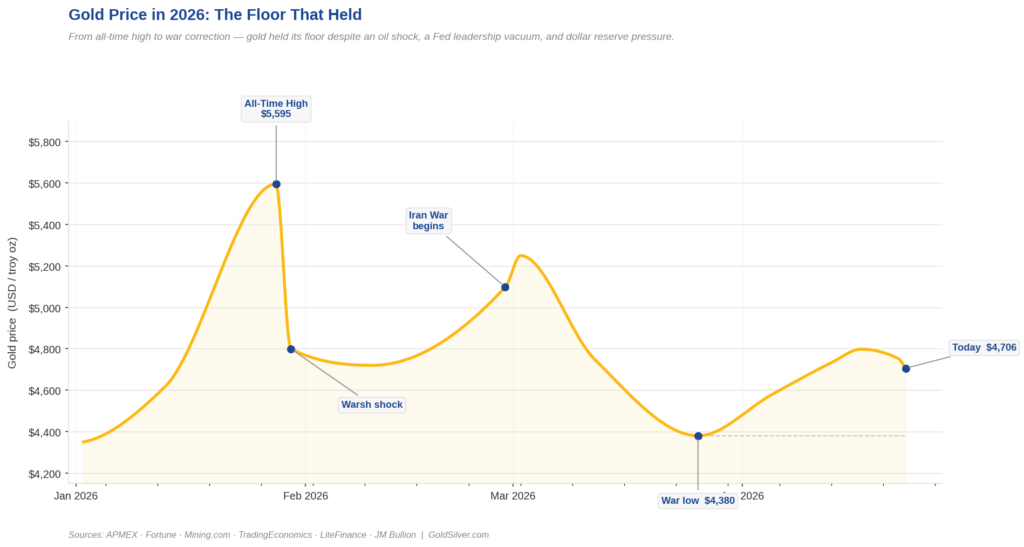
Despite that, gold’s structural floor has held. The metal’s all-time high was $5,595 per ounce on January 28, 2026. From there, the correction carried it to the $4,700 range — a 16% drawdown. In any comparable prior scenario — a major oil shock with a Fed on hold — that pullback would have been far steeper. It wasn’t.
What Does This Mean for Gold Investors Today?
In short, the dollar’s credibility doesn’t collapse in a press release. It erodes through decisions — each one defensible on its own, each one chipping away at the same foundation.
Iraq cannot predict when its oil revenue will be frozen next. Central banks can’t be certain their US Treasury holdings are safe in a crisis. Individual savers can’t be sure their dollar savings hold their value when political pressure reshapes monetary policy from above.
Yet today’s gold price reflects a temporary mechanism — real yields, oil costs, rate expectations. Those forces resolve. The pressure on the dollar’s reserve status comes from decisions made in Washington itself. That doesn’t go away when the Hormuz blockade ends.
That’s the difference between what’s moving gold this week and what’s building its floor over years.
Stay On Top of Gold & Silver Prices
Get important market alerts sent straight to your inbox.
SOURCES
1. TradingEconomics — Gold Price Historical Data and News
2. World Gold Council — Gold Reserves by Country
3. International Monetary Fund — International Financial Statistics
4. US Energy Information Administration — Strait of Hormuz Oil Transit Data
5. Reuters — US Blocks Iraq Dollar Shipments to Squeeze Iran-Backed Militias
6. Al Jazeera — US Halts Shipment of Iraq’s Oil Dollars to Curb Iran-Linked Groups
7. Polymarket — Kevin Warsh Confirmed as Fed Chair by May 15?
8. CNBC — Kevin Warsh Fed Chair Confirmation Hearing Live Updates
By the GoldSilver Editorial Team — helping investors understand sound money since 2005. This article is for informational purposes only and does not constitute financial, investment, or tax advice. Always consult a qualified financial advisor before making investment decisions.
You May Also Like:
- Why Chinese Silver Imports Hit a Record in 2026
- What Drives Gold Prices? 5 Forces Investors Are Watching Now
- The Gold-Silver Ratio Signal: What Silver’s Lead Means
- Gold Drops to $4,681 — Iran Ceasefire Expires Today
- The Real Reason Gold Is Down During an Oil War
- What the Warsh Hearing Means for Gold Prices
- IMF Says Treasuries Aren’t Safe Anymore. Gold Noticed First.
- Gold Price After Ceasefire Violation: The Floor Has Moved