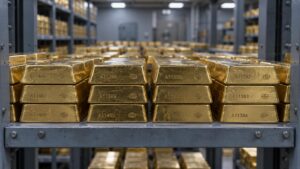
Silver Rises Over 120% YTD




Published: 04-30-2026, 02:50 pm
Gold and silver serve fundamentally different roles in a portfolio. Gold acts as monetary insurance — a non-correlated store of value that protects against inflation, currency debasement, and systemic risk. Silver carries those same monetary properties but adds industrial upside, making it more volatile and more responsive to economic growth. Most long-term investors benefit from holding both, with gold as the foundation and silver as the higher-beta complement.
Gold is trading near $4,638 per ounce in late April 2026 — still roughly 17% below its January all-time high of $5,589. Meanwhile, silver is hovering around $74, well off its own record above $121. The question, however, has shifted. It’s no longer “should I own precious metals?”
For most investors watching the macro environment, that’s settled. Instead, the sharper question is about gold and silver portfolio allocation: how much of each, why, and in what ratio. That answer depends entirely on understanding what each metal is actually doing in your portfolio.
Why Do Gold and Silver Play Different Roles in a Portfolio?
Gold and silver are both hard money — finite, no counterparty risk, no one else’s liability. However, that’s where the similarity ends. Gold is almost purely a monetary metal. Roughly 46% of annual demand comes from investment and central banks — [World Gold Council] — with jewelry making up most of the rest. As a result, no industrial use case could disappear overnight and crater the price.
Silver, by contrast, is built differently. It’s a hybrid: part monetary metal, part industrial commodity. Moreover, more than 50% of silver demand now comes from industrial applications — solar panels, electric vehicles, AI data center infrastructure — [Silver Institute]. That exposure, therefore, gives silver more upside in growth environments and more downside risk when conditions deteriorate.
In short, these metals aren’t interchangeable — they’re complementary. For example, owning only gold is like buying a seatbelt but no airbag. Similarly, owning only silver is like buying the airbag without the seatbelt.
Your Gold Buying Guide Most investors overpay when they buy gold. Then overpay again when they sell. This guide shows you exactly what to own — and why.
What Makes Gold the Ultimate Portfolio Insurance?
Gold has never gone to zero. Furthermore, it has never defaulted, and it has maintained purchasing power across thousands of years and dozens of collapsing currencies. That’s not marketing — it’s the historical record.
The current cycle reinforces that case. Specifically, central banks purchased 863 tonnes of gold in 2025 — the sixteenth consecutive year of net buying, even as the price hit record highs — [World Gold Council]. These are the most sophisticated institutional actors in global finance, and they buy gold because it protects reserves against inflation, dollar debasement, and geopolitical risk.
Moreover, that buying isn’t slowing. J.P. Morgan forecasts central bank and investor demand to average approximately 585 tonnes per quarter throughout 2026 — [J.P. Morgan Global Research].
Consider the analogy: you don’t buy homeowner’s insurance hoping your house burns down. Rather, you buy it because not having it is catastrophic. Gold works the same way. When markets crater, currencies weaken, or banking systems seize up, gold tends to hold or gain value.
In other words, it’s not competing with your stock portfolio — it’s protecting it. Furthermore, gold delivered 43% gains over the past year from already-elevated levels, which proves that insurance can also appreciate. Nevertheless, that’s a bonus. The core case is protection.
Why Does Silver Offer More Upside — and More Risk?
Silver’s story this cycle has been more dramatic than gold’s — and more complicated. Specifically, it reached a nominal all-time high of $121.67 on January 29, 2026, more than doubling in value over the prior twelve months before pulling back sharply — [Investing News Network]. That’s the upside. The pullback, however, is the risk.
The driver is structural industrial demand. Consequently, the silver market posted its fifth consecutive annual supply deficit in 2025 — global consumption outpaced mine production by 40.3 million ounces, per the 2026 World Silver Survey — [Silver Institute]. Solar panel manufacturing alone consumed 197.6 million ounces in 2024. In addition, mine supply — roughly 70% of which comes as a byproduct of copper, zinc, and gold mining — simply cannot keep pace.
That supply-demand dynamic, therefore, gives silver something gold doesn’t have: direct exposure to economic and technological growth. For instance, silver outperforms gold significantly in bull market conditions. In risk-off environments, by contrast, gold holds its value better. As a result, the two metals don’t compete — they cover different parts of the cycle.
How Much Gold and Silver Should You Hold?
No universal number fits every portfolio. However, the principles are consistent.
Most practitioners suggest 10–20% of investable assets in precious metals as part of a balanced gold and silver portfolio allocation. The precise figure depends on your time horizon, paper asset exposure, and view on systemic risk. Within that allocation, gold typically takes 60–75% of the metals position — the insurance layer. Silver, meanwhile, fills the remaining 25–40%, capturing the growth and industrial demand story.
Mike Maloney, GoldSilver.com’s founder, has long argued that the split should track the gold-to-silver ratio and the macroeconomic cycle. When the ratio is elevated — meaning silver is cheap relative to gold — shift weight toward silver. Conversely, when silver closes the gap, rotate back into gold and lock in the gains.
Used together, furthermore, they do something neither can do alone. Gold anchors the allocation against systemic risk. Silver, in addition, amplifies return potential and adds exposure to the clean energy megatrend now structurally embedded in industrial demand. As a result, the right question isn’t “gold or silver” — it’s “how much of each, and in what balance.”
How Do You Use the Gold-to-Silver Ratio to Decide Your Mix?
The gold-to-silver ratio is the most practical tool available for this decision. As of late April 2026, it sits near 63 — meaning approximately 63 ounces of silver buy one ounce of gold, which is above the modern free-market era average of 55–60 — [Trading Economics]. Historically, a ratio above 60 has signalled that silver is undervalued relative to gold. Consequently, that’s a case for tilting the metals allocation toward silver.
Importantly, this isn’t a trading signal. Rather, it’s a rebalancing framework. For example, investors who tracked the ratio through past cycles — buying silver when it was high, then rotating back to gold when it compressed — systematically grew their ounce count without adding fresh capital.
In practice, the steps are straightforward: know your metals allocation as a percentage of total investable assets, then check where the ratio stands, and finally adjust your gold-to-silver split accordingly. Start gold-heavy with a meaningful silver position. The ratio, therefore, tells you when to lean harder in either direction. When you’re ready to act on it, GoldSilver.com is a good place to start.
Stay On Top of Gold & Silver Prices
Get important market alerts sent straight to your inbox.
People Also Ask
What is the difference between gold and silver as investments?
Gold is primarily a monetary metal and store of value with minimal industrial use, making it the more stable of the two. Silver, however, has significant industrial demand — now over 50% of annual consumption — giving it higher upside potential in growth environments but also greater price volatility. That dual nature is what makes silver complementary to gold rather than a replacement for it.
How much of my portfolio should be in precious metals?
Most practitioners suggest 10–20% of investable assets in precious metals. Within that, gold typically forms the core (roughly 60–75%) as the insurance layer, while silver provides the higher-beta growth component. Ultimately, the right split depends on your time horizon, risk tolerance, and the current gold-to-silver ratio.
Is gold or silver a better investment right now?
The better question is: what job are you trying to do? Gold is the primary choice for protection against systemic risk and currency debasement. Silver, meanwhile, adds meaningful upside alongside that protection, with exposure to solar, EVs, and AI infrastructure. For most investors, therefore, holding both makes more sense than choosing one.
What is the gold-to-silver ratio and why does it matter?
The gold-to-silver ratio tells you how many ounces of silver it takes to buy one ounce of gold. When it’s above the modern era average of 55–60 — as it is in late April 2026, near 63 — silver is considered undervalued relative to gold. As a result, many investors use it to time shifts between the two metals within their allocation.
Does silver outperform gold in a bull market?
In major precious metals bull markets, silver tends to outperform gold significantly once the cycle matures. For instance, silver set its 2026 all-time high of $121.67 on January 29, more than doubling over the prior twelve months, while gold delivered 43% gains over the same period. However, the tradeoff is that silver also falls harder in corrections.
The Smartest Portfolio Move Isn’t Picking One — It’s Knowing How to Hold Both
The debate shouldn’t be gold versus silver. Instead, it should be about sizing each correctly for the environment you’re in. Gold is still 43% higher than a year ago despite its pullback. Moreover, silver is entering its sixth consecutive year of structural supply deficits, and central banks are still buying. As a result, the fundamentals haven’t changed, and the ratio tells you when to lean harder in either direction.
Gold protects what you’ve built. Silver amplifies what’s possible. GoldSilver.com is a good place to start building that foundation.
SOURCES
1. World Gold Council — Gold Demand Trends: Full Year 2025
2. World Gold Council — Central Banks: Gold Demand Trends Full Year 2025
3. Silver Institute — The Silver Market Is on Course for Fifth Successive Structural Market Deficit
4. Silver Institute — Silver Demand Forecast to Expand Across Key Technology Sectors
5. J.P. Morgan Global Research — A New High? Gold Price Predictions from J.P. Morgan Global Research
6. Trading Economics — Gold Price Chart & Historical Data
7. Investing News Network — What Was the Highest Gold Price Ever?
Disclaimer: This article is for informational and educational purposes only. It does not constitute investment advice. Please consult a qualified financial adviser before making any investment decisions.
You may also like:
- Gold Bullion vs. Jewelry: Why Serious Investors Choose the Bar
- Gold & Silver IRA: Why Starting Early Costs You Less
- Silver Fair Value: What the Data and History Show
- Gold or Silver Price Dip: Temporary Correction or Trend Reversal?
- What Switzerland’s Gold Freeze Means for Investors
- What History Shows About Buying Gold After a Pullback
- Should You Sell Gold During a Bull Market Pullback?
- Silver Bullion Buying Guide 2026: Coins, Bars, and Rounds Compared