Silver Rises Over 120% YTD




Published: 05-13-2026, 09:57 am | Updated: 05-13-2026, 10:01 am
Gold and silver market update — May 13, 2026
Trump’s first visit to China since 2017 is, at its core, a US-China summit gold and silver prices story — not just a trade headline. Five converging forces arrived together this morning: a live rare earth supply squeeze, re-accelerating food inflation, China’s grip on critical minerals, and a US stock market the World Gold Council is calling dangerously concentrated. Consequently, what happens in Beijing over the next two days matters more for precious metals investors than almost anything else on the calendar right now.
Trump in Beijing: First US Presidential Visit to China Since 2017
Air Force One touched down Wednesday evening. Trump was greeted by Chinese Vice President Han Zheng as 300 children waved American and Chinese flags on the tarmac. Moreover, bilateral meetings with Xi Jinping begin Thursday morning — the most substantive US-China summit since 2017 — with trade, the Iran war, Taiwan, and AI all on the table.
For precious metals investors, the stakes are direct and immediate. First, this summit could extend or collapse the rare earth truce affecting silver’s supply chain. Second, it could pressure Beijing to help reopen the Strait of Hormuz. Third, it will determine whether the US-China trade détente survives its November expiration. Nothing is settled as markets trade today.
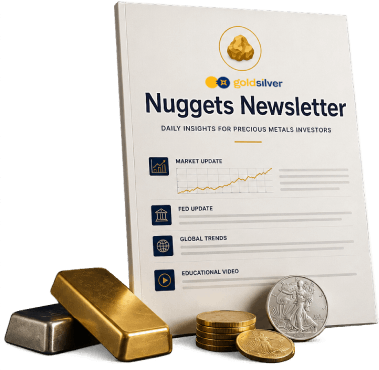
The Edge Every Investor Needs Smarter precious metals investing starts here. The Nuggets Newsletter brings you essential market insights, Fed updates, global trends, educational videos, and much more.
What Do China’s Rare Earth Export Controls Mean for Gold and Silver Supply Chains?
A Reuters investigation published this morning confirms a truce extension is on the agenda. However, Chinese customs data tells a harder story. Exports of heavy rare earths yttrium, dysprosium, and terbium are still down roughly 50% from pre-control levels. Furthermore, prices outside China have soared four- to fivefold for dysprosium and terbium. For yttrium, the increase is approximately 140-fold, according to commodities consultancy Argus. As a result, a US official confirmed shortages remain a live problem, and the White House recently had to intervene with Beijing directly to unlock approvals for a major defense-related procurement.
These materials run EV motors, semiconductors, F-35s, and Tomahawk missiles. In other words, the squeeze makes plain how fragile modern supply chains are — and why assets outside any government’s control matter.
Is the Iran War Now Driving US Food Inflation? Here Is What the Data Shows
Energy has dominated the inflation story. However, the April 2026 CPI — released Tuesday by the Bureau of Labor Statistics — shows the price shock is spreading into the grocery aisle. Specifically, food prices rose 3.2% year-over-year, up from 2.7% in March. Beef and veal are up 14.8% annually. In addition, the food-at-home index posted its biggest monthly jump since August 2022. The food industry association called the acceleration “expected,” because food production is energy-intensive at every stage.
This matters well beyond the grocery bill. Food inflation changes political behavior and suppresses consumer sentiment. Moreover, it keeps central banks on hold longer than any other category. Because a Fed pinned by food and energy costs keeps real wages negative, that is precisely the environment where the case for physical metal is strongest.
Are China’s Critical Minerals a Bigger Lever Than Tariffs?
Calling this week’s summit “trade talks” understates what is actually at stake. Since October 2025, the real contest has shifted from tariffs toward China’s control over critical minerals, rare earths, and the magnet supply chains behind modern military and manufacturing capability. Notably, the Council on Foreign Relations assessed the best realistic outcome as a tacit truce extension with modest deliverables — uneasy stability that buys China time while giving the US a narrow window to build resilience.
Silver sits directly in this story. Roughly 60% of annual silver demand is industrial — EVs, solar, semiconductors, electronics — and most of it flows through Chinese-controlled supply chains. Therefore, real trade openness is bullish for silver. Paper commitments, however, leave that demand engine running below capacity.
Is the US Stock Market’s Semiconductor Concentration a Risk for Equity Investors?
The World Gold Council raised a structural alarm in its May 11, 2026 Weekly Markets Monitor, titled “A Seminal Moment.” Specifically, semiconductor stocks have expanded their share of S&P 500 forward earnings to levels nearly matching their already-elevated index weighting — an overlap the WGC calls structurally unprecedented. In contrast, past tech-heavy cycles featured concentrated valuations or concentrated earnings expectations, but not both at once. Today, the 10 largest S&P 500 companies represent roughly 40% of the index. Semiconductors alone account for more than one-fifth of total market cap.
When this kind of concentration unwinds, it moves fast. Consequently, rapid institutional de-risking from equities is historically one of the cleanest triggers for large-scale rotation into physical gold. The WGC didn’t use the word “seminal” lightly.
What to Watch
Bilateral talks run Thursday and Friday. A genuine rare earth truce extension and real trade openness would ease supply chain pressure and, as a result, lift silver’s industrial demand. However, the Council on Foreign Relations considers a disappointment more likely. That outcome therefore keeps food inflation hot, the Fed frozen, and China’s mineral leverage intact — while a top-heavy equity market waits for the trigger that has historically moved capital into physical precious metals. The outcome is still unknown. Even so, the case for holding hard assets through this uncertainty has rarely been clearer.
Stay On Top of Gold & Silver Prices
Get important market alerts sent straight to your inbox.
SOURCES
1. CNN — Trump arrives in China for state visit, Xi meeting (May 13, 2026)
2. CBS News — Trump arrives in Beijing to meet with Xi Jinping (May 13, 2026)
3. NBC News — Trump en route to China for Xi meetings (May 13, 2026)
4. Al Jazeera — Trump and Xi to meet in Beijing: the key issues shaping the China summit (May 13, 2026)
5. Euronews — Trump arrives in Beijing for high-stakes summit with Xi (May 13, 2026)
6. AP / Spectrum News — Trump arrives in Beijing for talks with China’s Xi (May 13, 2026)
7. South China Morning Post — China confirms dates for Donald Trump’s state visit to Beijing (May 11, 2026)
8. Reuters — Trump, Xi to weigh rare earth truce extension, but China’s curbs still bite (May 13, 2026)
9. Bureau of Labor Statistics — Consumer Price Index Summary, April 2026 (May 12, 2026)
10. Bureau of Labor Statistics — Consumer Price Index Detailed Report, April 2026 (May 12, 2026)
11. USDA Economic Research Service — Food Price Outlook, Summary Findings (April 2026)
12. Council on Foreign Relations — At the Trump-Xi Summit, China Will Have the Upper Hand (May 10, 2026)
13. Council on Foreign Relations — Trump-Xi Summit: Analysis and Updates
14. Silver Institute — Silver Supply and Demand (World Silver Survey)
15. World Gold Council — Weekly Markets Monitor: A Seminal Moment (May 11, 2026)
Disclaimer: This article is for informational purposes only and does not constitute financial or investment advice. Always consult a qualified financial adviser before making investment decisions.
You May Also Like:
- The Real Reason Gold Falls When Inflation Surges
- CPI Hits 3.8%. Gold Falls. The Mechanism Nobody Explains
- Why the Gold Silver Ratio Is Falling — and What It Means
- What’s Moving Gold Prices This Week: CPI, Seoul & Beijing
- Silver Jumps 6% Before Trump-Xi Summit. Here’s Why
- April Jobs Beat 115K. Gold Held. The Dollar Didn’t. Here’s Why
- Jobs Beat, Ceasefire, Deficit: What It Means for Gold
- Gold Price Outlook: Oil Futures Disagree With Stock Markets