Silver Rises Over 120% YTD




Most investors know gold protects wealth. Fewer know that how you own it can cost — or save — you thousands in taxes.
If you’ve ever considered adding gold to your portfolio, you’ve likely encountered two paths: a Gold IRA or direct physical ownership. Both give you exposure to gold. But they work very differently when it comes to taxes, access, and control.
This guide breaks down the key differences so you can decide which structure fits your goals — or whether a combination of both makes sense.
What’s the Difference Between a Gold IRA and Physical Gold?
A Gold IRA is a self-directed retirement account that holds physical precious metals in an IRS-approved depository. It can include gold, silver, platinum, and palladium — all within a tax-advantaged structure.
Physical gold ownership means purchasing coins or bars that you directly possess and control. No intermediaries. No institutional layers. The metal is yours.
The choice between them isn’t just philosophical. It affects your taxes, your costs, how quickly you can access your money, and who’s responsible for keeping it safe.

The Financial System Isn’t Safer — And You Know It As risks mount, see why gold and silver are projected to keep shining in 2026 and beyond.
How Are Gold IRAs Taxed Compared to Physical Gold?
Here’s something most gold investors don’t realize until it’s too late: the IRS classifies physical gold as a collectible.
That matters because collectibles face a maximum capital gains tax rate of 28% when sold at a profit. Most long-term investments are taxed at 15–20%. That 8–13 percentage point gap can quietly erase a significant portion of your gains.
A Gold IRA sidesteps this entirely.
Because it operates as a tax-advantaged retirement account, your gold grows tax-deferred. You don’t owe taxes on gains until you take distributions in retirement — when many investors are in a lower tax bracket anyway.
Contributions to a traditional Gold IRA may also be tax-deductible, depending on your income and whether you participate in other retirement plans.
Already have a 401(k) or traditional IRA? A Gold IRA rollover lets you move those funds into a precious metals IRA without triggering a taxable event. Your retirement savings stay intact. You just add gold to the mix.
For long-term investors — especially those in higher tax brackets — the tax structure of a Gold IRA can meaningfully outperform physical ownership on an after-tax basis, even after accounting for annual fees.
How Is Gold Stored in an IRA vs. Physical Ownership?
With a Gold IRA, storage is handled for you. Your metals are held in an IRS-approved depository with professional security, insurance, and regular third-party auditing. Most facilities offer allocated storage — meaning your specific metals are identified and segregated as yours alone.
The tradeoff: you pay for it. Annual storage fees typically run 0.5–1% of your holdings’ value. And you cannot take personal possession of IRA metals without triggering taxes and potential penalties.
Physical gold flips this entirely. You own it outright. You decide where it lives and who knows about it.
That freedom comes with responsibility. A quality home safe offers immediate access but limited protection against theft or fire. A bank safe deposit box adds security but restricts access to banking hours — and typically doesn’t include insurance coverage for precious metals. Private vault storage offers the strongest protection but adds recurring cost.
Neither approach is inherently better. It depends on how much you value direct control versus the convenience of institutional storage — and how you weigh the ongoing fees against the peace of mind each option provides.
One more factor if you’re considering silver alongside gold: storage volume scales fast.
$100,000 in gold fits in a small pouch. The same dollar amount in silver weighs roughly 75 pounds. If you’re storing physical metals at home or in a private vault, that difference matters — both for space and for the cost of secure storage solutions.
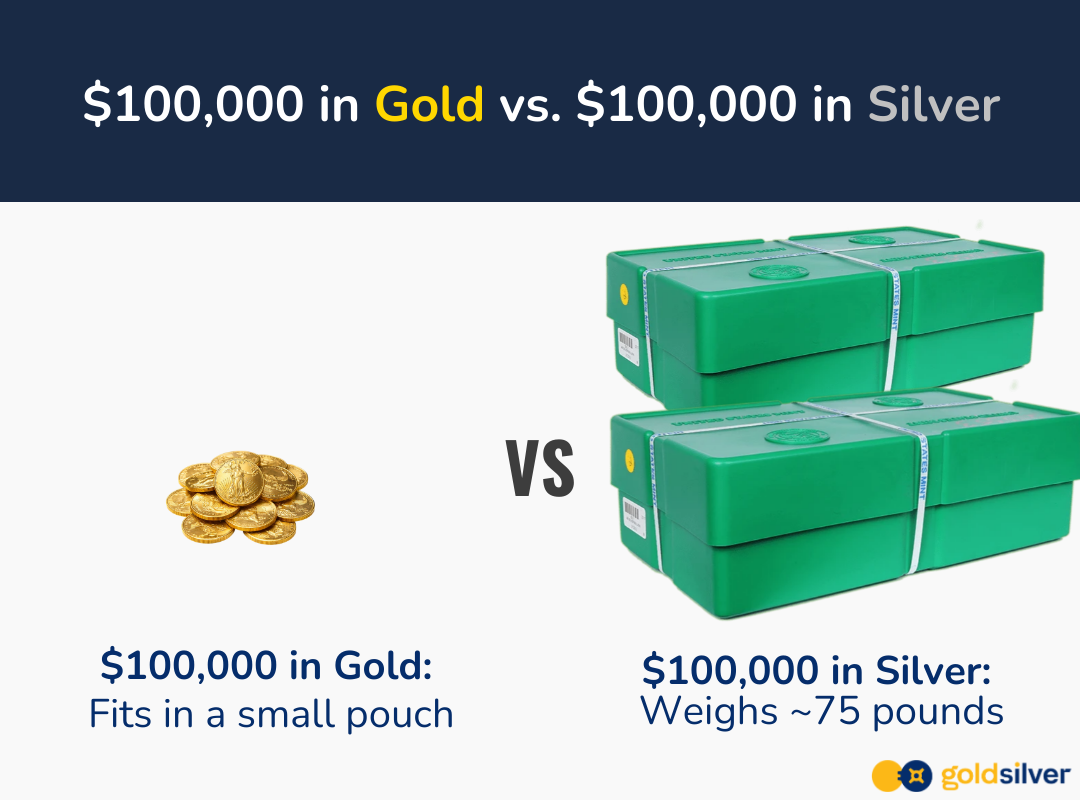
For investors drawn to silver’s value potential, this is worth factoring into your storage plan before you buy.
Gold IRA vs. Physical Gold: Which Has Lower Fees?
The costs look different on paper, but they’re closer than they first appear.
A Gold IRA involves setup fees ($50–$150), annual maintenance fees ($75–$300), storage fees, custodian fees, and transaction spreads when buying or selling metals. These are recurring costs. Over a decade, they add up.
Physical gold involves upfront premiums above spot price — typically 3–10% depending on the product — plus potential sales tax in some states, storage costs, insurance, and dealer spreads on future transactions. Most of these are one-time costs rather than annual ones.
For shorter holding periods, physical gold’s one-time costs can be more efficient. For longer holds, the Gold IRA’s recurring fees may be offset — or more than offset — by the tax savings. The math shifts depending on your tax bracket, account size, and how long you plan to hold.
The honest answer: run the numbers for your specific situation. There’s no universal winner here.
Can You Sell Gold From an IRA Whenever You Want?
Physical gold wins on flexibility. You can sell to a dealer whenever you need to, with no age restrictions or penalties. That makes it useful as a financial backstop — accessible during emergencies or when market conditions shift.
Gold IRAs are designed for the long game. Distributions before age 59½ typically trigger a 10% early withdrawal penalty plus income taxes on the distribution value. That’s a meaningful cost if you need access before retirement.
But that restriction is also a feature for some investors. It enforces long-term thinking in a way that discretionary accounts don’t.
One thing to note: selling physical gold quickly at a favorable price isn’t always easy. Pawn shops and local dealers often pay well below spot price. In disrupted markets, finding a serious buyer at fair value can take real effort.
That’s worth planning for before you need to sell. GoldSilver’s Sell Back program is designed for exactly this — a straightforward process to sell your metals back at competitive prices, without the uncertainty of hunting for a buyer on your own.
Which Is Right for You: Gold IRA or Physical Gold?
Gold IRAs work best for investors focused on long-term retirement planning who want tax advantages and don’t need immediate access to their metals.
Physical gold suits investors who prioritize direct control, want flexibility without institutional constraints, or view gold as insurance against scenarios where access to traditional financial systems becomes uncertain. When you hold physical gold, there’s no custodian, no counterparty, no account to freeze.
Neither approach is wrong. They solve different problems.
How Much Gold Should You Hold in an IRA vs. Physical?
Most sophisticated investors don’t choose one or the other — they use both.
A Gold IRA handles the retirement planning side: tax-deferred growth, professional storage, and a structure that rewards long-term thinking. Physical gold handles everything else: liquidity, direct control, and a layer of protection that exists entirely outside the financial system.
The right balance depends on your timeline, tax situation, and how you think about risk. But the starting point is the same: own gold. The structure you choose is a second-order question.
Investing in Physical Metals Made Easy

People Also Ask
What are the key differences between a Gold IRA and physical gold?
A Gold IRA holds precious metals in an IRS-approved depository within a tax-advantaged retirement structure. Physical gold means direct ownership of coins or bars you possess and store yourself. Gold IRAs offer tax-deferred growth and professional storage but restrict access until retirement. Physical gold provides immediate control and liquidity but puts storage and security responsibilities on you.
What are the tax benefits of a Gold IRA compared to owning physical gold?
Gold IRA contributions may be tax-deductible, and your investment grows tax-deferred until retirement. You can roll over existing retirement funds without a taxable event. Physical gold offers no tax advantages and faces a 28% maximum capital gains tax when sold — significantly higher than the 15–20% rate on most other long-term investments.
How is physical gold stored versus gold in an IRA?
IRA gold must be held in an IRS-approved depository with professional security, insurance, and auditing, at a cost of roughly 0.5–1% annually. Physical gold can be stored in a home safe, bank safe deposit box, or private vault. You have full control, but you’re also fully responsible for security and insurance.
Which is better for long-term investment: Gold IRA or physical gold?
It depends on your goals. Gold IRAs work best for retirement-focused investors who want tax advantages and don’t need immediate access. Physical gold suits those who want direct control, worry about systemic risk, or need flexibility without early withdrawal penalties. Many investors use both.
What are the costs of a Gold IRA versus buying physical gold?
Gold IRAs carry setup fees ($50–$150), annual maintenance ($75–$300), storage fees (0.5–1% annually), custodian fees, and transaction costs. Physical gold involves upfront premiums (3–10% over spot), potential sales tax, storage costs, insurance, and dealer spreads. Gold IRA fees are recurring; physical gold costs are mostly one-time.
Note: This article is provided for informational purposes only and should not be considered investment advice. Always conduct thorough research or consult with qualified financial professionals before making investment decisions.