Silver Rises Over 120% YTD




Published: 05-28-2026, 11:34 am
Key Takeaways
- The United States leads all gold reserves by country with 8,133.5 tonnes — but has not been a net buyer in decades. [World Gold Council, 2026] Meanwhile, the active accumulation story is elsewhere: Poland (582t, targeting 700t), China (2,313t officially, likely considerably more), and Uzbekistan (416t, representing 87% of its total reserves). [World Gold Council Gold Demand Trends Q1 2026]
- Central banks bought a net 244 tonnes in Q1 2026, exceeding both the prior quarter and the five-year average. [World Gold Council Gold Demand Trends Q1 2026] Furthermore, the 2022 freezing of ~$300 billion in Russian reserves held in Western institutions triggered a structural shift in reserve management that shows no sign of reversing. [Brookings Institution, 2025]
- The US and Germany hold ~69% of their reserves in gold, while China holds just 9% and Japan holds 5%. [World Gold Council, IMF IFS, Q1 2026] As a result, that gap is the largest single source of identifiable structural demand in the gold market today.
When ranking gold reserves by country, the United States leads all nations — holding 8,133.5 tonnes stored primarily at Fort Knox and the Federal Reserve Bank of New York. [World Gold Council] However, that stockpile has barely moved since the early 2000s.
So the real story in 2026 is not who has the most. It’s who is buying — and why.
In Q1 2026, central banks purchased a net 244 tonnes, exceeding both the prior quarter and the five-year average. [World Gold Council Gold Demand Trends Q1 2026, published April 29, 2026] Notably, that’s not speculative activity. Instead, it reflects deliberate, strategic accumulation — and it tells you more about the future of the monetary system than any single price chart.
Which Countries Hold the Most Gold?
Below are the top 10 official gold holders as of Q1 2026, sourced from World Gold Council and IMF International Financial Statistics data: [World Gold Council; IMF IFS, December 2025 edition]
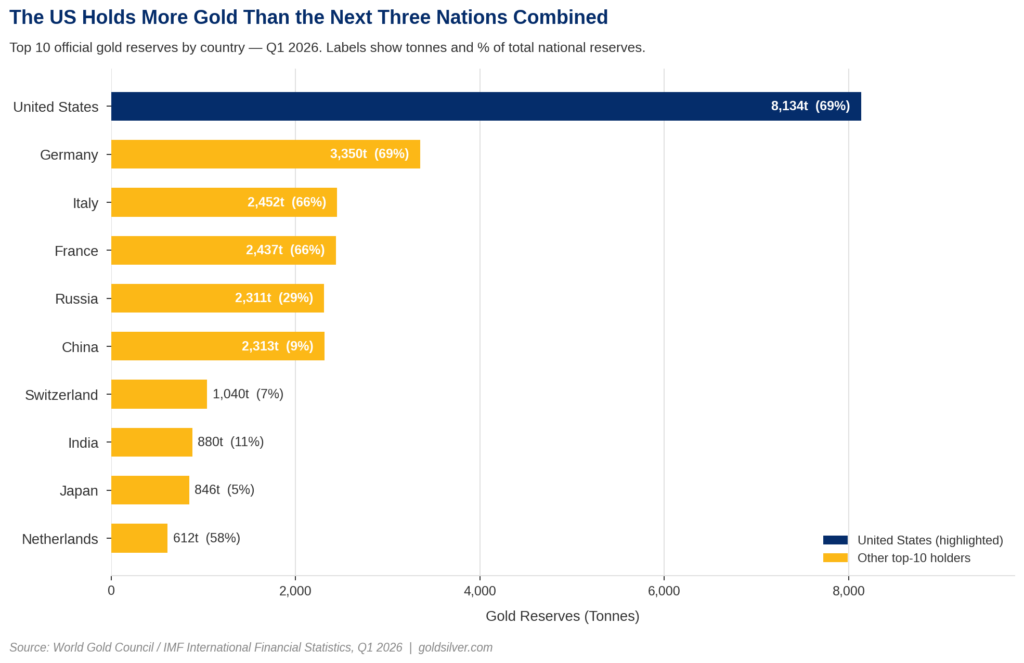
Together, the top 10 hold roughly 70% of all official gold reserves worldwide. [World Gold Council] Moreover, the US and Europe together account for more than 60% — a concentration that reflects gold’s re-emerging monetary role in the global reserve system.
Two numbers in particular stand out. The US and Germany both hold approximately 69% of their total reserves in gold — a legacy of the Bretton Woods era. By contrast, China holds just 9% and Japan holds only 5%. [World Gold Council / IMF IFS] That divergence between Western legacy holders and Eastern economies is consequently the most consequential structural dynamic in the gold market right now.
The Knowledge That Changes Everything
Two essential guides — yours free. Understand why gold matters and why fiat currencies always fail.
Why Are Central Banks Buying Gold at Record Pace?
The buying wave started in 2022. It hasn’t let up since.
Central banks purchased a net 1,082 tonnes in 2022 — the highest annual total in over five decades — then added another 1,037 tonnes in 2023. [World Gold Council] As a result, Q1 2026 came in at 244 tonnes net, again above the five-year quarterly average. [World Gold Council Gold Demand Trends Q1 2026]
The trigger was February 2022. Within days of Russia’s invasion of Ukraine, Western governments froze approximately $300 billion in Russian central bank reserves held abroad. [Brookings Institution, 2025] Consequently, every reserve manager on earth understood the same thing: dollar-denominated reserves held abroad are only as safe as your political relationship with the country that controls the clearing system.
Gold held in a sovereign vault, however, answers to no one. It can’t be frozen, sanctioned, or devalued by a foreign government. Therefore, that property moved from theoretical to operationally critical in 2022 — and the buying data since then reflects exactly that shift. It’s also the same logic driving the BRICS gold accumulation strategy.
Who Is Buying the Most Gold in 2026?
Poland led all buyers in Q1 2026, adding 31 tonnes to reach 582 tonnes total. [World Gold Council Gold Demand Trends Q1 2026] Moreover, the National Bank of Poland formally adopted a 700-tonne target in January 2026 — up from roughly 103 tonnes in 2018. [National Bank of Poland, January 2026] Governor Adam Glapiński has been explicit about the reasoning: Poland sits on NATO’s eastern flank, and gold held in Warsaw can’t be touched by any external power.
Uzbekistan added 25 tonnes in Q1 2026, lifting its total to 416 tonnes. [World Gold Council Gold Demand Trends Q1 2026] Notably, that figure represents 87% of its total foreign reserves — one of the highest gold-to-reserve ratios of any central bank in the world.
The People’s Bank of China added 7 tonnes in Q1, extending a buying streak of more than 17 consecutive months. [World Gold Council Gold Demand Trends Q1 2026] Official holdings now stand at 2,313 tonnes, representing 9% of total reserves. However, unofficial estimates put actual Chinese holdings at 2x to 3x that figure, due to accumulation routed through state-owned entities and the Shanghai Gold Exchange that never appears in official data — a pattern covered in depth in our central bank gold buying analysis.
India, meanwhile, has been a steady buyer, using its 880-tonne reserve as a dynamic tool to manage currency volatility and reduce dollar concentration. [World Gold Council]
Why Aren’t Western Countries Buying?
Simply put, they already have what took decades to accumulate.
The US, Germany, Italy, and France built their gold positions largely during and after the Bretton Woods era, when gold underpinned the international monetary system. As a result, those are legacy holdings — and they’ve appreciated dramatically.
For example, the US carries its 8,133.5 tonnes at the statutory price of $35 per ounce, giving it a book value of roughly $37 billion. However, at the current market price of approximately $4,450 per ounce (May 2026), the same stockpile is worth approximately $1.16 trillion. [US Treasury; live gold market data, May 2026] Consequently, that represents one of the largest unrealized gains on any government balance sheet in the world.
The asymmetry is worth sitting with. The countries that designed the current monetary system are sitting on gold. Meanwhile, the countries questioning it are actively buying more.
How Much Gold Does China Actually Hold?
China officially reports 2,313 tonnes — sixth in global gold reserves by country rankings, and roughly 9% of total reserves. [World Gold Council / IMF IFS, Q1 2026] Nevertheless, China’s track record on disclosure is instructive.
In July 2015, the People’s Bank of China announced its reserves had jumped from 1,054 tonnes to 1,658 tonnes. [People’s Bank of China, July 2015; World Gold Council] That single announcement confirmed a 604-tonne increase, reflecting six years of undisclosed purchases. Monthly reporting resumed after that. However, the precedent for strategic opacity remains well established.
Several signals point to current holdings well above the official figure. First, record throughput volumes continue flowing through the Shanghai Gold Exchange. Second, domestic mine output runs at approximately 380 tonnes per year, making China the world’s largest gold producer. [World Gold Council, 2024 data] Third, policy directives are actively pushing gold accumulation across multiple levels of the financial system.
If actual holdings are closer to 4,000–5,000 tonnes — a range some institutional analysts consider credible — gold would represent 15–20% of China’s reserves rather than 9%. At that level, a gold-referenced trade settlement architecture consequently becomes operationally plausible, not just theoretical.
What Does the Buying Pattern Actually Signal?
Reserve rankings tell you who has the most gold. Buying behavior, however, tells you who no longer trusts the system as designed.
Consider Poland. Its gold reserves grew from approximately 103 tonnes in 2018 to 582 tonnes by Q1 2026 — an increase of more than 460% in under eight years. [World Gold Council; National Bank of Poland] That’s not diversification. That’s fortress construction. Similarly, China has added to reserves for 17 consecutive months while simultaneously holding trillions in US Treasuries — effectively hedging against the very system it helped finance. Furthermore, Uzbekistan placing 87% of its reserves in gold is a clear statement about which assets it trusts to hold value when things break.
These aren’t traders reacting to a chart. Rather, these are sovereign institutions with multi-decade mandates, acting on information advantages no retail investor can match. In fact, three consecutive years above 1,000 tonnes of annual net purchases [World Gold Council] is not momentum. It’s a structural reallocation — and the most credible institutional endorsement gold has received in the modern era.
The takeaway for individual investors, therefore, isn’t to mirror central bank strategy. It’s simpler: understand what they’re doing, and ask yourself why.
Stay On Top of Gold & Silver Prices
Get important market alerts sent straight to your inbox.
People Also Ask
Has the US gold reserve ever been independently audited?
Not comprehensively. The last full independent audit of US gold reserves was conducted during the Eisenhower administration. Since then, the US Treasury and the US Mint have run only their own internal audits. Additionally, the Federal Reserve Bank of New York verifies gold it stores on behalf of foreign governments — but no independent third-party audit of all 8,133.5 tonnes has ever been publicly completed. However, no credible evidence of discrepancy has emerged.
Which country holds the highest percentage of its reserves in gold?
Among major central banks, Uzbekistan leads — with gold representing approximately 87% of its total foreign reserves. [World Gold Council Gold Demand Trends Q1 2026] By comparison, the US and Germany both sit at approximately 69%. Meanwhile, China holds 9%, Japan 5%, and Switzerland 7%. [World Gold Council / IMF IFS, Q1 2026] In short, the higher the percentage, the more structurally committed to gold that country is over dollar-denominated assets.
Does the IMF hold gold reserves?
Yes — approximately 2,814.1 metric tonnes (around 90.5 million troy ounces). [IMF Factsheet: Gold in the IMF] Consequently, the IMF would rank third globally if treated as a single entity, ahead of Italy and France. These holdings belong to the institution itself, not to individual member countries. Furthermore, the IMF’s last major disposal was a 403.3-tonne sale program from 2009 to 2010: 200 tonnes to the Reserve Bank of India, 10 tonnes each to Sri Lanka and Bangladesh, 2 tonnes to Mauritius, and 181.3 tonnes through on-market sales. [IMF Press Release No. 09/310; World Gold Council CBGA3]
Why is China’s gold-to-reserves ratio so low?
China’s total foreign exchange reserves exceed $3 trillion, mostly in dollar-denominated assets including US Treasuries. Against that base, 2,313 tonnes of gold represents only approximately 9%. [World Gold Council / IMF IFS] Two explanations coexist: first, strategic under-reporting to avoid telegraphing a dollar exit; or second, deliberate maintenance of large dollar holdings to preserve trade flexibility. What’s beyond debate, however, is the buying — more than 17 consecutive months of net purchases as of Q1 2026. [World Gold Council Gold Demand Trends Q1 2026] Whatever the ratio says, the direction is clear.
What happens to gold if central banks stop buying?
Since 2022, central banks have averaged more than 1,000 tonnes of net purchases per year, absorbing roughly one-third of annual global mine production. [World Gold Council] A reversal toward the near-zero or net-selling behavior of the 1990s and 2000s would consequently remove a substantial demand floor. However, the conditions that produced this buying cycle haven’t changed: dollar reserves have been weaponized, de-dollarization pressure is structural, and geopolitical fragmentation isn’t reversing. Therefore, most institutional analysts see no near-term basis for a sustained pullback.
What Does This Mean for Investors in Physical Gold and Silver?
Central bank buying has created a demand floor that didn’t exist ten years ago. Specifically, more than 1,000 tonnes of annual official-sector purchases means roughly one-third of global mine output is absorbed by institutions that don’t sell on short-term price signals. [World Gold Council] As a result, that floor is structural, not cyclical.
The frame is straightforward. The most credentialed reserve managers on earth hold 69% of their reserves in gold — and are still adding. Moreover, the countries furthest from that ratio are buying fastest. This isn’t ultimately a story about who has the most. Rather, it’s about who wants more, and what that reveals about the monetary order they’re positioning for.
Central banks think in decades. They build positions slowly, deliberately, and without urgency. Individual investors can, therefore, take the same approach. Create your free GoldSilver account and start holding the asset the world’s reserve managers are quietly accumulating.
SOURCES
1. World Gold Council — Gold Demand Trends Q1 2026: Central Banks; Gold Reserves by Country; Central Bank Gold Reserves Survey 2025; Global Mine Production by Country
2. IMF — International Financial Statistics, December 2025 Edition
3. IMF — Gold in the IMF Factsheet; Press Release No. 09/310 (Gold Sales Program, 2009); Press Release No. 10/333 (Bangladesh Bank Sale, 2010)
4. Brookings Institution — What is the Status of Russia’s Frozen Sovereign Assets?
5. National Bank of Poland — 700-Tonne Gold Reserve Target Resolution, January 20, 2026
6. People’s Bank of China via CNBC — China Breaks Silence on Gold Reserves, July 2015
7. US Treasury — US Reserve Assets
Disclaimer: This article is for informational and educational purposes only. It does not constitute investment advice. Please consult a qualified financial adviser before making any investment decisions.
You may also like:
- Gold Portfolio Allocation: Why Wall Street Is Rewriting the 60/40
- What Does the SILVER Act Mean for Precious Metals Investors?
- What Backs the US Dollar? Not Gold. Not Silver.
- Why Is Gold Valuable? The 5,000-Year Answer Most Investors Get Wrong
- 72% of Family Offices Hold No Gold. What They’re Missing.
- Gold Remonetization: Six Forces Restoring Gold’s Monetary Role
- Silver Industrial Demand: Solar, EVs, and the Supply Gap
- Bank of America’s $6,000 Gold Forecast Isn’t a Price Call. It’s a System Call.