Silver Rises Over 120% YTD




After a historic run in precious metals, investors aren’t just asking whether to own gold or silver — they’re asking how to think about gold or silver investment in 2026.
The numbers from 2025 were striking. Gold climbed roughly 65%, breaking above $4,500 per ounce. Meanwhile, silver rallied 147%. Both metals dramatically outperformed many traditional asset classes.
But strong past performance doesn’t tell you what comes next. Markets reset. Conditions shift. And in an environment defined by policy uncertainty, rising debt, and geopolitical tension, the smarter question isn’t which metal will win — it’s what role each metal plays in a resilient portfolio.
This article won’t predict prices. Instead, it walks through the key differences between gold and silver — their strengths, their risks, and how experienced investors have historically thought about owning both.
The Macro Context: Why Precious Metals Are Still Part of the Conversation
Before comparing the two metals, it helps to understand why precious metals remain relevant at all.
Monetary policy and real interest rates
Gold and silver tend to perform well when real interest rates — interest rates adjusted for inflation — are low or negative. That’s because holding a non-yielding asset becomes more attractive when the alternatives aren’t paying much in real terms.
Markets are currently pricing in monetary easing, but the path isn’t clear. If inflation proves stickier than expected while growth slows, the Federal Reserve may find itself with limited options. That kind of environment, sometimes called stagflation, has historically been among the most favorable for gold in particular.
Currency confidence and fiscal deficits
The U.S. continues to run large structural deficits, and global debt levels remain historically elevated. For investors who think carefully about long-term purchasing power, this raises legitimate questions about fiat currency stability.
Gold has a unique role here. It carries no counterparty risk and functions as a neutral reserve asset — which is part of why central banks have been accumulating it at near-record levels in recent years. Silver benefits from some of the same monetary tailwinds, though it doesn’t hold the same official reserve status.

The Financial System Isn’t Safer — And You Know It As risks mount, see why gold and silver are projected to keep shining in 2026 and beyond.
What Gold Does Well: Stability and Liquidity
Gold’s primary role in a portfolio isn’t to be exciting — it’s to be dependable.
It’s one of the most liquid assets in the world, trading around the clock across global markets. During periods of systemic stress — financial crises, currency instability, geopolitical shocks — gold has a long track record of holding value when other assets don’t.
Ray Dalio, founder of Bridgewater Associates and one of the most widely followed macro investors of the past several decades, has publicly argued that every serious portfolio should include a meaningful gold allocation. His reasoning centers on gold’s ability to act as a hedge against both inflation and currency debasement — risks he considers underappreciated by most investors. “If you don’t own gold,” Dalio has written, “you know neither history nor economics.”
That’s not a price prediction. It’s a structural argument about what gold does — and it’s one that has influenced how many institutional and individual investors approach asset allocation.
Gold’s risks in 2026
After a historic multi-year run, a period of consolidation would be entirely normal. A meaningful rebound in real yields could create short-term price pressure. And if geopolitical tensions ease significantly, some of the safe-haven demand that has driven gold higher may moderate.
If you’re curious what major banks and institutional analysts are currently projecting for gold, we’ve compiled their forecasts here: Gold Price Forecast & Predictions.
What Silver Does Well: Industrial Demand and Leverage
Silver occupies a different space. It’s both a monetary asset and an industrial one — and that dual identity is the source of both its appeal and its complexity.
It is a critical input in solar panels, electric vehicles, semiconductors, and a wide range of electronics. As renewable energy infrastructure has expanded globally, industrial demand for silver has grown alongside it. Silver markets have experienced annual supply deficits for several consecutive years, driven in part by that industrial consumption.
Because silver’s market is considerably smaller than gold’s, capital inflows can move prices more dramatically. That’s what investors sometimes mean when they describe silver as “gold with leverage” — when conditions favor precious metals broadly, silver has historically amplified those moves.
Seasoned resource investor Rick Rule has described silver this way for years: the smaller market size that makes it more volatile on the downside is the same characteristic that produces outsized moves when sentiment turns positive.
Silver’s risks in 2026
That leverage works in both directions. If global growth slows or industrial activity contracts, silver’s demand picture weakens in a way that gold’s does not. Post-rally speculative positioning can also unwind quickly in smaller markets.
Silver rewards investors who understand what they’re holding and can tolerate meaningful price swings. For those who can’t, the volatility may undermine the rationale for owning it in the first place.
For a look at what analysts are forecasting for silver specifically, see our roundup here: Silver Price Forecast & Predictions.
The Gold-to-Silver Ratio: A Useful (But Imperfect) Lens
The gold-to-silver ratio measures how many ounces of silver it takes to purchase one ounce of gold. For much of monetary history, this ratio was essentially fixed — governments and monetary systems set it by decree, often around 15:1 or 16:1.
That changed in 1971, when President Nixon ended the U.S. dollar’s convertibility to gold, effectively severing precious metals prices from any fixed anchor. Since then, both metals have traded freely, and the ratio has swung widely with market conditions.
Over much of the past decade, it sat between 70:1 and 90:1 — well above its long-run average of 40:1 to 60:1 — a gap that led many analysts to argue silver was significantly undervalued relative to gold. Today, following silver’s strong rally, the ratio has compressed back to the mid-50s, right in line with historical norms.
Gold-to-Silver Ratio Over 10 Years
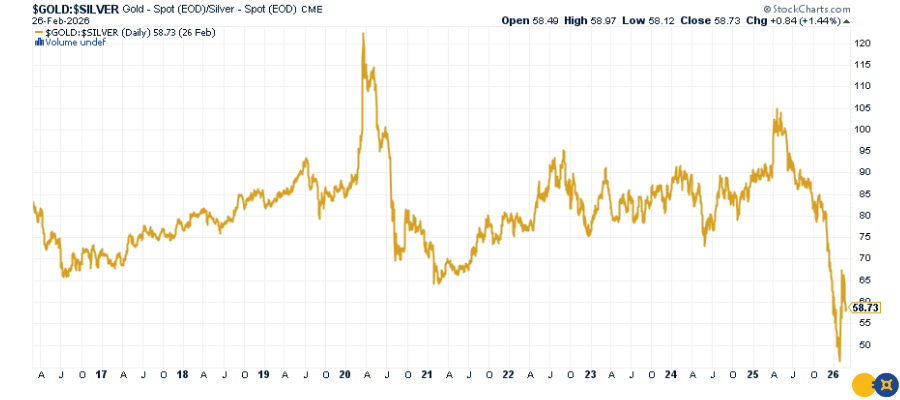
What does that tell us? Historically, when the ratio reaches extremes in either direction, there has been a tendency to revert toward the mean. When it climbed above 80 or 90, silver was often the metal that eventually caught up. When it compressed toward 40 or below, gold tended to reassert itself.
Some traders watch this closely to time their entry points between the two metals — rotating into silver when the ratio is historically high, and shifting toward gold when it compresses. And there are cases where this has worked well.
Last April, the ratio climbed to 100:1 — one of its most extreme readings outside of the brief COVID spike in 2020. At the time, we wrote about what that signal historically meant for silver investors. In the months that followed, silver climbed from around $32 to roughly $94 — nearly tripling in price as the ratio reverted sharply toward its historical range.
But it’s not an exact science. The ratio can stay elevated or depressed for longer than anyone expects, and other factors — industrial demand, macro conditions, market sentiment — can override the signal entirely. It’s a useful lens, not a reliable timer.
What’s changed is the starting point. Investors are no longer looking at a ratio screaming silver undervaluation. They’re looking at a historically normal relationship between the two metals — which makes the gold vs. silver decision less about obvious opportunity and more about which risk profile fits their goals.
How Many Investors Approach Owning Both
The gold vs. silver framing often implies a choice. In practice, many experienced investors treat them as complementary.
Gold anchors the allocation — providing stability, liquidity, and long-term purchasing power protection. Silver adds a growth component within the metals position, with more upside potential alongside more volatility.
A conservative metals allocation might lean 70–80% gold and 20–30% silver. A more growth-oriented investor might weight silver more heavily. Neither is universally right — the appropriate balance depends on your time horizon, risk tolerance, and what role precious metals are meant to play in your broader portfolio.
Dollar-cost averaging is worth considering in either case, particularly after significant multi-year gains. Rather than trying to time entry points — which nobody does reliably — spreading purchases over time reduces the risk of getting the timing wrong in either direction.
The Bottom Line
This article isn’t a prediction about where gold or silver prices go from here. Nobody knows that — and anyone who claims otherwise is selling something.
What we do know is that both metals have served a meaningful role in investor portfolios throughout modern financial history. Gold offers stability, deep liquidity, and structural demand from central banks around the world. Silver offers a different profile — smaller market, industrial tailwinds, more volatility, and historically higher percentage moves when conditions favor precious metals broadly.
The smarter framework for gold or silver investment in 2026 isn’t about picking a winner. It’s about understanding what each metal does, being honest about your own risk tolerance, and building a position that can hold up across different economic scenarios — not just the one you expect.
Because in an uncertain world, financial security isn’t built on predictions. It’s built on assets that have maintained purchasing power across centuries.
Investing in Physical Metals Made Easy

People Also Ask
Is gold or silver a better investment in 2026?
There’s no universal answer — it depends on what you’re trying to accomplish. Gold is generally favored for stability and wealth preservation, supported by deep liquidity and consistent central bank demand. Silver tends to offer higher upside potential given its smaller market size and industrial tailwinds, but with meaningfully more volatility. Many investors hold both for that reason, using gold as an anchor and silver as the growth component of their metals allocation.
Why did silver outperform gold so dramatically in 2025?
Silver’s outsized rally reflected its dual role as both a monetary and industrial metal. Persistent supply deficits, strong demand from solar panels, semiconductors, and EV manufacturing, and silver’s historically smaller market size all contributed — capital inflows move silver prices more sharply than gold. Silver also tends to lag gold in the early stages of a precious metals bull market, then catch up aggressively, which is the pattern that played out through much of 2025.
What is the gold-to-silver ratio telling investors in 2026?
After spending much of the past decade well above its historical average — peaking above 100:1 in April 2025 — the ratio has compressed sharply and now sits in the mid-50s, close to its long-run norm of 40:1 to 60:1. Historically, extreme readings have tended to revert toward that average over time, which is exactly what occurred as silver rallied. Today’s ratio suggests the relationship between the two metals is closer to historically normal — which changes the investment calculus compared to when silver’s undervaluation was more obvious.
How much of my portfolio should be in gold and silver?
Precious metals allocations vary widely depending on an investor’s goals, time horizon, and risk tolerance. Common guidance suggests somewhere between 5% and 15% of a total portfolio, with the balance between gold and silver reflecting how much volatility an investor is comfortable with. Conservative investors typically weight heavily toward gold; those seeking more upside potential may allocate more to silver. It’s worth speaking with a financial advisor about what makes sense for your specific situation.
What are the biggest risks of investing in silver in 2026?
The most significant risks include a potential slowdown in global industrial activity, which would weaken a key pillar of silver demand, and elevated volatility following 2025’s historic rally. Sharp reversals are not uncommon in smaller commodity markets, and speculative positioning built up during a strong run can unwind quickly. Silver rewards investors who understand its risk profile going in — it’s not a metal that tends to move slowly in either direction.
Disclaimer: This article is for informational purposes only and does not constitute investment advice. Past performance is not indicative of future results. Always consult a qualified financial advisor before making investment decisions.
You May Also Like:
- Gold Silver Prices: Short-Term Noise, Long-Term Signal
- Silver Canadian Maple Leaf: Why It’s One of the World’s Top Bullion Coins
- Gold Portfolio Allocation 2026: What J.P. Morgan’s Forecast Means for Investors
- How Government Debt Affects Gold and Silver
- Gold vs Silver: The Liquidity Difference That Matters
- Silver Price Components: Premium, Spot, and Dealer Markup Explained