Silver Rises Over 120% YTD




Something significant is happening in the world’s financial system—and most everyday investors haven’t noticed yet. Central banks, the institutions responsible for managing national currencies and monetary policy, have been quietly accumulating gold at a pace not seen in generations. This isn’t a temporary blip or a reaction to a single crisis. It’s a structural shift in how the world’s most powerful financial institutions think about money, risk, and the future of global reserves.
So why are central banks buying gold again—and what does it mean for you?
The Numbers Tell the Story
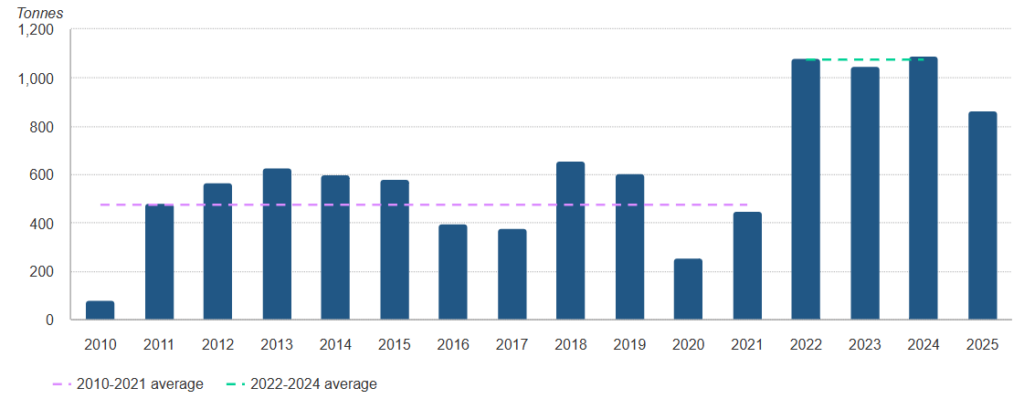
The scale of central bank gold buying in recent years is staggering. According to the World Gold Council, central banks added over 1,000 tonnes of gold to their reserves in 2022, 2023, and 2024—with 2022’s 1,082 tonnes marking the highest level of net purchases since 1950. In 2023, purchases reached 1,037 tonnes, the second-highest annual total on record, followed by approximately 1,045 tonnes in 2024. Full-year 2025 data shows 863 tonnes added globally—below the four-figure pace of recent years, but still well above the long-run historical average.
To understand how extraordinary this is: from 2010 to 2021, the average annual pace was around 473 tonnes. In just three years, central banks nearly doubled their rate of accumulation. And even as buying moderated in 2025—partly due to record-high gold prices prompting a more measured approach—the broad strategic commitment remained intact, with 23 countries adding to reserves in H1 2025 alone.
Central banks have now been net buyers of gold for 16 consecutive years, reversing a decades-long era of selling.

The Financial System Isn’t Safer — And You Know It As risks mount, see why gold and silver are projected to keep shining in 2026 and beyond.
Why Now? The Key Drivers Behind the Trend
1. De-Dollarization and Reserve Diversification
For decades, the U.S. dollar has served as the world’s dominant reserve currency. Central banks held U.S. Treasuries as their primary store of value. But confidence in this arrangement has been eroding—and gold is filling the gap.
A major turning point came when the U.S. and its allies froze Russia’s foreign exchange reserves following the 2022 invasion of Ukraine. The message was clear to governments worldwide: dollar-denominated assets held abroad can be seized or restricted during geopolitical conflicts. Gold, by contrast, carries no such risk. It cannot be frozen, sanctioned, or devalued by a foreign government’s policy decision.
This realization has accelerated the push for reserve diversification, particularly among emerging markets. China, India, Poland, Singapore, Turkey, and dozens of other nations have been steadily reducing their dependence on dollar assets while building gold holdings.
2. Geopolitical Risk and Global Instability
Beyond the Russia-Ukraine conflict, the broader geopolitical landscape has grown considerably more complex. Tensions between major powers, regional wars, and shifting trade alliances have all contributed to a flight toward assets considered politically neutral and universally accepted.
Gold has historically served this role. It holds no nationality, carries no counterparty risk, and has been recognized as a store of value across civilizations for thousands of years. In a world where alliances are shifting and financial infrastructure can be weaponized, central banks are treating gold as the ultimate form of financial insurance.
As one analyst from the Official Monetary and Financial Institutions Forum (OMFIF) noted, geopolitical events have laid a foundation for gold to become prominent once again in central bank reserve portfolios—and as a means of settling payments between certain countries.
3. Inflation Concerns and Currency Devaluation
The inflationary surge following the COVID-19 pandemic reminded central banks of a fundamental vulnerability in fiat currency systems: governments can print money, and when they do, purchasing power erodes. Gold cannot be printed.
While central banks spent 2022 and 2023 raising interest rates to fight inflation, many simultaneously bought gold—a seemingly contradictory move that actually reflects sophisticated long-term thinking. Gold isn’t a short-term trade for these institutions; it’s a multi-decade hedge against the systemic risks of debt-fueled monetary expansion.
With government debt-to-GDP ratios rising globally—and the U.S. total public debt now exceeding 122% of GDP—the probability that governments will eventually inflate their way out of obligations has increased. Gold is the logical counterweight.
4. Growing Distrust of Sovereign Debt
For most of the post-World War II era, U.S. Treasuries were considered the safest asset in the world. That status is increasingly being questioned. Rising debt levels, fiscal dysfunction, and the risk of real returns being eroded by inflation have made central banks more skeptical of sovereign debt as a reserve asset.
Gold, by contrast, has no credit risk, no counterparty, and no maturity date. Its value doesn’t depend on any government’s ability or willingness to honor an obligation. For institutions managing national reserves over decades-long time horizons, these properties are deeply attractive.
Who Is Buying—and How Much?
The buying is being led by emerging market central banks, though the trend has now spread to developed economies as well.
China remains one of the most prominent buyers, having officially added 225 tonnes between late 2022 and 2023, with total reported reserves reaching approximately 2,300 tonnes. Gold still accounts for only about 5–7% of China’s total reserve portfolio—suggesting significant room to continue accumulating.
Poland has been one of the most aggressive buyers among European nations, adding over 100 tonnes in 2025 alone. Its reserves now stand at 550 tonnes and account for roughly 28% of total international reserves, approaching an updated target of 30% — a goal Poland raised from its prior 20% target in October 2025.
India has steadily increased its gold reserves, adding over 200 tonnes since 2017. In 2024, India repatriated 100 tonnes of its gold from the Bank of England’s vaults back to domestic soil — a signal of shifting trust in Western custodianship.
Singapore, Turkey, Kazakhstan, Brazil, Czech Republic, and many others have all added meaningfully to their gold holdings in recent years. The breadth of buying is arguably as significant as the volume.
Notably, 68% of central banks now store most of their gold within their own borders, up from roughly 50% in 2020. The freezing of Russia’s overseas assets prompted many nations to repatriate their gold rather than hold it in Western vaults.
Central bank demand in 2025 remained resilient in the face of record gold prices
Annual central bank net purchases, tonnes*
Source: World Gold Council
How Central Bank Buying Impacts Gold Prices
The scale of central bank demand has fundamentally reshaped gold market dynamics. These institutions generally buy based on long-term strategic reserve management goals rather than short-term price movements—which creates a persistent floor beneath gold prices. That said, the WGC noted that the record-high price environment in 2025 did prompt some moderation in the pace of buying, a reminder that central banks are not entirely immune to price considerations.
From 2021 to mid-2024, gold ETFs were actually net sellers—and yet gold prices rose significantly anyway. That divergence is highly unusual. Historically, ETF flows and gold prices moved closely together. The decoupling reveals just how powerful central bank demand has become as an independent price driver.
This is one reason why gold demand has remained robust even during periods of high interest rates and a strong U.S. dollar—conditions that historically weighed on gold prices.
Is This a Sign of Economic Uncertainty?
Yes—but it’s more than that. Central banks don’t make reserve allocation decisions lightly. These institutions manage sovereign wealth across multi-decade horizons, and when they shift their behavior as dramatically as they have since 2022, it reflects deep structural concerns rather than short-term market sentiment.
The shift to gold signals three things simultaneously: declining confidence in the dollar-centric reserve system, rising concern about geopolitical and financial instability, and a long-term reassessment of what “safe” actually means in a reserve portfolio.
For individual investors, this trend is worth paying close attention to. When the world’s most sophisticated and well-resourced financial institutions consistently move in the same direction, it’s a signal worth understanding.
What This Means for Individual Investors
Central bank gold buying doesn’t just move prices—it validates gold’s role as a strategic long-term asset. If national treasuries and monetary authorities are increasing their gold allocations to manage risk, diversify away from dollar dependence, and hedge against inflation, individual investors face many of the same underlying challenges.
A diversified portfolio that includes some allocation to physical gold or silver can serve similar protective functions: reducing correlation to traditional financial assets, providing a hedge against currency devaluation, and preserving purchasing power over time.
Experts generally suggest a precious metals allocation of 5–15% of a portfolio, depending on risk tolerance and investment goals. Whether through physical metals, ETFs, or other vehicles, the strategic case for gold has only grown stronger as central banks around the world continue to accumulate it.
The Bottom Line
Central banks aren’t buying gold because they expect a quick profit. They’re buying it because the global financial system is undergoing a meaningful structural shift—away from dollar dominance, toward a more multipolar reserve landscape where no single currency holds absolute sway.
Gold, with its universal acceptance, political neutrality, and centuries-long track record as a store of value, sits at the center of that transition. The institutions with the deepest research capabilities, the longest time horizons, and the most at stake have been making this bet consistently for 16 years—and doubling down in recent ones.
That’s a signal worth taking seriously.
Investing in Physical Metals Made Easy

People Also Ask
Why are central banks increasing their gold reserves?
Central banks are increasing their gold reserves primarily to reduce dependence on the U.S. dollar, hedge against inflation, and protect against geopolitical risk. The 2022 freezing of Russia’s foreign exchange assets was a pivotal moment—it demonstrated that dollar-denominated reserves held abroad can be seized or restricted, while gold cannot. This has driven a broad, sustained shift toward gold as a politically neutral, seizure-resistant reserve asset.
How does central bank gold buying affect gold prices?
Central bank gold buying creates a strong, persistent floor beneath gold prices. Because these institutions buy based on long-term strategic goals rather than short-term price movements, they are price-insensitive buyers who continue accumulating regardless of market conditions. This explains why gold prices rose significantly between 2021 and mid-2024 even as gold ETFs were net sellers—central bank demand filled the gap and then some.
Which countries are buying the most gold?
Emerging market central banks have led the trend, with China, India, Poland, Singapore, and Turkey among the most active buyers in recent years. China officially added 225 tonnes between late 2022 and 2023, while Poland purchased 130 tonnes in 2023 alone and is targeting gold at 20% of its total international reserves. In H1 2025, Poland, Azerbaijan, and Kazakhstan were the top three buyers, reflecting how geographically widespread the trend has become.
Is central bank gold buying a sign of economic uncertainty?
Yes, but it signals something deeper than short-term market anxiety. When the world’s most well-resourced financial institutions consistently and aggressively shift their reserve allocations, it reflects structural concerns—declining confidence in dollar-denominated assets, rising global debt levels, and a long-term reassessment of what constitutes a truly “safe” reserve. Central banks manage wealth across decades, not quarters, so their sustained commitment to gold carries significant weight.
Should individual investors buy gold because central banks are buying it?
Central bank gold buying validates gold’s long-term role as a strategic asset and highlights risks—inflation, currency devaluation, geopolitical instability—that affect individual investors too. While personal investment decisions depend on individual financial goals and risk tolerance, many financial experts recommend a 5–15% allocation to precious metals as a portfolio diversifier. If the institutions with the deepest research capabilities and the most at stake are consistently moving toward gold, it’s a trend worth understanding and potentially acting on.
This article is provided for informational purposes only and does not constitute investment advice. Always consult a qualified financial advisor before making investment decisions.