Silver Rises Over 120% YTD




Daily News Nuggets | Today’s top stories for gold and silver investors
February 27th, 2026 | Brandon Sauerwein, Editor
Gold and Silver Prices Rise as Inflation Data Rattles Wall Street
Wholesale prices ran hotter than expected in January. The Producer Price Index rose 0.5% for the month — well above the 0.3% economists forecast. Core PPI, which strips out food and energy, surged 0.8%. That’s nearly three times the expected reading.
Markets reacted fast. Dow futures fell more than 580 points in early trading. S&P 500 futures dropped nearly 1%. The PPI matters for a simple reason: when producers pay more, those costs typically get passed to consumers. It also feeds directly into the PCE index — the Fed’s preferred inflation gauge.
Sticky inflation is quickly becoming the dominant driver behind gold and silver prices — and Wall Street is adjusting. Two rate cuts are still priced in for this year.
Today’s report makes that case harder to hold. Inflation that stays stubbornly above target keeps the Fed on the sideline — and every month the Fed waits is another month that gold’s appeal as a hedge grows stronger.

Tech’s Worst Month in Nearly a Year
February has been brutal for tech. The Nasdaq Composite is on pace for its worst monthly performance since March 2025, down roughly 2.5% — and Friday is the last chance for a reprieve.
Nvidia is the clearest window into the mood. The chipmaker reported blowout earnings this week — $68.1 billion in Q4 revenue, with Q1 guidance of $78 billion. Investors still sold it down 5.5%. When a company beats by that margin and still falls, it says more about the market than the company.
The rot runs deeper than one stock. AI valuation fatigue is spreading. Fears are growing that automation could disrupt jobs faster than the economy can absorb. Block announced it’s cutting more than 4,000 employees and explicitly credited AI. Financials and industrials are quietly outperforming.
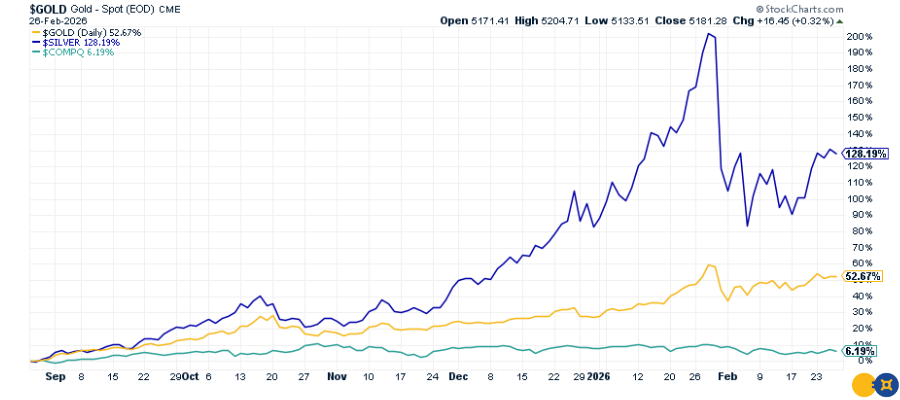
The chart below tells the six-month story plainly. While the Nasdaq has barely moved, gold is up more than 50%. Silver has more than doubled. The money didn’t disappear — it just went somewhere else.
Gold and Silver vs. the Nasdaq (Sep 2025 – Feb 2026)
Silver Breaks Out — and It’s Sending a Signal
Silver jumped more than 4% Friday, leaving gold’s modest gain in the dust. That kind of outperformance gets attention — and it usually means more than one thing is happening at once.
The drivers are layered. Inflation expectations are rising. Industrial demand tied to solar panels and electronics continues to grow. And after weeks of consolidation just below $90, some of Friday’s move likely reflects short-covering as traders got caught leaning the wrong way.
When silver outpaces gold by this margin, it tends to signal something broader. The gold-silver ratio tightened sharply — a pattern that historically accompanies expanding appetite for hard assets across the board. Silver is part monetary metal, part industrial commodity. That dual nature makes it a useful read on where investor sentiment is actually heading.
Gold Holds Steady as US-Iran Talks Enter Round Three
Gold rose above $5,200 per ounce Friday as US and Iranian diplomats sat down for a third round of nuclear talks in Geneva. The metal is up roughly 20% year-to-date — but right now, investors are watching rather than buying.
The logic is binary. Talks collapse, gold goes higher. A deal materializes, gold pulls back. “Iran-US tensions and uncertainty surrounding Trump’s tariffs are a bullish catalyst,” said Carlo Alberto De Casa of Swissquote. The tariff angle adds another layer — the US trade representative warned this week that rates could rise above 15% for some countries, without naming who.
Gold cleared the $5,200 resistance level that capped it all week. Analysts see the next targets at $5,340 and then $5,400 — but the next catalyst likely comes from Geneva, not Wall Street.
Gold Is Turkey’s Unauthorized Stimulus Program
Turkish households are sitting on roughly $600 billion worth of gold — held outside the banking system, tucked away in homes and passed down through generations. It’s one of the highest household gold ownership rates in the world. And right now, it’s complicating Turkey’s fight against inflation in ways nobody planned for.
Over the past year, surging gold prices added $300 billion to the value of those holdings. January alone accounted for $80 billion of that gain. The wealth effect is real and measurable. Turks are spending more and buying homes — even with annual inflation still above 30%. Turkey’s central bank has flagged that housing prices have risen sharply in provinces with higher gold deposits.
The problem is straightforward. When people feel wealthier, they spend more. More spending means more demand. More demand means more inflation. Gold is functioning like a stimulus program the government didn’t authorize and can’t turn off.
It’s a reminder that gold isn’t just a financial asset. At scale, it reshapes economies.