Silver Rises Over 120% YTD




Published: 07-02-2026, 09:52 am
Gold rose 2.49% to $4,132.56 on July 2, 2026. Silver rose 3.85% to $61.45. Both moves came as traders unwound a Federal Reserve rate-hike bet ahead of the gold jobs report. Silver’s gain is outrunning gold’s by more than 1.5-to-1.
The move extends a reversal that began July 1, 2026. A soft ADP employment print, paired with dovish Federal Reserve commentary, started unwinding days of hawkish rate-hike positioning. As of July 2, 2026, markets had not yet fully digested the Bureau of Labor Statistics’ June jobs report. This piece covers what’s confirmed: the setup before the report. And the mechanism linking jobs data to metals prices.
Here’s the mechanism, and why silver is moving harder than gold.
The setup: a hawkish bet ahead of the gold jobs report
Federal Reserve messaging turned notably hawkish in the two trading days before the gold jobs report. On June 30, 2026, Cleveland Fed President Beth Hammack told CNBC the job market was consistent with full employment. Hammack, a voting FOMC member, said persistent inflation “may mean that we need higher interest rates to bring inflation back down to target.” Her comments reinforced a tightening-leaning outlook among traders.
As of June 29, 2026, CME’s FedWatch Tool put the odds of a July hold at roughly 70%. That left meaningful odds on a hike instead of a cut. The 10-year Treasury yield climbed alongside that repricing. It held near 4.48% on July 2, 2026. That’s a sharp rebound off a seven-week low of 4.36%, set June 29, 2026.
The ADP National Employment Report, released July 1, 2026, cracked that hawkish narrative. Private employers added just 98,000 jobs in June. Economists surveyed by Reuters expected roughly 118,000. May’s gain, unrevised, was 122,000. Federal Reserve Chair Kevin Warsh spoke at the European Central Bank’s Sintra forum on July 1, 2026. He said inflation expectations “have come down in recent weeks.” He also reaffirmed the Fed’s 2% inflation target.
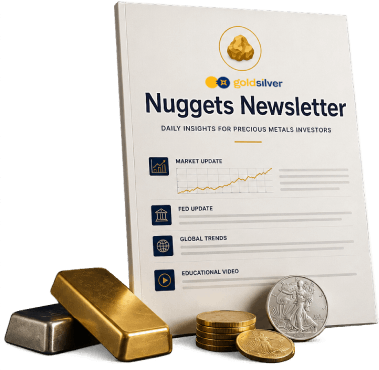
The Edge Every Investor Needs Smarter precious metals investing starts here. The Nuggets Newsletter brings you essential market insights, Fed updates, global trends, educational videos, and much more.
The mechanism: real yields, not fear
Gold and silver prices respond to one thing: the cost of cash versus the cost of holding a non-yielding asset. They don’t respond to bad news itself. When rate-hike odds rise, the expected return on holding Treasurys rises too, and gold’s relative appeal falls. Once those odds unwind quickly, that calculation reverses just as fast. The July 1 and July 2, 2026 trading sessions reflect that reversal in progress.
A gold jobs report doesn’t need to be weak in absolute terms to move this calculation. It only needs to come in weaker than what the market priced in over the prior 48 hours. Real yields, the return investors earn after subtracting inflation, are what connect a jobs report to a metals price. Nominal yields can hold steady, or even fall, while inflation stays elevated. That combination is exactly where gold and silver have historically performed best.
Why silver is moving further than gold
Silver’s industrial demand profile explains its outsized move relative to gold. The gold-silver ratio, which tracks how many ounces of silver equal one ounce of gold, fell 1.31% to 67.25 on the move. That drop confirms silver’s advantage in real time. Roughly 60% of annual silver consumption ties to electronics, solar panels, and semiconductors. That makes silver more sensitive than gold to the growth outlook priced into a gold jobs report. Silver also trades in a thinner, more leveraged futures market than gold, amplifying moves in both directions. When a Federal Reserve rate narrative shifts quickly, silver typically moves further than gold on the way up. It moves further on the way back down too, once the narrative reverses.
What this changes and what it doesn’t
A single jobs report doesn’t rewrite the multi-year case for owning physical gold and silver. That’s the real mechanism: rate expectations swinging sharply on a handful of data points. It’s exactly why gold and silver hedge against a monetary system built on these bets. The Federal Reserve is choosing between two imperfect paths. Raise rates into a labor market already showing cracks. Or hold rates and let inflation keep running. Neither path weakens the case for owning an asset that answers to neither.
Stay On Top of Gold & Silver Prices
Get important market alerts sent straight to your inbox.
SOURCES
1. CNBC — Private payrolls rose by 98,000 in June, less than expected, ADP reports, Gold gains over 2% after soft jobs data, Fed Chair Warsh’s comments
2. Reuters, via Yahoo Finance — Fed’s Hammack tells CNBC rate hikes may be needed to quell high inflation
3. Trading Economics — US 10-Year Treasury Note Yield
4. GrowBeanSprout — CME FedWatch Tool, Rate Probability Tracker
5. BlackRock — Gold & Silver: Prices, Volatility, What’s Next
6. GoldSilver — Live Gold & Silver Price Charts
Disclaimer: This article is for informational purposes only and does not constitute financial or investment advice. Always consult a qualified financial adviser before making investment decisions.
You May Also Like:
- Warsh Called Inflation “Too High.” He Also Said the Risk Is Fading. Gold Noticed.
- ADP Missed. Gold Shrugged. Warsh Is Live in Sintra Right Now.
- OCBC Just Cut Its Gold Forecast by $740. The Reason Is the Story.
- Gold Is Closing Its Worst Quarter Since 2013. A War Made It Happen.
- 172,000 Jobs Doubled the Forecast. Thursday’s Report Could Move Gold Again.
- The Dot Plot Has 18 Dots. The Chair Withheld His.
- Gold’s Worst Week of 2026. Central Banks Just Filed a Record Buy Signal.