Silver Rises Over 120% YTD




Published: 06-30-2026, 09:35 am
Gold entered Q2 at around $4,700 an ounce. As of June 30, 2026, it is leaving at $4,015. That is a gold price decline of roughly 14% — the worst quarterly performance since Q2 2013, according to Reuters, when the Federal Reserve’s taper tantrum sent bullion down 22.8% [Macrotrends, historical gold price data].
The mainstream explanation is correct as far as it goes: higher rate-hike expectations, a stronger dollar, elevated real yields. But it misses the inversion that makes this quarter genuinely unusual.
Gold is falling during a war.
That is not how it is supposed to work. For decades, Middle East conflict has been one of the most reliable catalysts for gold’s upside. When the US and Israel struck Iran on February 28, gold was near its all-time high. Then the Strait of Hormuz closed. As a result, oil climbed. Inflation expectations rose. The Federal Reserve — already under new Chair Kevin Warsh — was forced into a hawkish posture. Markets are now pricing a 64% probability of a September rate hike, according to CME FedWatch data.
The war did not push investors toward gold’s haven premium. It pushed them away from gold’s rate sensitivity.
Why Did a War Push Gold Lower Instead of Higher?
Gold produces no income. Its appeal rests entirely on the cost of holding it — which real interest rates determine. When real yields are low or negative, the math favors gold. When real yields climb, it doesn’t.
That is exactly what happened. The Hormuz disruption sent oil higher, which stoked inflation, which forced the Fed toward hikes, which lifted real yields. Each link in that chain is bad for gold’s paper price. None of it changes gold’s role as a monetary asset. It is a repricing — not a verdict.
For context: the 2013 taper tantrum sent gold down 22.8% in a single quarter [Macrotrends, historical gold price data] — deeper than today’s decline and driven by the same real-yield mechanism. After that crash, gold kept falling for another two and a half years, bottoming in December 2015 [Macrotrends, historical gold price data]. The bull market that followed ran for nearly a decade.
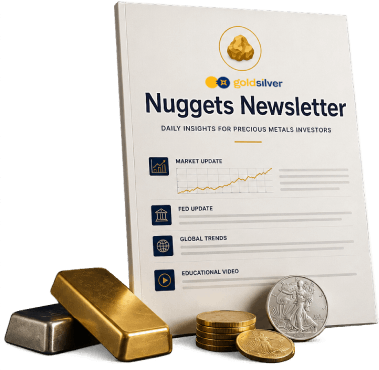
The Edge Every Investor Needs Smarter precious metals investing starts here. The Nuggets Newsletter brings you essential market insights, Fed updates, global trends, educational videos, and much more.
What Are Central Banks Doing While Paper Traders Sell?
While paper traders reprice rate expectations, sovereign buyers are doing something else entirely.
Central banks purchased a net 244 tonnes of gold in Q1 2026 [World Gold Council, Gold Demand Trends Q1 2026] — 17 consecutive months of net purchases. Asian retail buyers matched that conviction: bar and coin demand hit 474 tonnes globally in Q1, the second-highest quarter on record [World Gold Council, Q1 2026]. Poland, Uzbekistan, Kazakhstan, China — and a growing list of first-time sovereign buyers — have not paused on price.
The bank forecasts tell the same story. Goldman Sachs analysts Lina Thomas and Daan Struyven cut their year-end target to $4,900 [Goldman Sachs Global Investment Research, June 20, 2026] — but kept the structural bull case intact. JPMorgan held its year-end target near $6,000 [JPMorgan Global Research, June 2026]. This morning OCBC lowered to $4,360 [OCBC Group Research, June 30, 2026], citing real yields and dollar strength, while calling the medium-term case unchanged.
Every bank that cut its target said the same thing: near-term headwind, long-term thesis intact.
The paper market is repricing for a rate environment. The physical market is positioning for a decade.
What Would Reverse Gold’s Q2 Decline?
Two data points arrive in the next 72 hours. The ISM Manufacturing PMI drops Wednesday. The June jobs report drops Thursday. Both test whether the economy is strong enough to sustain the rate hikes markets have priced in.
If the data softens, rate-hike odds come down. Real yields compress. The conditions driving this quarter’s decline begin to reverse — mechanically, not speculatively.
In short, that is not a prediction. It is how the mechanism runs in reverse.
Physical holders do not need to time that inflection. They own gold because they understand purchasing power erosion over years, not quarters. A 14% gold price decline does not change the underlying balance sheet math.
That is not blind optimism. That is how sound money works.
Stay On Top of Gold & Silver Prices
Get important market alerts sent straight to your inbox.
SOURCES
1. GoldSilver.com — Live Gold & Silver Price Charts (spot prices, June 30, 2026)
2. Reuters via CNBC — Gold heads for worst quarter in 13 years on strong dollar, Fed hike bets (June 30, 2026)
3. World Gold Council — Gold Demand Trends Q1 2026 (April 29, 2026)
4. OCBC Group Research — Precious Metals Forecasts (June 30, 2026)
5. CME Group — FedWatch Tool (rate hike probability data, June 30, 2026)
6. Goldman Sachs Global Investment Research — Precious Metals Outlook, analysts Lina Thomas and Daan Struyven (June 20, 2026)
7. JPMorgan Global Research — Gold Price Forecast 2026
8. Macrotrends — Gold Price Historical Data (Q2 2013 quarterly decline; December 2015 price bottom)
Disclaimer: This article is for informational purposes only and does not constitute financial or investment advice. Always consult a qualified financial adviser before making investment decisions.
You May Also Like:
- 172,000 Jobs Doubled the Forecast. Thursday’s Report Could Move Gold Again.
- The Dot Plot Has 18 Dots. The Chair Withheld His.
- Gold’s Worst Week of 2026. Central Banks Just Filed a Record Buy Signal.
- Silver Looks Like It’s Losing. The Ratio Says It’s Loading.
- Q1 GDP Beat. Jobless Claims Beat. Gold Rose. Here’s Why.
- PCE Hit 4.1%. Gold Went Up. Here’s Why.
- 298 Tonnes of ETF Gold Is Underwater. Central Banks Aren’t.