Silver Rises Over 120% YTD




Published: 04-28-2026, 09:43 am | Updated: 04-28-2026, 09:46 am
Gold and silver market update — April 28, 2026
Key Takeaways
- China’s three-move silver sequence: export licensing (January 2026), record imports (March 2026), and now a sulfuric acid export ban effective May 2026 — each tightening silver supply at a different layer of the chain.
- Why sulfuric acid matters for silver: Roughly 70% of newly mined silver is a byproduct of copper, lead, and zinc mining (Silver Institute, World Silver Survey 2025). You don’t restrict silver by restricting the acid — but you get the same result.
- Chile carries the most acute risk: the world’s largest copper producer imports over one million tonnes of Chinese sulfuric acid annually. China supplied 37% of Chile’s acid imports in 2025, and about a fifth of Chile’s copper output depends on acid-based leaching.
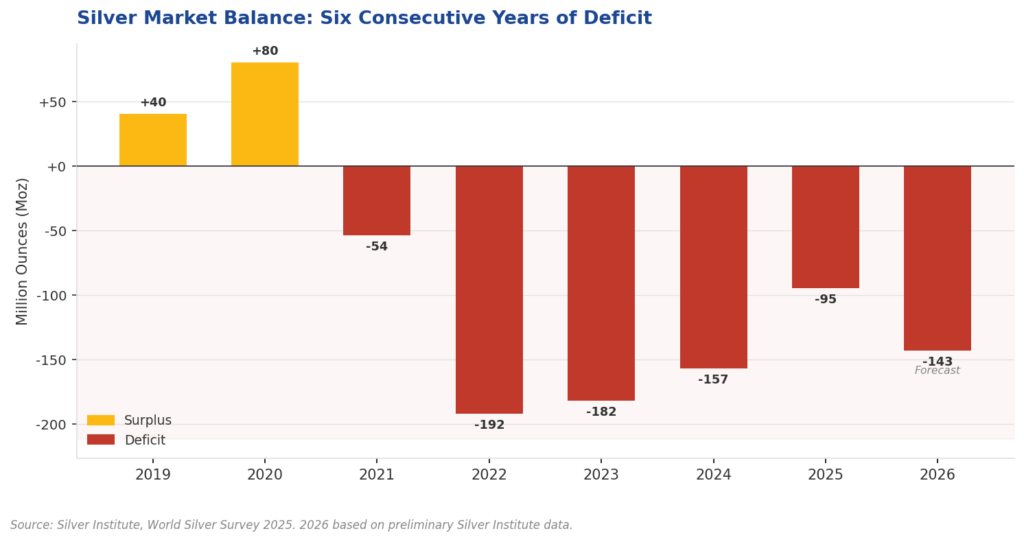
- The structural context: Silver demand is forecast to outstrip supply for the sixth consecutive year in 2026, adding to a cumulative five-year deficit already exceeding 800 million ounces — roughly an entire year of global mine production (Silver Institute).
Since late 2025, China has made three distinct moves in the silver market. It restricted silver exports. It set record import volumes. Now it’s halting exports of sulfuric acid — confirmed by Bloomberg and S&P Global, effective May.
That third move doesn’t mention silver. It doesn’t need to. The ban targets copper mining operations worldwide. Because roughly 70% of all newly mined silver is a byproduct of copper, lead, and zinc mining, a squeeze on copper output is also a squeeze on silver supply.
This isn’t a restriction on silver. It’s a restriction on the industrial chemistry that produces a large part of it.
How Does China’s Sulfuric Acid Ban Affect Silver Supply?
Sulfuric acid is the key input for copper heap-leach mining. Specifically, it’s the process that extracts copper from lower-grade oxide ores by dissolving the metal out of crushed rock. Most of that leaching happens in Chile — the world’s largest copper producer. Chile has historically imported over one million tonnes of Chinese sulfuric acid each year. According to S&P Global Market Intelligence, China supplied 37% of Chile’s total acid imports in 2025.
The squeeze is already showing. By mid-April, some copper producers were operating with less than 30 days of acid supply on hand, according to Ivanhoe Mines co-chairman Robert Friedland, cited by S&P Global on April 12. Additionally, acid prices in Chile have jumped roughly 44% in a single month. Rio Tinto’s chief commercial officer called Chile “the most exposed country in terms of need for sulphuric acid imports” at an industry conference this month.
So where does silver enter the picture? According to the Silver Institute’s World Silver Survey 2025, roughly 70% of all newly mined silver comes as a byproduct of copper, lead, and zinc mining — not from dedicated silver mines. Silver doesn’t get extracted separately; it rides along with the base metal. As a result, when copper production slows, silver output drops with it.
In other words, you don’t have to restrict silver supply directly if you restrict the process that produces it as a side effect.
Notably, analysts at S&P Global and CRU expect the ban could last through end of 2026. If it does, output cuts at marginal copper operations in Chile, the DRC, and Zambia are likely — and silver supply takes the hit alongside copper.
The Edge Every Investor Needs Smarter precious metals investing starts here. The Nuggets Newsletter brings you essential market insights, Fed updates, global trends, educational videos, and much more.
Is China’s Silver Strategy Part of a Larger Pattern?
The acid ban didn’t come out of nowhere. It’s the third move in a sequence that started with China’s Ministry of Commerce on October 30, 2025.
Move one: export licensing. From January 1, 2026, Chinese firms need government licenses to export refined silver. Only 44 large, state-aligned entities qualified, per a Ministry of Commerce notification confirmed by Reuters on December 30, 2025. Furthermore, the minimum threshold — 80 tonnes of annual production capacity — shuts out most smaller exporters entirely.
Move two: record imports. China’s silver imports hit a record in March 2026. Meanwhile, the same country tightening silver outflows was pulling in more silver than ever.
Move three: today’s story. It doesn’t touch silver directly. Instead, it tightens the acid supply that copper miners in Chile depend on — and with it, the byproduct silver those mines produce.
Each move operates at a different layer of the supply chain. Together, however, they point in one direction.
What Does Today’s COMEX Delivery Date Tell Us?
Today — April 28 — is the first notice date for COMEX May silver futures. This is the point at which long-position holders must declare whether they want physical delivery. More than 26,900 contracts remain open, representing over 134 million ounces. COMEX inventory trackers describe physical pressure as elevated.
The paper market rolls forward on schedule. The physical supply it’s priced against does not.
Does China Have a Grand Plan — or Is This Coincidence?
None of these three moves requires a conspiracy theory to explain.
The silver export licensing protects China’s own industrial supply — solar panels, electronics, and EVs all depend on it. The acid ban, meanwhile, is partly a response to the Iran conflict. Specifically, the Strait of Hormuz closure has cut off roughly a third of global seaborne sulfur trade, squeezing the feedstock China needs for domestic fertilizer production.
Each policy, therefore, has a clear domestic rationale. However, the cumulative effect on China silver supply outside its borders is real regardless of intent. Three moves. Three different supply levers. All tightening since late 2025.
Silver demand is already forecast to outstrip supply for the sixth consecutive year in 2026. In addition, the five-year cumulative deficit has topped 800 million ounces — roughly a full year of global mine output. This acid ban lands on a market with nothing to spare.
Physical silver — owned outright, stored outside the financial system — sits outside all of this. It doesn’t need re-refining. It doesn’t roll to the next futures month. No export license touches it.
That’s not a philosophical point. It’s a practical one.
What Should Investors Watch Next?
The acid ban’s direction is confirmed. Duration, however, is the open question. Chilean buyers covered their acid needs for the first half of 2026 — but left the second half largely unhedged, according to S&P Global. As a result, the pressure point arrives this summer.
Watch Chile’s copper output data in May and June. That’s where the acid shortage becomes a production number — and where the silver byproduct effect turns from a thesis into a data point.
Stay On Top of Gold & Silver Prices
Get important market alerts sent straight to your inbox.
SOURCES
1. IDNFinancials — China Allows 44 Companies to Export Silver for 2026–2027
2. Trivium China — China’s Silver Export License Requirements Take Effect
3. Bloomberg — China Moves to Ban Sulfuric Acid Exports as Iran War Hits Supply
4. S&P Global Platts — China’s Sulfuric Acid Restrictions Set to Squeeze Miners
5. S&P Global Platts — No Quick Sulfuric Acid Fix for Chilean Copper Sector
6. Mining.com — China Moves to Ban Sulfuric Acid Exports as Iran War Hits Supply
7. Mining.com — Copper King Chile Faces Acid Supply Crunch as China Exports Dry Up
8. Supply Chain Magazine — How China’s Sulphuric Acid Ban Will Hit Metals & Fertiliser
9. Supply Chain Magazine — China’s Acid Ban Puts Chile’s Copper Output on the Line
10. Silver Institute — Silver Industrial Demand Reached a Record 680.5 Moz in 2024
11. Silver Institute — World Silver Survey 2025 (PDF)
By the GoldSilver Editorial Team — helping investors understand sound money since 2005. This article is for informational purposes only and does not constitute financial, investment, or tax advice. Always consult a qualified financial advisor before making investment decisions.
You May Also Like:
- Powell Press Conference: What It Means for Gold
- Iran Blinked — And One Word From Powell Decides What Happens Next
- COMEX Silver First Notice Day April 30: What to Watch
- What Warsh as Fed Chair Means for the Gold Price
- 5 Signals the Mainstream Gold & Silver Narrative Missed
- Before the Fed Speaks, Watch This Number for Gold
- Gold Price Today: What to Watch Before the April 29 FOMC
- What’s Driving Gold Prices? Oil, PMI, and Newmont