Silver Rises Over 120% YTD




Published: 04-15-2026, 10:37 am | Updated: 04-15-2026, 04:50 pm
Silver surged more than 5% on Tuesday, climbing towards $80 per ounce for the first time since March. It’s holding those gains Wednesday. Peace talk optimism is rippling through oil, the dollar, and Fed rate expectations — and all three matter for precious metals.
The move looks simple, but the mechanism behind it isn’t. And it’s worth understanding before the next headline moves the market.
Why did the Iran war hurt gold and silver prices?
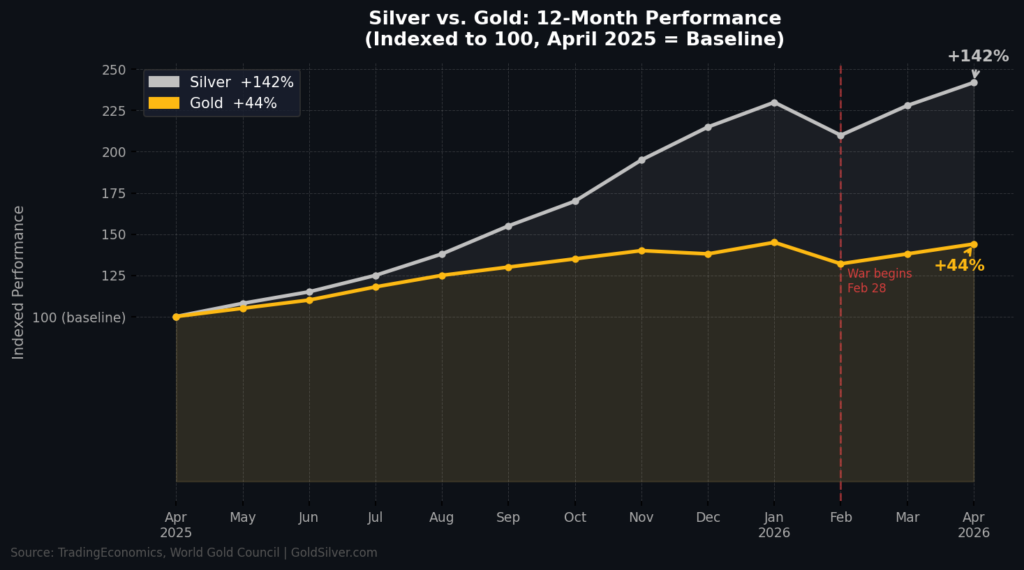
When the US and Israel launched their air campaign against Iran on February 28, most investors expected gold to surge. Geopolitical crisis usually means safe-haven buying and higher metals prices. Not this time. Gold fell roughly 10% from its pre-war levels.
And the reason was oil. Iran closed the Strait of Hormuz, through which roughly 20% of global oil flows. Crude surged above $100 a barrel. Higher oil meant higher inflation. Higher inflation meant the Federal Reserve couldn’t cut rates. Elevated rates make Treasury bonds attractive again — bad news for metals, which pay no yield.
The war didn’t create safe-haven demand. It created an inflation shock — and that trapped precious metals. On CME FedWatch, rate-cut odds collapsed from 40% before the conflict to 14% at its peak (CME FedWatch, April 2026).
Silver felt the squeeze from two directions. As a monetary metal, it suffered from the same rate dynamics as gold. As an industrial metal tied to solar, EVs, and grid infrastructure, it also absorbed the demand hit from manufacturing disruptions.
The Edge Every Investor Needs Smarter precious metals investing starts here. The Nuggets Newsletter brings you essential market insights, Fed updates, global trends, educational videos, and much more.
Why are Iran peace talks bullish for silver and gold?
The US-Iran ceasefire, brokered by Pakistan on April 8, began reversing those dynamics immediately. Treasury yields dropped four basis points on the announcement. Rate-cut odds jumped to 43% within hours. Gold rose more than 3% that day.
Since then, the situation has stayed fragile. Talks in Islamabad on April 11–12 collapsed. The US naval blockade of Iranian ports remains in place. The truce expires April 21. But the White House confirmed Tuesday that a second round of negotiations is being actively planned.
Markets are already front-running a deal. Oil is back below $90. The dollar index has slid to 97.96 — a six-week low — as the war risk premium unwinds.
For silver, peace works through two channels at once.
The first is monetary. Lower oil cools inflation expectations. That reopens the Fed’s rate-cut pathway. Markets now price roughly a 30% chance of a 2026 cut — almost double the odds from days ago (CME FedWatch, April 2026). Chicago Fed President Austan Goolsbee said this week he might hold rates all year if oil stayed elevated. White House Council of Economic Advisers Chair Stephen Miran said he didn’t think it would.
The Fed is watching oil. So should you.
The second is industrial. Silver’s demand from solar manufacturing, EV batteries, and grid infrastructure was suppressed by the conflict. A sustained ceasefire restores it.
How much has silver gained compared to gold?
Silver is up 142% over the past 12 months (TradingEconomics, April 2026). Gold is up approximately 101% over the same period (TradingEconomics, April 2026). Both numbers are exceptional by any historical standard. Silver’s is in a different category entirely.
The gold/silver ratio — ounces of silver needed to buy one ounce of gold — sits at roughly 60:1 today. That ratio has been tightening as silver outpaces gold. Historically, a tightening ratio marks the phase of a metals bull market where silver generates its biggest outperformance.
At $80.50 per ounce, silver is within reach where gold at $4,825 isn’t. A $5,000 allocation buys 62 ounces of silver — or one ounce of gold. That’s not just a price difference. It’s more exposure per dollar.
Is the long-term case for gold and silver still intact?
The Iran war was noise. Loud noise — but noise. The underlying case for precious metals is monetary, not geopolitical, and it hasn’t moved.
The People’s Bank of China has added gold to its reserves for 17 consecutive months. Holdings now stand at 2,313 tonnes — approximately 11% of China’s foreign exchange reserves at current spot prices (World Gold Council, April 2026). Chinese gold ETFs added $8.5 billion in Q1 2026 — 50 tonnes, the strongest quarter on record (World Gold Council, April 2026).
The US fiscal deficit keeps expanding. The Fed’s rate-hold posture reflects a system where borrowing costs are as much political as economic. That’s not new. It’s structural.
Gold and silver don’t need a war. They need a world where fiat currency systems erode purchasing power over time. That world isn’t going anywhere.
What should precious metals investors watch next?
April 21 is the date. A confirmed deal — or even a truce extension — sends oil lower, the dollar weaker, and rate-cut odds higher. All three are tailwinds.
A breakdown before April 21 reverses some of those gains. But the structural bid — central bank accumulation, fiscal expansion, monetary debasement — doesn’t reverse with a headline.
Silver is up 142% in twelve months. It absorbed a war, a blockade, and a ceasefire that nearly didn’t hold. The trend didn’t break. If the truce holds past April 21, the three tailwinds — lower oil, a weaker dollar, and rising rate-cut odds — all point in the same direction for silver.
Draw your own conclusion.
Stay On Top of Gold & Silver Prices
Get important market alerts sent straight to your inbox.
SOURCES
1. TradingEconomics — Silver Price
2. TradingEconomics — Gold Price
3. CME Group — FedWatch Tool
4. World Gold Council — China Gold Market Update: A Seasonal Demand Rebound in March
By the GoldSilver Editorial Team — helping investors understand sound money since 2005. This article is for informational purposes only and does not constitute financial, investment, or tax advice. Always consult a qualified financial advisor before making investment decisions.
You May Also Like
- The Fed Goes Silent in 3 Days – What Does That Mean For Gold?
- Gold Is Down 10% From Its War-Peak — and Still Up 46% in a Year
- Gold Outranks the Dollar at Central Banks — What It Means for Your Savings
- Hormuz Blockade Sent Gold Down 2%. Here’s Why That’s Bullish
- Gold Jumps 2% as Trump Plans Iran War Address Tonight
- $88 Billion a Month: Why U.S. Debt Is Driving Gold Prices
- CPI Hits 3.3%, GDP Stalls — Is Stagflation 2026 Here?