Silver Rises Over 120% YTD


Published: 11-19-2026, 10:05 am
Is bearish talk a silver buy signal? Market strategist Gareth Soloway thinks it can be. In a new interview with host Megan King Diaz, he explained why. When viewers tell him silver will fall to $20, he is glad to hear it. His reasoning flips a common instinct. This article covers the core logic and leaves the chart work for the full video.
Key Takeaways:
- Soloway reads loud bearishness as a sign that speculative money has left.
- At the highs, he saw leverage and sky-high social media targets. Today he sees fear.
- He adds on meaningful price drops, not on a fixed calendar.
- He admits that no one can call the exact bottom.
Why Does Gareth Soloway Welcome Calls for $20 Silver?
Because loud pessimism tells him the weakest buyers have already left. Soloway says he now hears the opposite of what he heard at the highs. Viewers tell him silver will fall much further as he talks about buying in the high $40s. He calls that “what you want to see.”
His logic runs in two steps. First, he believes speculative money has mostly exited. Second, he says people are now too nervous to use leverage. Together, those two signs suggest few forced sellers remain. As a result, he starts accumulating, as long as his long-term case stays intact.
Analysts call this contrarian thinking. A contrarian signal appears when nearly everyone expects the same outcome. In that case, few people may remain to push the price further in that direction. Soloway treats it as one input, not a guarantee.
The Knowledge That Changes Everything
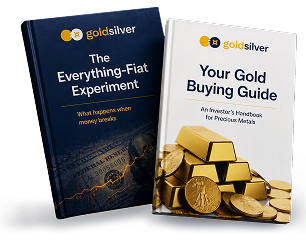
Two essential guides — yours free. Understand why gold matters and why fiat currencies always fail.
What Did Social Media Look Like When Silver Was Near $100?
It looked like certainty. Silver topped $100 an ounce for the first time on January 23. It then set a record above $121 on January 29. Soloway recalls posts at those levels calling for $250. He says many people also used leverage.
He gives a simple example. Someone with $3,000 sees many voices shouting higher targets. That person then uses leverage to control $6,000. Leverage raises the stakes in both directions. In addition, he points to lines at pawn shops. He also says people mortgaging homes to buy is a sign of a top.
Then the reversal came fast. Silver then fell about 30% on January 30. It touched about $71 intraday on February 2. FINRA describes the pattern. Some investors rush in as prices rise and may buy just before a drop. Others sell in fear when markets fall. Soloway believes the crowd has now flipped from greed to fear.
For this week’s slide, see our report on silver’s drop as Treasury yields eased.
Why Does He Buy by Price Instead of the Calendar?
Because a slightly lower price barely improves his average cost. Dollar-cost averaging means investing equal amounts at regular intervals, whatever the market is doing. Soloway does not follow that calendar approach. Instead, he asks whether silver has fallen enough to justify more risk.
He uses a plain example. Put $1,000 in today. Next month, add another $1,000 at a price one penny lower. You doubled your exposure, but your average cost barely moved. In his view, you took on twice the risk for almost no benefit. So he waits for a meaningful discount before adding.
That approach has trade-offs. FINRA says spreading purchases over time can lower risk. However, it often lowers returns compared with a lump sum. Waiting for a price drop adds its own risk, because the drop may run further than expected. Soloway admits that believing a low is in does not make it so. That is why he spaces his purchases rather than buying all at once.
For an earlier look at silver’s break under $50, read why silver fell faster than gold.
What Does the Full Interview Cover That This Article Skips?
Plenty. Soloway walks through his own charts and shows where he plans to add next. He explains why old price peaks matter to his silver purchases. He also shares what he expects silver to do if the economy slows. In addition, he covers gold, interest rates and the bond market. Finally, he gives a long-range outlook for both metals.
None of that fits in a short summary. Watch the full interview to see the charts and hear Megan’s questions.
Watch the full video with Gareth Soloway
Stay On Top of Gold & Silver Prices
Get important market alerts sent straight to your inbox.
People Also Asked
It can be one input, but it is not a guarantee. Soloway reads extreme pessimism as a sign that speculative money has left. However, he says no one has a crystal ball. A low can fail to hold. Pair sentiment with price levels and a long-term view.
A contrarian buy signal appears when nearly everyone expects the same price direction. Investors who use it read extreme pessimism as a sign that selling may be running out. It does not predict timing, and it does not promise a rebound.
Dollar-cost averaging means investing equal amounts at regular intervals, regardless of market conditions. It can lower risk and remove some emotion from investing. However, it often produces lower returns than a lump sum.
Silver set a record above $121 on January 29, 2026. It first broke $100 on January 23. On February 2, it touched about $71 intraday.
SOURCES
1. Reuters (via MarketScreener) — Silver tops $100 an ounce for the first time
2. Nasdaq (Investing News Network) — What Was the Highest Price for Silver?
3. CME Group — Uncovering the Hidden Drivers of Commodities
4. FINRA — The Benefits and Limitations of Dollar-Cost Averaging
Disclaimer: This article is for informational purposes only and does not constitute investment advice. Past performance is not indicative of future results. Always consult a qualified financial advisor before making investment decisions.
You May Also Like:
- Why Gold Fell Below $3,800 After Nvidia’s Record Quarter
- Why Is Christopher Whalen Still Buying Gold as It Falls?
- Gold Fell After Hot CPI. What Does Trey Reik Watch Instead?
- Physical Gold vs. Gold ETF vs. Mining Stocks: Which Fits You?
- Michael Oliver: Is Gold’s 29% Drop Just Like 2008?
- Gold Broke $4,000. The Fed Just Proved Him Right.
- Why Isn’t Gold at $6,000 Yet? Gerald Celente Explains
- Peter Grandich: What Happens to Gold When Stocks Fall?