Silver Rises Over 120% YTD




When Mike and Alan published this episode of The GoldSilver Show, silver was trading around $58 an ounce.
Together, they warned that a structural supply crisis was quietly building — one that could eventually make physical silver not just expensive, but nearly impossible to acquire at any reasonable price.
Alan laid out five stages of silver’s trajectory to describe where things were headed: Undermined, Undervalued, Unchained, Unstoppable, and Unobtainium. Mike added a sixth: “Unaffordium” — the point where physical silver doesn’t just become scarce, it becomes unaffordable.
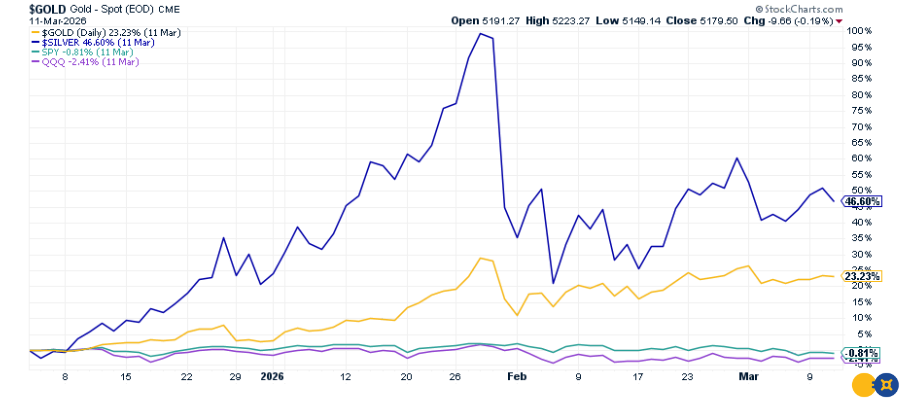
Three months later, silver touched an all-time high of $121.62 an ounce, the March COMEX delivery cycle was described by analysts as a stress test of the entire global silver pricing system, and the metal was still trading near $86 as of this writing — roughly 47% above where it was when Mike hit publish.
The fireworks, it turns out, had already started.
Is There a Silver Supply Deficit?
The foundation of Maloney’s argument was simple: the world is entering a structural silver supply deficit, where global demand is beginning to exceed available supply. And unlike most commodities, that imbalance can’t be fixed quickly.
Unlike gold, where most of the metal ever mined still exists in some recoverable form, silver is consumed by industry. Every year, enormous quantities disappear into solar panels, semiconductors, electric vehicles, medical devices, and advanced batteries — and most of it is not economically recoverable. It doesn’t come back.
Meanwhile, mine supply has struggled to keep pace for years. The result is a persistent silver supply deficit that has been showing up in industry data for several years — and accelerating.
According to Maloney: “There just isn’t enough. There’s not going to be enough for at least until the end of this decade — and that means super high prices.”
That forecast was far more bullish than most Wall Street analysts were projecting at the time. But expectations across the industry have been rising quickly. Several major banks have recently lifted their silver outlooks, now pointing to dramatically higher prices in the years ahead. (See our full breakdown of the latest silver price forecasts here.)
Why Can’t New Silver Supply Arrive Quickly?
One reason the shortage is so hard to resolve is the timeline required to bring new silver to market.
Mining projects don’t move fast. A discovery has to be made, financed, permitted, and constructed before a single ounce reaches the market. As Mike explains in the video, even a high silver price can only do so much: “To find a discovery, turn it into a mine, and get that ore above ground and refined into bars takes five to ten years.”
That lag is critical. Even if higher prices are attracting more exploration today — and they are — new supply cannot arrive fast enough to relieve the current pressure. The market doesn’t have the luxury of waiting.

Why Is Industrial Demand for Silver Exploding?
At the same time supply is constrained, demand continues to surge on the industrial side.
Silver is one of the best electrical conductors on Earth. That makes it indispensable for the technologies being built right now: solar panels, electric vehicles, next-generation electronics, and emerging energy infrastructure. Solar alone has become a dominant new demand source — each panel requires silver in its conductive paste, and global solar deployment is still accelerating.
The same macro forces pushing countries toward energy transition are pushing structural demand for silver higher. These aren’t temporary trends. They’re built into the infrastructure of the next decade.
Why Is Most Silver Mined as a Byproduct — And Why Does It Matter?
There’s another layer that makes silver supply uniquely inflexible: most silver doesn’t come from silver mines.
The majority of global silver production is a byproduct of mining other metals — copper, lead, zinc, and gold. That means silver output doesn’t automatically rise when silver prices increase. If base metal mining slows for any reason, silver output can fall even as silver demand is surging.
It’s a structural vulnerability that most investors overlook — and one that makes silver particularly exposed to a supply crunch.
What’s the Difference Between Paper Silver and Physical Silver?
Perhaps the most important part of Maloney’s analysis was his warning about the difference between paper silver and physical silver.
Most price discovery in silver happens through futures markets, where traders buy and sell contracts representing large quantities of metal. Historically, the vast majority of these contracts are settled in cash — not physical delivery. That creates a system where the amount of silver being traded on paper can vastly exceed the amount of real metal actually available.
As long as most participants accept cash settlement, the system holds together. But if enough investors demand physical delivery, the dynamic shifts — and the physical market begins to set the price, not the paper market.
That scenario, which Maloney described as a theoretical risk in December, showed up in the real world just months later. The March 2026 COMEX delivery cycle was described by market analysts as a stress test for the entire global silver pricing system, with delivery demand representing over 60% of total registered inventory. The CME responded by raising margin requirements — a move that briefly sent prices lower but did nothing to resolve the underlying physical supply tension.
Maloney called this phase “unobtainium.” We may now be watching its early stages.

Get Expert Insights from Alan Hibbard Learn from Alan Hibbard, a trusted voice in precious metals delivering clear, actionable analysis on gold, silver and the global economy.
When Shortages Force Price Discovery
If supply deficits continue while industrial and investment demand rises, price discovery eventually migrates toward physical availability. Paper prices and physical prices begin to diverge.
Silver briefly hit $121.62 an ounce in January 2026 before a margin-hike-driven correction pulled it back toward $70. As of this writing, it has recovered to the mid-to-upper $80s. Bank of America’s metals research team maintains a 2026 target range of $135 to $309, based on gold-to-silver ratio compression and supply constraints.
The range of outcomes is wide — but it’s wide to the upside, not the downside.
Why Investors Are Paying Attention
For investors, the silver story has always operated on two levels simultaneously.
Silver is an industrial metal — and an increasingly critical one. But it is also a monetary asset, with a history as sound money that stretches back thousands of years. That dual role means silver tends to react powerfully during periods of currency debasement, inflation, and financial instability.
When investment demand piles on top of industrial demand — as it has in the current environment — price moves can be rapid and significant. That’s one reason many analysts believe silver can outperform gold during the later stages of a precious metals bull market, as the gold-to-silver ratio compresses from historically elevated levels.
The Bottom Line
When Mike Maloney published this video in December 2025, silver sat at $58 an ounce. He warned that a structural supply crisis was building, that the paper market could eventually crack under physical delivery pressure, and that the fireworks hadn’t started yet.
“There just isn’t enough silver—and there won’t be for years.”
Three months later, silver has already gained nearly 50% from those levels, hit an all-time high, and the physical delivery system has been stress-tested in exactly the way he described. The thesis isn’t hypothetical anymore.
Watch his full breakdown here.
Investing in Physical Metals Made Easy

People Also Ask
What is a silver supply deficit?
A silver supply deficit occurs when global demand for silver exceeds the amount produced by mines and recycled supply. In recent years, industrial demand from sectors like solar energy and electronics has outpaced production. Analysts like Mike Maloney have warned that this imbalance could persist for years, potentially pushing silver prices much higher.
Why is silver demand increasing so quickly?
Silver demand is rising because the metal is essential in modern technologies. It is widely used in solar panels, semiconductors, electric vehicles, and advanced electronics. As global electrification and renewable energy adoption expand, demand for silver continues to grow.
Why can’t new silver supply come to market quickly?
Developing new mines takes time. From discovery to full production, a new silver mine can take five to ten years due to exploration, permitting, financing, and construction. This long timeline means supply cannot easily respond when demand surges.
Could a silver shortage push prices higher?
Historically, persistent supply deficits in commodities eventually lead to higher prices. When demand exceeds available supply, prices rise to encourage new production or reduce consumption. Many analysts believe the current silver market conditions could lead to significantly higher prices in the coming years.
Where can I learn more about silver price forecasts?
Investors can explore detailed analysis of silver market fundamentals and price forecasts at GoldSilver.com, where analysts track supply deficits, industrial demand trends, and macroeconomic drivers. You can also read GoldSilver’s full breakdown of the latest silver price predictions to see how major financial institutions are adjusting their outlook.