 Silver Rises Over 120% YTD




Gold is element 79 — a dense, chemically inert metal that cannot be made, printed, or destroyed. Its supply is scarce by nature, its durability absolute. Five thousand years of human history have chosen it as the most reliable store of purchasing power ever found. That's why gold holds value when governments inflate, fires burn, and central banks debase. Nothing they do changes what it is.
Most people know gold is valuable. Far fewer can explain why gold holds value the way it does. The answer isn't simply that gold is rare or shiny — it goes deeper than supply and demand, and it starts with what gold actually is.
What Is Gold?
Gold is a chemical element — symbol Au, atomic number 79. Unlike most metals, it doesn't form from earthly geology. It comes from the collision of neutron stars — a product of cosmic events. Gold does not tarnish, rust, or corrode. It cannot be made or copied in any industrial process. New gold must be found and mined — slowly, expensively, with no shortcut. Annual mine production adds roughly 1–2% to the total above-ground stock each year. That growth rate is lower than virtually every fiat currency on earth. The universe built scarcity into gold. That is why gold holds value in a way no printed currency ever can.
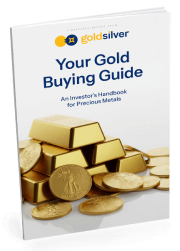
Your Gold Buying Guide Most investors overpay when they buy gold. Then overpay again when they sell. This guide shows you exactly what to own — and why.
Why Has Gold Been Used as Money for 5,000 Years?
Gold is the only widely available material that combines all five properties of sound money: scarcity, durability, divisibility, portability, and easy to verify. Every society that discovered it arrived at the same conclusion on its own. The Egyptians, the Romans, the Chinese, the Aztecs — all chose gold as a store of wealth before any of them had contact with the others.
Separate cultures kept arriving at the same answer because the logic is simple: good money must hold value over time. To do that, it must be hard to produce in large quantities. Gold cannot be made — only mined, at great cost. The first gold coins appeared around 700 BC in Lydia, modern-day Turkey. That logic hasn't changed in 2,700 years.
What Makes Gold Different from Paper Currency?
Paper currency — the dollar, the euro, the yen — is fiat money. It has no physical backing. Its value rests entirely on government decree and public trust. That ended on August 15, 1971, when President Nixon cut the dollar-gold link for good. Every major currency has been fully fiat ever since.
The scale of the difference: The US Federal Reserve's balance sheet grew from about $900 billion in 2008 to over $8 trillion by 2022 — a near-tenfold rise in 14 years. By contrast, gold's above-ground stock took all of human history to reach about 212,000 tonnes, growing by just 1–2% a year. No policy decision changes that.
When money supply expands faster than real output, each unit of currency buys less. That is inflation. Gold doesn't become more valuable when this happens — the currency measuring it becomes less valuable. The distinction matters because it means gold isn't a gamble. It is a gauge of monetary debasement.
Does Gold Actually Hold Its Value Over Time?
In 1971, when Nixon closed the gold window, gold was priced at $35 per ounce. Since then, it has risen more than 12,000% in dollar terms. Over the same period, the US dollar lost about 87% of its purchasing power. A dollar in 1971 bought what costs roughly $7.60 today.
Gold's performance isn't linear. It trades sideways for years and can fall sharply in the short term. Across full monetary cycles, however, the pattern of how gold holds value is consistent: it preserves purchasing power while fiat currencies erode. Every inflationary period in modern history has ended the same way — the assets governments can't print held their ground, and the ones they could didn't.
Who Is Actually Buying Gold — and What Does It Tell Us?
The most telling signal isn't the price. It's who is buying.
Central bank demand: Central banks purchased 1,045 tonnes of gold in 2024 — the third year in a row above 1,000 tonnes, more than double the 473-tonne annual average from 2010 to 2021. Total global gold demand in 2025 exceeded 5,000 tonnes for the first time in recorded history, reaching 5,002 tonnes. The buyers include the National Bank of Poland, the Reserve Bank of India, and the People's Bank of China, among dozens of others. J.P. Morgan Global Research has forecast approximately 800 tonnes of central bank gold buying in 2026, with a year-end price target of $6,300 per ounce.
In a World Gold Council survey of about 60 central banks, the top reasons cited for holding gold were consistent: it stores value over the long term, it holds up during crises, and it spreads risk away from currencies that can be debased. These institutions don't chase trends — they make reserve decisions that hold for decades. And they are buying gold.
How Do You Actually Own Physical Gold?
Physical gold carries no counterparty risk. There is no bank promise, no platform risk, no exposure to insolvency. Gold itself is the asset.
The two main forms are coins and bars. Coins — like the American Gold Eagle or the Canadian Gold Maple Leaf — carry legal tender status and are known globally, which aids liquidity. Bars carry lower premiums above spot, making them more cost-efficient for larger positions. Both can be held in a home safe, stored in a third-party vault, or held inside a self-directed IRA for US investors.
Allocated vs. unallocated: Allocated means specific bars or coins are legally yours. Unallocated means you hold a claim — one that may be backed by pooled reserves or derivatives rather than metal. If the goal is genuine protection from monetary debasement, allocated physical gold is the only version that delivers it.
Why Does Gold Have Value If It Has No Yield?
Gold's value comes from what it preserves, not what it produces. It pays no dividend or interest. Over more than five decades, however, gold has risen over 12,000% in dollar terms while the dollar lost about 87% of its purchasing power. In a system where any government can instruct its central bank to create more currency, gold's immunity to that process is the yield. It shows up as maintained purchasing power, not a coupon payment.
Is Gold a Good Investment?
The data makes a consistent case. Gold has held its value across every major monetary cycle in recorded history. Central bank demand has run above 1,000 tonnes a year for three years in a row. Global demand hit a record 5,002 tonnes in 2025 — a signal that the world's most informed buyers still treat gold as a core reserve asset. Whether it belongs in a specific portfolio depends on time horizon and goals, but the core argument hasn't weakened.
What Gives Gold Its Value Compared to Other Metals?
Most metals have industrial uses that tie their value to economic cycles — silver and platinum included. Gold is different. It combines chemical inertness, extreme durability, natural scarcity, divisibility, and global recognizability in a way no other widely available metal does. Its near-total resistance to destruction, and the hard ceiling on its supply, are what have made it the monetary metal of choice for over five millennia.
How Is the Gold Price Determined?
Gold trades around the clock across global markets, mainly through the London OTC market and the COMEX futures exchange in New York. The spot price reflects physical supply and demand, currency movements, real interest rates, central bank activity, and investor sentiment. The London Bullion Market Association sets the official benchmark price twice daily.
Has Gold Ever Lost Its Value Permanently?
No. Gold has endured prolonged drawdowns — after its 1980 peak of $850 per ounce, it took over 25 years to reclaim that level in nominal terms. Still, purchasing power was never permanently destroyed. Fiat currencies, by contrast, have a consistent long-term record: every major one in history has lost value over time. Gold hasn't.
Stay On Top of Gold & Silver Prices
Get important market alerts sent straight to your inbox.
If You've Made It This Far, You Already Understand Why Gold Matters
Most people come to gold through a feeling — something isn't adding up with how money works, and they want to understand it properly. The history backs the instinct. Governments have expanded money supplies, restructured debts, and rewritten monetary rules across every century and every economic system. Yet gold has just kept being gold: finite, impossible to destroy, beyond the reach of any committee's vote.
That doesn't make it a short-term trade. The price moves in cycles, and sharp drawdowns are part of the pattern. Over the time horizons that actually matter — decades, not quarters — physical gold has done the one thing most assets can't. It holds its value against the slow erosion that fiat currency reliably delivers.
The argument for gold isn't built on any single crisis or event. It's built on what every monetary system in history has eventually demonstrated. If you want to see what owning physical gold actually looks like, create a free account at GoldSilver.com.


