Silver Rises Over 120% YTD




Published: 02-24-2026, 10:30 am | Updated: 02-25-2026, 09:09 am
Daily News Nuggets | Today’s top stories for gold and silver investors
February 24th, 2026 | Brandon Sauerwein, Editor
Gold Pauses After Five-Day Rally as Traders Lock in Gains
Gold snapped its five-session winning streak Tuesday morning, pulling back after a strong run fueled by a softer U.S. dollar and declining Treasury yields. The metal had climbed steadily as investors recalibrated Fed policy expectations — with growing bets that rate cuts could arrive sooner if economic data continues to cool.
Today’s dip looks more like consolidation than a reversal. After nearly a week of gains, some traders are taking profits while waiting for fresh economic signals. A firmer dollar and modest rebound in yields added short-term pressure.
Markets remain sensitive to policy uncertainty, uneven global growth, and geopolitical tensions — all forces that continue to drive safe-haven demand.
The bigger picture: Despite the daily swings, gold and silver prices in 2026 have outpaced nearly every major asset class — including the S&P 500, which is barely above flat on the year. One down session doesn’t change the broader trajectory that’s been in place all year.
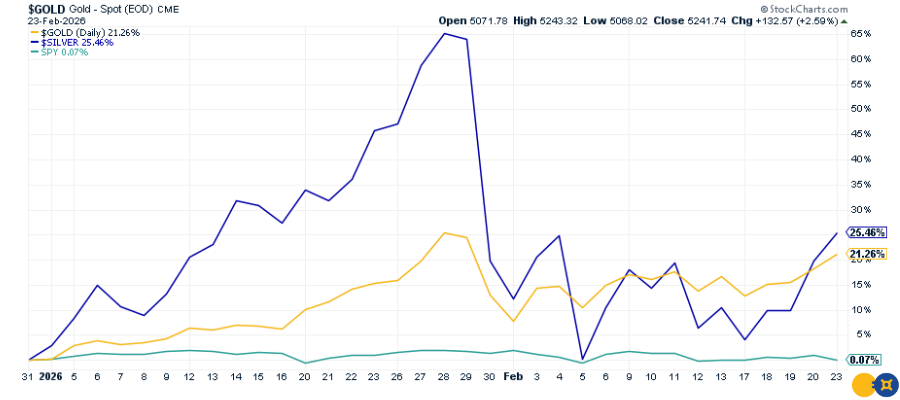
Precious Metals in 2026: Gold +21%, Silver +25% YTD
Yes, Silver Has Been Volatile. Here’s What the Numbers Actually Show.
If silver’s recent price swings have felt unsettling, that’s understandable. Sharp moves in both directions over the past few weeks have tested patience — driven by shifting rate-cut bets, AI-related metals chatter, and fluctuating industrial demand signals.
But volatility and weakness aren’t the same thing.
Even after the turbulence, silver is still up roughly 25% year-to-date. Gold and silver prices in 2026 have both left the S&P 500 — essentially flat on the year — well behind. Silver is outperforming not just the index, but gold itself.
Silver has always amplified gold’s moves. The swings feel bigger because they are bigger. But so are the gains when the trend holds — and right now, it’s holding.
Gold up 21%. Silver up 25%. S&P 500 barely above zero. Precious metals aren’t just surviving the uncertainty of 2026. They’re thriving in it.
The Edge Every Investor Needs Smarter precious metals investing starts here. The Nuggets Newsletter brings you essential market insights, Fed updates, global trends, educational videos, and much more.
Strategic Metals Reserve Could Fuel Price Volatility
Washington is making a big bet on metals. A new $12 billion proposal — dubbed “Project Vault” — would establish a Strategic Critical Minerals Reserve to secure domestic access to essential industrial metals. The initiative reflects growing U.S. efforts to reduce dependence on foreign supply chains.
While framed as a national security measure, analysts warn of unintended consequences. Flooding already constrained markets with large-scale government demand could push up prices for copper, silver, and rare earth elements — critical inputs for energy, defense, and tech.
Layered on top of existing tariff uncertainty, the proposal risks injecting fresh inflationary heat into the economy. Higher commodity prices ripple through manufacturing and consumer goods — complicating the Fed’s already difficult balancing act.
When governments compete for supply, prices tend to move first and ask questions later. That’s historically been good news for hard assets — and gold in particular.
Goldman Says AI Fears Are Boosting Asset-Heavy Stocks
Goldman Sachs strategists say investors are rotating toward “asset-heavy” companies — and away from AI-driven tech stocks showing signs of fatigue. After a powerful rally built on artificial intelligence optimism, some of the highest-flying names are facing valuation scrutiny. Capital is moving toward businesses with tangible assets and predictable cash flows.
The beneficiaries are familiar names in unfamiliar spotlight: industrials, energy producers, infrastructure players, and materials companies. Unlike AI-linked stocks — where valuations hinge on long-term growth projections — these firms derive value from physical assets, commodity exposure, and near-term earnings. Things you can see and touch.
It’s a classic rotation. When speculative narratives get crowded, investors look for durability. Goldman’s analysis suggests the AI trade isn’t dead — but the market is demanding proof, not promise.
As capital flows toward real-economy businesses, commodity-linked sectors could see renewed attention, especially if tech volatility persists.
But if AI is lifting some boats, it may be quietly sinking others.
Stay On Top of Gold & Silver Prices
Get important market alerts sent straight to your inbox.
Is AI Coming for Wall Street’s Margins?
Wall Street had a rough Monday. Banks and payment companies sold off sharply as investors reassessed what AI could mean for the economics of finance. American Express fell 7.2%. JPMorgan, Citigroup, and Morgan Stanley each dropped more than 4%. Mastercard and Visa declined 5.8% and 4.5%, respectively.
The trigger was a single research report. It suggested rapid AI adoption could dramatically lower transaction and processing costs — gutting the fee-based revenue streams that generate billions for banks and card networks. Analysts called it an “AI scare trade”: a sudden reckoning with the possibility that fat margins in finance could thin fast.
The concern isn’t abstract. For years, AI was seen as a growth engine for tech companies. Now markets are confronting its disruptive potential in older, more established industries. Payments. Lending. Advisory services. If AI reduces friction across all three, traditional financial firms could face sustained margin pressure — not a one-day event, but a structural shift.
This is the next phase of the AI story. Not just who wins, but who quietly loses.