Silver Rises Over 120% YTD




Published: 03-18-2026, 10:30 am | Updated: 03-18-2026, 09:55 am
Morning News Nuggets | Today’s top stories for gold and silver investors
March 18th, 2026 | Brandon Sauerwein, Editor
The U.S. economy outlook heading into spring looks deceptively resilient. But with oil near $100, the Fed deciding rates today, and the Strait of Hormuz effectively closed, the cracks are getting harder to ignore. Here’s what’s moving markets.
Is Gold’s $5,000 Floor About to Be Tested?
Gold dipped below $5,000 on Wednesday morning ahead of the big Fed meeting. The brief breach rattled some investors — but the recovery matters. The metal is pulling back from highs over $5,500 in late February. That’s a significant retreat. Yet it’s holding a level that would have seemed extraordinary just months ago.
Two forces are competing right now. Safe-haven demand from the Iran war and Hormuz crisis is keeping a floor under prices. But caution ahead of today’s Fed decision is capping the upside.
A hawkish tone from Powell could strengthen the dollar and pressure gold further. A dovish or uncertain signal — particularly around growth — could send it higher quickly.
What the chart shows is a market that’s consolidating, not collapsing. Gold is still up sharply from where it started the year. The $5,000 level is now the line to watch.
Gold Prices: Three Month Chart
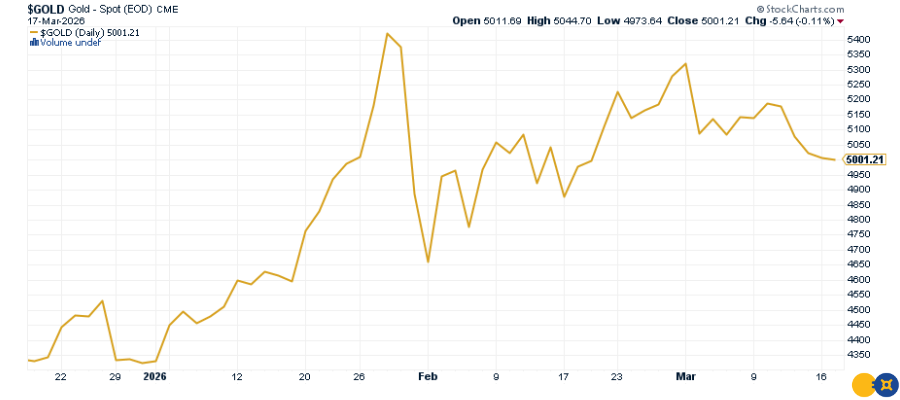
Gold has climbed nearly 15% since January — and is now testing the $5,000 floor.
Source: StockCharts.com, data until March 17, 2026
Why Won’t Any U.S. Allies Help Reopen the Strait of Hormuz?
President Trump asked the world to help secure the Strait of Hormuz. The world, largely, said no.
China, France, Germany, Japan, Australia, and the UK have all declined or quietly backed away from joining a naval coalition. Trump called their reluctance “amazing” — then, in a pivot that surprised no one, announced the U.S. doesn’t need help anyway.
The rejections aren’t just diplomatic awkwardness. Germany made the subtext text: Washington didn’t consult its allies before starting the war, so the current appeals are a tough sell. Japan is sympathetic but boxed in by its pacifist constitution. The UK says the strait must reopen — just not with British warships in the middle of it.
The result is a U.S. increasingly alone in a conflict it launched without a clear endgame or an exit ramp in sight. Energy markets are drawing their own conclusions. Oil near $100 isn’t just a supply story — it’s a confidence story. And right now, confidence that someone will fix this is in short supply.
The Edge Every Investor Needs Smarter precious metals investing starts here. The Nuggets Newsletter brings you essential market insights, Fed updates, global trends, educational videos, and much more.
If Oil Stays at $100, What Does That Mean for Interest Rates?
The Iran war didn’t just send oil prices toward $100 a barrel. It blew up the Fed’s entire roadmap for the year.
With crude sitting around $96, the $100 threshold is the number markets are watching. Cross it, and the Fed’s paralysis deepens further. A few weeks ago, the debate inside the central bank was narrow: how close are rates to neutral, and when do cuts begin? That debate has fractured. Some officials still favor cuts if inflation cools. Others are now openly discussing rate hikes.
The disagreement hinges on a classic question. Supply-driven oil shocks typically slow growth rather than ignite core inflation. But former Kansas City Fed president Esther George put it plainly: there are too many variables in play to confidently chart any path forward.
The timeline matters. Analysts estimate oil near $100 for three months would tip the economy toward recession. Cut rates and inflation reaccelerates. Hold too long and growth breaks. There’s no clean exit.
Gold sits in the middle of that tension — supported by inflation fears, pressured by a stronger dollar. Right now the only thing in clear abundance is uncertainty.
What Will the Fed Signal at 2PM Today — and Why Does It Matter?
The rate decision itself is almost certain: hold at 3.5%–3.75%. What’s less certain is everything Powell says afterward.
Markets will be parsing his tone closely. A hawkish lean — even without a rate move — could strengthen the dollar and pressure gold. A more cautious signal on growth could have the opposite effect.
The Fed is navigating a genuine dilemma. Today’s meeting also includes updated projections on the U.S. economy outlook — including the closely watched dot plot — which will show where officials expect growth, inflation, and rates to land by year-end.
Cut too soon, and inflation reaccelerates. Hold too long, and the economy slows. There’s no neutral position — every word Powell chooses today will be read as a signal.
That ambiguity is itself the story. When the Fed can’t clearly communicate its next move, markets get nervous. And nervous markets have historically been good for gold.
The U.S. Economy Outlook Looks Strong. So Why Are Economists Nervous?
The U.S. economy outlook heading into spring 2026 looks deceptively strong. The headline numbers look fine. Growth is holding. Unemployment is low. But many economists are increasingly describing the expansion as “delicate” — and the cracks are becoming harder to ignore.
Consumer spending, the backbone of U.S. growth, is showing fatigue. Households are drawing down savings and leaning on debt. That’s not a sign of confidence — it’s a sign of strain. Higher borrowing costs are working their way through the system. Housing activity is sluggish. Business investment is cautious. Credit demand is softening.
The Fed knows this. It’s why cutting rates feels risky and holding feels equally risky. Inflation hasn’t fully cooled. But push too hard, and a fragile expansion could tip into something worse.
Markets tend to see through the strong surface-level data. When the gap between appearance and reality widens, uncertainty follows. That’s the environment gold was built for.
Stay On Top of Gold & Silver Prices
Get important market alerts sent straight to your inbox.