Silver Rises Over 120% YTD




Published: 05-06-2026, 05:33 pm | Updated: 05-06-2026, 05:45 pm
Gold and silver market update — May 6, 2026
Key Takeaways:
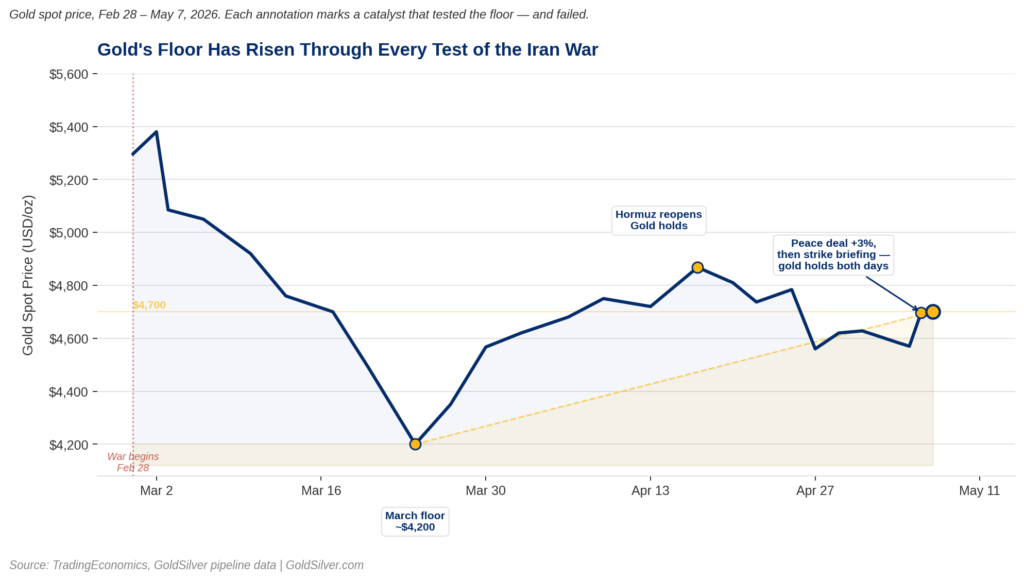
- Gold held near $4,700 today even as US Central Command briefed President Trump on Iran strike options — the same catalyst that sent it sharply lower in March. The non-reaction is the signal.
- Gold’s floor has risen from ~$4,130–$4,200 intraday lows in March to ~$4,700 today, surviving every geopolitical reversal in between. That floor was built by monetary forces — fiscal dominance, central bank buying, dollar weakness — not by the war.
- The next real price catalyst isn’t Iran. It’s the Warsh Senate vote (week of May 11) and his first FOMC with updated dot plot projections on June 16–17, where the rate-cut path either opens or stays closed.
Gold is trading near $4,700 today — evidence that gold is decoupling from geopolitics in real time. It held Wednesday’s 3% peace deal rally even after Axios reported that US Central Command briefed President Trump on Iran strike options, including a plan for a “short and powerful” wave of attacks. Brent crude recovered to around $101–102 a barrel after Wednesday’s sharp drop.
When a market stops falling on the catalyst that used to break it, something fundamental has shifted.
Why Is Gold Not Falling on Iran Escalation News?
In March, every Iran escalation signal sent gold lower. Not because war is bad for gold — but because the war’s oil shock was keeping the Federal Reserve frozen. Elevated oil pushed inflation higher. Higher inflation ruled out rate cuts. And gold, which pays no yield, loses appeal when rates stay high.
That trap technically still exists. CME FedWatch shows a 94.9% probability of no rate change in June. But three things have changed since March — and together they explain why gold is holding near $4,700 regardless.
The Edge Every Investor Needs Smarter precious metals investing starts here. The Nuggets Newsletter brings you essential market insights, Fed updates, global trends, educational videos, and much more.
Why Has the Gold Price Floor Risen Since March?
The floor moved higher and kept moving. Gold closed at $4,491 in the week ending March 20 — its worst weekly performance since 1983 — with intraday lows in the $4,130–$4,200 range. Since then it has absorbed ceasefire reversals, tanker strikes, and military briefings without breaking. Every headline that should have crushed it didn’t. The bids are deeper than the news is loud.
The monetary backdrop got worse — independently of the war. At last week’s FOMC, Powell confirmed he’ll stay on the Fed board as governor after Kevin Warsh takes the chair. The Senate Banking Committee advanced Warsh’s nomination 13–11 on April 29.
A full Senate vote is expected the week of May 11. Warsh will likely chair the June 16–17 FOMC — the first one with a fresh dot plot. Year-end rate hike odds ticked up to ~9.1% after the April meeting.
None of that is Iran. It’s a transitioning central bank operating under fiscal dominance — and it keeps building gold’s bid whether or not a deal gets signed in Tehran.
Gold is now shrugging off bearish data too. ADP reported 109,000 private payrolls in April. That was ahead of the 84,000 Dow Jones consensus and the strongest reading since January 2025. A strong jobs number normally weighs on gold, because fewer cracks in the labor market mean less pressure on the Fed to cut. Gold didn’t move.
ActivTrades analyst Ricardo Evangelista noted Wednesday that a Hormuz deal “would alleviate inflationary pressures and create the conditions for the Federal Reserve to cut rates in 2026.” Yet gold was already rallying before any deal was signed. That’s a different kind of bid — one that doesn’t need a resolution to hold its ground.
What Does It Mean That Gold Has Decoupled from Geopolitical News?
The last 24 hours gave a clean, controlled experiment:
- Morning: Peace deal hopes → oil down → inflation cools → Fed cut path opens → gold up 3%.
- Hours later: Strike briefing lands → oil recovers → Fed stays frozen → gold holds.
Same metal. Same day. Opposite signals. The geopolitical premium and the peace premium cancelled each other out — and gold still held near $4,700. That means both are smaller than the structural monetary floor beneath them.
That floor is built on $1 trillion in annual US debt interest payments, near-record central bank gold buying, and a dollar that has weakened significantly over the past year. These aren’t news events. They don’t reverse on a headline. They compound.
The ceiling is a different question. It moves on rate expectations — and that’s what the June 16–17 FOMC will settle. Friday’s nonfarm payrolls (consensus: 55,000–62,000, down from 178,000 in March) are the clearest preview. A weak number gives Warsh room to signal cuts at his first meeting. A strong one keeps the ceiling where it is.
The war stress-tested this floor repeatedly over ten weeks. It held every time. That’s not an accident — it’s arithmetic.
Stay On Top of Gold & Silver Prices
Get important market alerts sent straight to your inbox.
SOURCES
1. TradingEconomics — Gold Spot Price, May 6, 2026
2. TradingEconomics — Brent Crude Oil Spot Price, May 6, 2026
3. Axios — Scoop: Commanders to brief Trump on new Iran military options
4. CNBC — Gold climbs over 3% as Middle East peace hopes drag down dollar, oil
5. CNBC — Private payrolls rose by 109,000 in April, topping expectations, ADP says
6. CME Group — FedWatch Tool: June 2026 rate hold probability
7. Federal Reserve — FOMC Statement, April 29, 2026
8. Global Times — Gold suffers worst weekly rout in 43 years, March 22, 2026
9. Congressional Budget Office — Director’s Statement on the Budget and Economic Outlook: 2026 to 2036
Disclaimer: This article is for informational purposes only and does not constitute financial or investment advice. Always consult a qualified financial adviser before making investment decisions.
You May Also Like:
- The Fed Is Frozen. The Debt Is Growing. Gold Is Watching.
- Gold Jumps on Iran Deal Hopes. The Real Driver Is the Fed
- What the IMF’s Inflation Forecast Shift Means for Gold
- What’s Really Driving Gold Prices Today — 5 Key Signals
- Gold Price and the Jobs Report: A Pre-Market Guide
- The Gold-Silver Ratio Is Expanding — and Being Misread
- Gold, Silver, and Stagflation: 5 Signals That Matter Now
- Why Gold Fell on the Hormuz Tanker Strike